
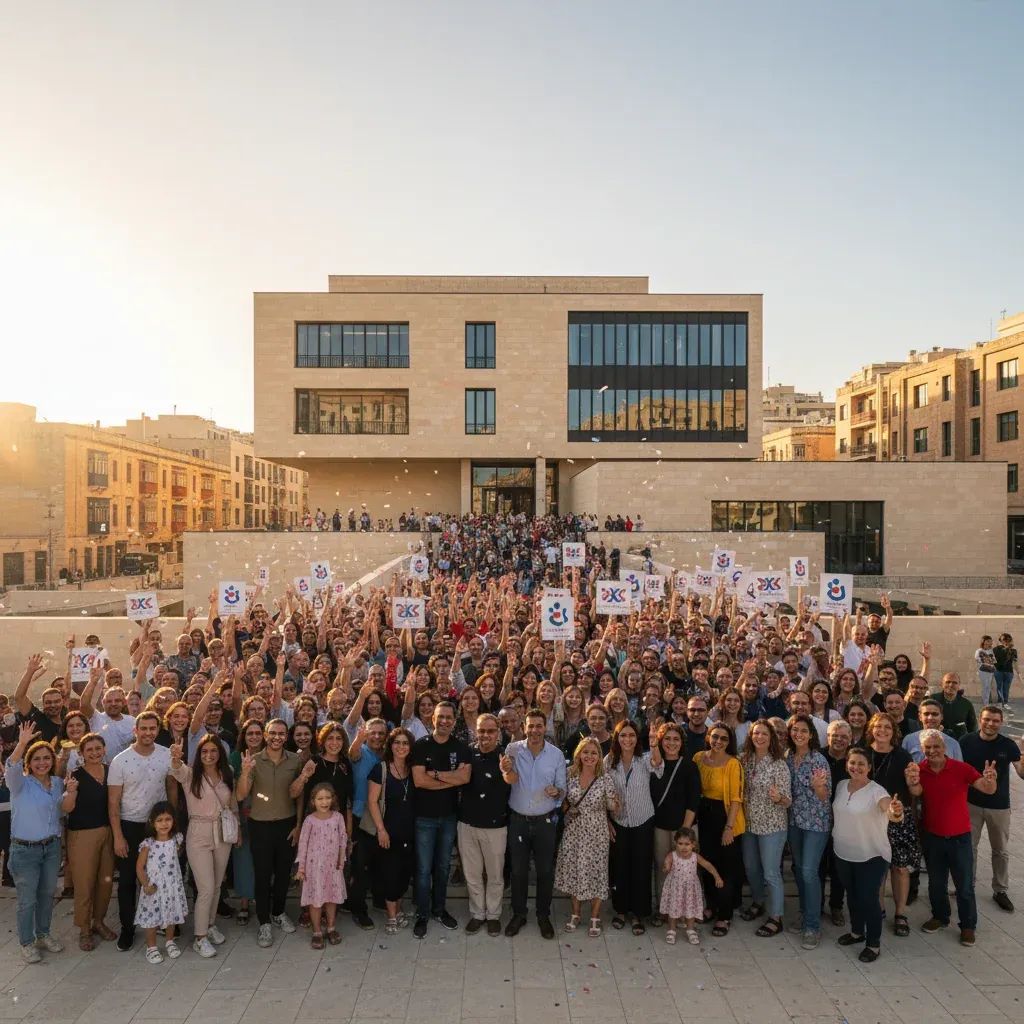
Malta's Prime Minister Robert Abela unveiled the core theme of the Labour Party's upcoming electoral manifesto at a political rally in Birżebbuġa, positioning "a stronger Malta" and "new prosperity" as the government's priority ahead of an anticipated 2026 general election. The announcement, made before a crowd on Sunday evening, signals Labour's intent to campaign on economic momentum and constitutional neutrality as geopolitical tensions escalate across Europe and the Middle East.
Why This Matters
• Election timing: The next general election is constitutionally due by June 2027, but speculation about a June 2026 vote is intensifying.
• Economic claims: Abela cited Malta's budget surplus and among the highest GDP growth rates in the EU as proof of policy success.
• Neutrality focus: The government is framing Malta's constitutional ban on foreign military bases as a strategic asset during the ongoing Iran conflict.
The Manifesto's Core Pillars
Abela indicated the manifesto is "almost ready" and will lay out a program centered on family welfare, stability, and economic expansion. The document is expected to formalize commitments across several policy domains, including sustained GDP growth targets, expanded energy subsidies funded by a €250M reserve, and further tax reductions for parents and low-income earners.
Labour's strategy team has been meeting regularly in recent weeks to refine the platform. The Malta Aqwa (Stronger Malta) branding echoes past campaign slogans but is now being anchored to tangible economic indicators, including the country's recent fiscal surplus and wage growth.
One of the more symbolic policy announcements in the run-up to the manifesto was the government's €43M deal to reclaim Manoel Island and Fort Tigné, returning both sites to public ownership. Abela described them as "national treasures" and framed the transaction as part of a broader effort to regain control of key assets and heritage sites.
Neutrality as a Political and Economic Asset
Abela devoted significant attention to Malta's 1987 constitutional neutrality clause, which prohibits foreign military installations on the island. He argued that this stance has allowed the government to maintain stability and implement costly subsidy programs—such as those offsetting international fuel and energy price surges—without the fiscal strain or security risks faced by NATO-aligned states.
Foreign Affairs Minister Ian Borg, speaking at the same event, reinforced this message. He stressed the need for Malta to avoid dependency in sectors ranging from defense to digital infrastructure, describing the country's neutrality as a form of strategic autonomy.
The historical context for this rhetoric dates back to March 31, 1979, when the last British military forces withdrew from Malta, ending a presence that dated to the early 19th century. That date is now commemorated annually as Freedom Day. The withdrawal allowed Malta to solidify its non-aligned identity and later enshrine neutrality in the constitution.
Despite this, Malta has navigated a complex path with international defense partners. The Malta Armed Forces participates in the NATO Partnership for Peace (PfP) program, reactivated in 2008 after a 12-year suspension. In February 2024, Malta and NATO signed an Individually Tailored Partnership Programme (ITPP) covering areas like cyber defense, hybrid threats, and defense reform.
However, Malta remains the only EU member state not participating in PESCO (Permanent Structured Cooperation), the bloc's defense integration framework. While neutral EU peers like Austria and Ireland have joined, Malta has refrained, citing concerns that membership could conflict with constitutional obligations.
What This Means for Residents
The Labour Migration Policy, set to take effect fully this year, is one of the most direct impacts on day-to-day life. The policy introduces a mandatory pre-departure course for non-EU workers, stricter entry requirements, and mechanisms designed to match labor supply with actual market demand. The aim is to reduce friction in sectors like hospitality and construction, where labor shortages have driven wage inflation and operational delays.
On the fiscal side, the government's continuation of energy and fuel subsidies—funded by the €250M reserve—means that household utility bills and transport costs will remain below market rates for the foreseeable future. This is particularly relevant given ongoing instability in global energy markets linked to the Iran conflict.
Tax policy is expected to feature prominently in the final manifesto. The minimum wage, which began annual increases in October 2023, is set to continue rising through 2027. Additional income tax relief for parents and lower earners is likely to be formalized, building on previous commitments that exceeded initial targets.
The reclamation of Manoel Island and Fort Tigné is not just symbolic. Both sites are expected to be integrated into public recreational infrastructure, potentially offering new green spaces and heritage access in densely populated areas.
Economic Performance and Electoral Calculus
Labour's campaign messaging is anchored to hard economic data. Malta has consistently posted among the highest real GDP growth rates in the EU over the past two years, and the government recently achieved a rare budget surplus. These figures give the party a strong platform to argue for continuity.
However, the timing of the election itself remains uncertain. While the constitutional deadline is June 2027, Abela has repeatedly stated that the date is his prerogative and will be set according to the "national interest." Political insiders suggest a June 2026 vote is increasingly likely, which would allow Labour to capitalize on current economic momentum before potential headwinds emerge.
The opposition Nationalist Party has criticized Labour's reliance on foreign labor and questioned the sustainability of subsidy programs, but has yet to release a comprehensive alternative economic platform.
Balancing Neutrality with Security Cooperation
Malta's foreign policy stance has practical implications beyond rhetoric. In April 2025, the UK and Malta signed a bilateral defense cooperation plan, covering areas like training provision and logistical support for British naval and air force operations. Malta has allowed Royal Naval ship visits for maintenance and Royal Air Force stopovers, all framed as non-aligned technical cooperation.
The country has also sought support from France and Spain for naval and maritime security capabilities, reflecting a pragmatic approach to defense needs that stops short of formal military alliance.
Malta's refusal to join PESCO has drawn criticism domestically. Some analysts argue that the country's stance needs re-evaluation as the EU moves toward deeper collective defense integration, particularly in response to Russia's actions in Ukraine and instability in North Africa. Yet no major political party in Malta currently supports NATO membership, and public sentiment remains firmly attached to the principle of neutrality.
The Road Ahead
The final manifesto is expected to be released within the coming weeks. Labour's focus will be on translating economic data and policy continuity into a narrative of stability and prosperity that resonates with voters concerned about cost of living, job security, and regional instability.
For residents, the practical implications are clear: continued subsidies, targeted tax relief, a more regulated labor market, and a foreign policy that prioritizes autonomy over alignment. Whether this formula will be sufficient to secure another term for Labour will depend on how effectively the opposition can challenge the economic narrative—and whether voters believe that Malta's current trajectory is sustainable.


