
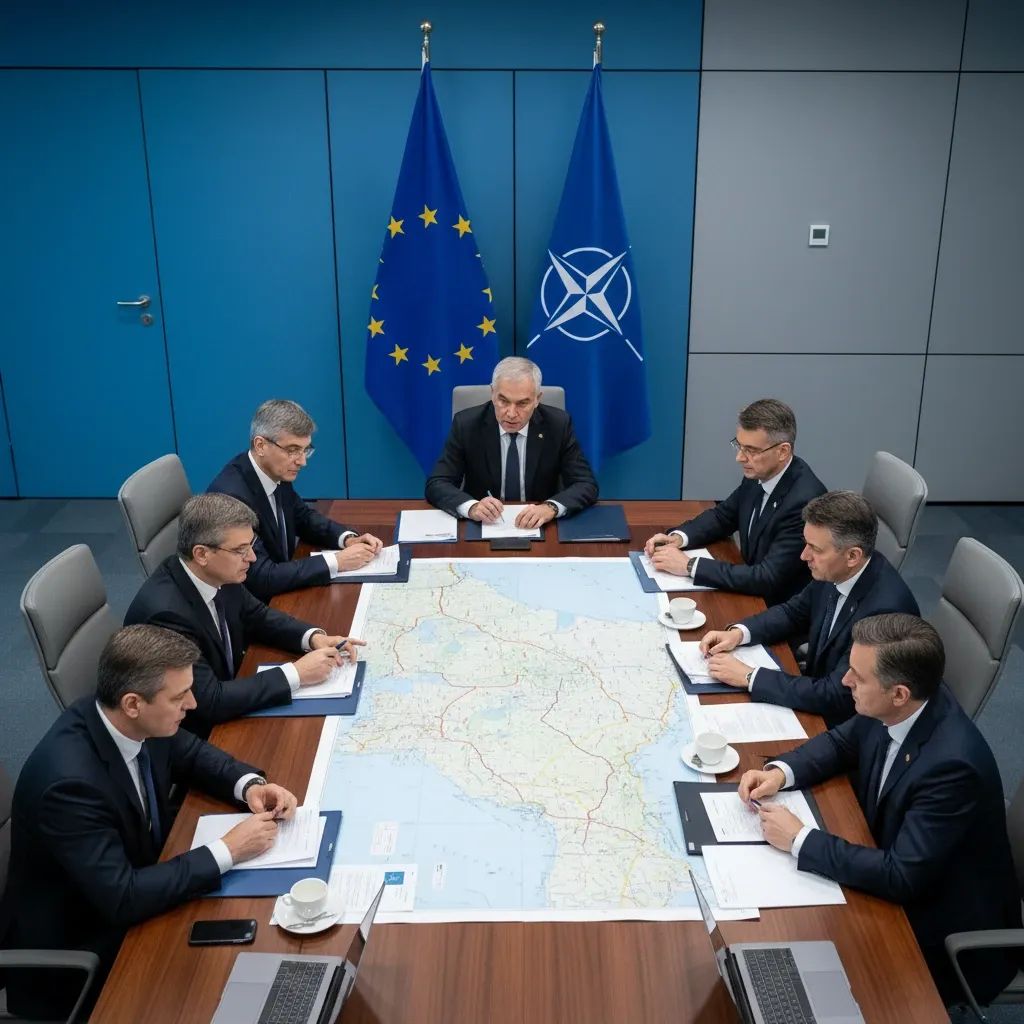
The European security landscape is undergoing a fundamental transformation as NATO members shift toward higher defense spending and the United States signals conditional commitment to collective defense. For Malta—a neutral EU member state with no NATO obligations—understanding these changes matters deeply, as they reshape the regional security environment and influence EU defense initiatives that do apply to the island.
Why This Matters for Malta:
• NATO spending targets have jumped from 2% to 5% of GDP by 2035, forcing European members to unlock an additional €254 billion annually for defense requirements.
• US commitment to collective defense is now conditional, with the Trump administration treating European defense as primarily a European responsibility.
• EU defense initiatives like SAFE and ReArm Europe directly affect Malta, offering financing mechanisms and integration frameworks that the island can access as an EU member.
From Munich to Reality: How Europe is Responding
When US Secretary of State Marco Rubio addressed European officials at the Munich Security Conference, the rhetoric emphasized that Washington's National Security Strategy now treats European defense as primarily a European responsibility. This message carries significant implications for all European nations, including Malta, as the continent's strategic posture evolves.
German Chancellor Friedrich Merz characterized the situation plainly: the post-war international order is undergoing significant stress from Russian expansion, Chinese competition, and American strategic reorientation. What he described represents a strategic recalibration that carries fiscal and security consequences for all European nations, regardless of NATO membership.
The Trump administration's assessment of Russian intentions differs from broader European concerns. While European foreign policy strategists regard Moscow's military capabilities and territorial ambitions as a significant regional threat, Washington treats Russia within a broader strategic competition framework. This divergence shapes how European nations—including Malta—must evaluate their own security requirements and regional positioning.
The European Defense Spending Reality: From 2% to 5%
At the 2025 NATO Summit in The Hague, NATO member states endorsed a benchmark: 5% of GDP dedicated to defense and security-related spending by 2035. This target breaks down into 3.5% for core defense requirements and up to 1.5% for broader security investments including critical infrastructure protection, network defense, civil preparedness, and industrial capacity.
To contextualize the scale: the 23 NATO members who are also EU states would need to increase their collective defense expenditure from the current €392 billion (2.1% of GDP in 2025) to approximately €635 billion just to meet the 3.5% core requirement. This massive rearmament effort is reshaping Europe's defense industrial base and strategic priorities.
For Malta and other EU member states, these developments create both pressures and opportunities. While Malta is not subject to NATO spending targets, the continent's defense realignment influences EU-wide security cooperation initiatives that Malta participates in as a member state.
What European Defense Realignment Means for Malta
The practical implications extend beyond NATO members. The United States is systematically transferring operational leadership to European officers, effectively requiring Europe to assume greater responsibility for its own defense. This shift means that all European nations' strategic security calculations must account for European-led defense frameworks rather than defaulting to American guarantees.
European NATO members collectively spent approximately $500 billion on defense in 2024, while the US defense budget reaches $980 billion for 2025. This disparity underscores Washington's argument: American military spending has long subsidized European security, a relationship now being fundamentally reexamined.
The EU Security Action for Europe (SAFE) initiative, adopted in May 2025, offers up to €150 billion in competitively priced loans to member states for urgent defense investments. This forms part of the ReArm Europe Plan, which aims to unlock over €800 billion in defense spending across the union. For Malta, access to these financing mechanisms provides concrete pathways to participate in European defense collaboration without NATO membership obligations.
Europe's Fragmentation Challenge
Europe's fundamental weakness lies not in total spending but in fragmentation. The continent operates with a "dilution factor" of 15—meaning Europe fields five times as many major military systems as the United States while commanding only a third of its defense budget. Germany's procurement policies clash with various member states' purchasing decisions, creating a patchwork of incompatible equipment and duplicated capabilities.
This procurement complexity manifests in stark numbers: 83 separate PESCO (Permanent Structured Cooperation) projects run simultaneously across 26 member states, each with varying levels of commitment and interoperability. The European Defence Fund allocated €1 billion across 31 funding topics for 2026, yet questions remain about whether these investments will produce coherent European capabilities or deepen the existing fragmentation.
For Malta, which lacks the defense industrial base of larger nations, this situation creates both risk and opportunity. The risk: being marginalized in emerging capability coalitions and technological partnerships. The opportunity: leveraging new EU procurement procedures and financing frameworks currently being developed, which aim to improve access to defense investments for smaller member states pursuing joint initiatives.
Four Flagship European Defense Projects Launching Through 2026
The European Commission has prioritized four concrete initiatives that will materialize over the coming months:
European Drone Defence Initiative (EDDI) and Eastern Flank Watch are slated for early 2026 deployment, with the European Air Shield and European Space Shield following in the second half of the year. These projects represent the EU's attempt to build integrated defense capabilities and reduce dependence on non-European systems.
The Eastern Flank Watch carries particular significance for maritime regions like the Mediterranean, as it involves coordinated surveillance and rapid-response frameworks. While focused on NATO's eastern periphery, the surveillance and maritime coordination capabilities developed for eastern defense will likely extend to Mediterranean operations, affecting regional security architecture in which Malta operates.
EU Defense Cooperation: The Emerging Framework
EU officials have discussed expanding European defense cooperation through various mechanisms. The reactivation of the 1955 Western European Union treaty has been mentioned as a potential legal framework for defense collaboration among interested EU members, the UK, and Norway. This approach could create more coherent security structures for European nations seeking deeper integration.
British Prime Minister Keir Starmer has urged Europe to develop industrial capacity and defense capabilities to sustain strategic autonomy, while various EU political groups advocate for a more unified European defense market. Yet the gap between political rhetoric and operational reality remains significant. Major EU economies will each need to increase their defense budgets substantially to meet emerging targets, a fiscal commitment that will strain public finances across the continent.
Malta's Position in a Changing European Security Environment
For Malta, the emerging security environment presents three distinct considerations:
First, EU defense financing mechanisms like SAFE loans and joint procurement initiatives offer concrete pathways to strengthen Malta's defense and security capabilities without NATO membership obligations. Malta can strategically participate in European defense initiatives that align with its interests as a Mediterranean EU member state.
Second, operational integration into evolving European defense frameworks demands investment in interoperability, communications infrastructure, and specialized capabilities that Malta can realistically provide—likely focused on maritime surveillance, cyber defense, and critical infrastructure protection rather than conventional military expansion.
Third, procurement decisions must navigate the evolving European defense market and EU initiatives promoting joint purchasing and standardized systems. Participation in multi-state defense contracts creates opportunities for Malta to access advanced capabilities at competitive costs through EU mechanisms.
Malta's Strategic Calculus: Adapting to a Reordered Europe
The transformation underway in European defense is not temporary political positioning but a structural realignment reflecting evolving geopolitical realities. Increasing numbers of European foreign policy strategists agree that previous defense arrangements require fundamental reassessment given contemporary strategic competition and regional developments.
Malta's unique position as an EU member state in the central Mediterranean—historically valuable for maritime security and regional stability—takes on renewed importance in a European-led security framework where southern Mediterranean security requires active European coordination rather than automatic external guarantees.
The Defense Readiness Roadmap 2030, agreed in late 2025 with major investments beginning this year, sets concrete milestones for European military-security readiness. European nations, including Malta through EU mechanisms, are repositioning themselves within this new framework of increased responsibility for regional security cooperation.
Moving Forward: Malta's Pragmatic Path
The European Investment Bank is increasing its defense-related lending allocations, while new EU financing mechanisms are launching to support member states in defense-related investments. EU leaders will soon negotiate the 2028-34 budget cycle, which includes €131 billion earmarked for defense and space.
For Malta and other EU member states, the immediate priority involves three actionable steps: securing access to EU defense financing instruments, identifying strategic contributions that enhance Mediterranean security cooperation, and participating in joint EU procurement initiatives that offer cost efficiency and interoperability benefits.
The message from Washington was unambiguous: Europe must assume greater responsibility for its own security within NATO. For Malta, this reality—while not creating direct NATO obligations—demands engagement with evolving EU defense cooperation frameworks. The island's strategic location in the Mediterranean, combined with EU membership, positions Malta to participate meaningfully in European security adaptation, accessing new financing and cooperation mechanisms designed to strengthen the continent's collective security posture in an era of great power competition and shifting strategic alignments.


