The Nationalist Party (PN) is betting heavily that opening its policy kitchen to the public can reverse three consecutive electoral losses. Over this weekend at the Excelsior Hotel in St. Julian's, party leader Alex Borg is hosting a two-day gathering designed to prove the opposition has matured from permanent protest into a credible alternative government—a threshold the party must clear if it hopes to dent the governing Labour Party's commanding position ahead of the next election.
Political conventions in Malta traditionally feature closed-door party meetings, making this public format a departure from standard practice. The PN's decision to invite NGOs, trade unions, business representatives, and community leaders signals a structural shift in how opposition parties typically develop policy.
Why This Matters:
• Policy blueprint emerges Sunday: The PN will unveil its foundational platform priorities, giving voters concrete insight into opposition governance plans rather than campaign slogans.
• Public participation reshapes strategy: Unlike traditional closed-door party conclaves, the PN invited NGOs, trade unions, business representatives, and community leaders to jointly design policy—a structural shift that signals institutional adaptation.
• Electoral arithmetic tightens: Recent polling volatility suggests the political race remains more fluid than headlines suggest, making this policy refresh potentially consequential for 2026 campaign dynamics.
The Political Math Behind the Convention
The PN faces a straightforward challenge: after a decade in opposition, it must convince voters it has evolved beyond reflexive criticism into a party equipped to govern. Alex Borg, who took over the party leadership following consecutive defeats, frames this weekend's gathering as the moment the opposition transitions from "permanent opposition" to "government in waiting."
Recent polls show conflicting trends. While a January 2026 MaltaToday survey suggested the Labour advantage had narrowed to just 3 percentage points, subsequent tracking by statistician Vincent Marmarà indicated the gap widened again—with Prime Minister Robert Abela's trust rating at 44.4% versus Borg's 34.7%. The polls show volatility, with significant ground to make up.
Abstention patterns add another wrinkle. Labour appears to be bleeding more support to voter disengagement than the PN can recapture, meaning neither major party can assume that frustrated voters automatically become loyal supporters. The opposition must demonstrate not just that alternatives exist, but that specific alternative policies matter to daily life.
How This Convention Differs From Party Theater
Most political conventions operate as controlled spectacles: leadership delivers speeches, party loyalists applaud, resolutions pass unopposed, and journalists file predictable coverage. The PN's structure breaks this mold.
Instead of a parade of speakers, the party deployed facilitators and rapporteurs to guide themed workshop discussions. George Vital Zammit, the convention chairperson tasked with synthesizing discussions into an electoral program, positioned the event as a "laboratory for imagination" rather than a confirmation ritual. His warning—that parties which stop listening "become an echo of themselves"—hints at internal awareness that the PN's traditional coalition may no longer suffice.
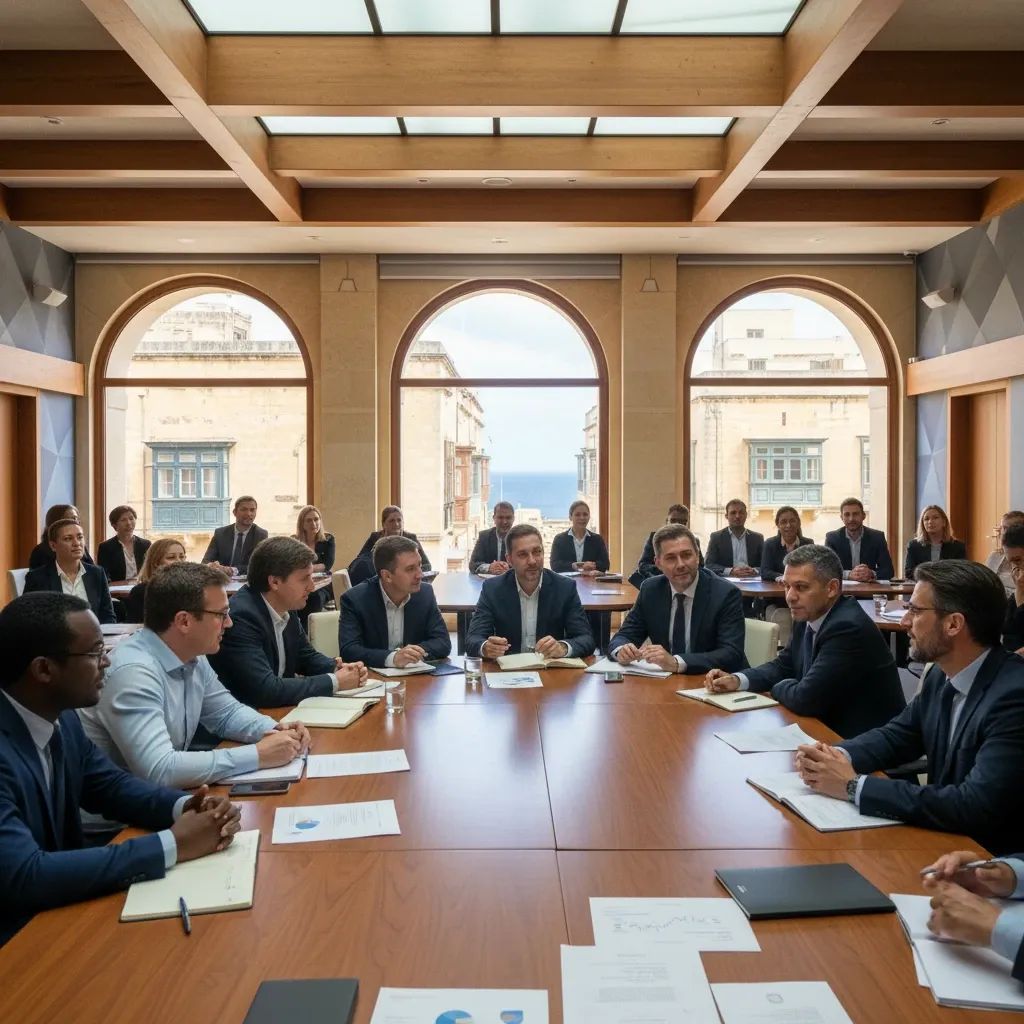
The party invited non-members explicitly. Local business owners can sit alongside trade unionists; NGO representatives participate in the same workshops as party activists. This permeable boundary signals either genuine openness to external input or a sophisticated public relations strategy—perhaps both. Regardless, it represents a departure from hermetically sealed party processes.
The convention also brought in international speakers: Dolors Montserrat, Secretary General of the European People's Party and former Spanish minister, and Mikuláš Dzurinda, former Slovak prime minister. Their participation places Malta's domestic opposition politics within a center-right European context, lending external credibility while subtly suggesting that the PN's platform reflects broader ideological currents rather than purely local improvisation.
Six Pillars Shaping the Opposition's Vision
The convention's framework organizes discussions around six policy domains, each addressing demonstrable voter concerns. Specific policy proposals will be unveiled Sunday following workshop synthesis.
Quality of Life and Sustainability tackles the gridlock, housing pressures, and environmental strain residents navigate daily. Workshops here grapple with whether population growth remains sustainable and how urban planning can better balance development with livability—issues that have dominated local political discourse for years without consensus solutions.
Economic Prosperity for Everyone confronts the cost-of-living crisis that has dominated Maltese households. The pillar addresses wage stagnation, productivity enhancement, and whether economic growth actually reaches worker paychecks or concentrates in corporate profits. For residents watching prices climb while wages lag inflation, this pillar offers the opposition a direct channel to propose counter-measures.
Strong Communities acknowledges growing frustration with planning decisions perceived as undermining neighborhood character. Local council empowerment, development standards, and social cohesion mechanisms form the core discussion—essentially asking whether communities have meaningful say over their physical transformation.
Government That Looks After You centers on healthcare and social services. Given that healthcare access consistently ranks among top voter concerns in polling, workshops here carry particular weight. The emphasis is on administrative efficiency and citizen-centered service delivery rather than ideological declarations.
Malta Ready for Tomorrow addresses education modernization, artificial intelligence integration, and workforce preparation. Rather than nostalgia-tinged appeals, this pillar positions the opposition as future-focused, emphasizing competitive positioning in a rapidly evolving global economy.
Gozo's Role in National Strategy receives dedicated Saturday evening sessions at the Kempinski Hotel in Gozo. This thematic separation reflects growing recognition that Gozo's infrastructure, accessibility, and development patterns cannot be treated identically to the main island. Residents of Gozo have long experienced governance designed for urban Malta and applied wholesale to a rural, island context—this convention segment signals willingness to customize policy.
Why Public Input Matters (and When It Doesn't)
The PN's decision to solicit public input through workshops rather than polling or focus groups carries symbolic weight beyond the policy content generated. It suggests the party views governance as collaborative rather than hierarchical; that voters merit a voice in shaping alternatives rather than merely ratifying leadership decisions.
Practically, this approach generates grassroots investment in proposals. Workshop participants become mini-advocates for conclusions they helped shape. They become conduits through which policy discussions permeate communities beyond what traditional media coverage achieves. This network effect can prove electorally valuable if workshop participants actively promote the opposition's platform during subsequent campaign.
The risk runs the opposite direction. If workshop discussions generate expectations that PN leadership later abandons—if compromise produces watered-down policies that disappoint participants—the party faces backlash from those who believed they participated in genuine coalition-building rather than performance theater. Mark Anthony Sammut, president of the PN's General Council, acknowledged this implicitly when emphasizing that participants approach the process with "courage"—the message being that difficult trade-offs require brave conversations, not comfortable consensus.
From Listening to Governing
The convention's operational challenge mirrors a broader opposition problem: translating critique into governance. Many voters can articulate what they dislike about current policies. Fewer can specify realistic alternatives that don't create new problems. The opposition's task involves converting legitimate frustration into coherent policy frameworks that withstand scrutiny.
Sunday's presentations will offer the first public glimpse of whether the PN has accomplished this translation. Rapporteurs will synthesize workshop discussions into policy conclusions. Matthew Xuereb, editor of Newsbook and RTK, will host a panel examining these proposals—a forum where weaknesses become immediately apparent.
The truly difficult work arrives afterward, when PN leadership must decide which workshop conclusions become official party commitments, which get softened into aspirational language, and which prove unviable politically or economically. That process—invisible to most observers—determines whether the convention becomes a genuine policy reset or a more elaborate version of traditional party positioning.
What Residents Should Watch
For people living in Malta, the convention's utility depends on specificity. Broad language about "quality of life" means little without concrete proposals addressing the issues residents confront: Can the opposition articulate a housing affordability strategy? Does the PN propose alternative healthcare delivery models or just more funding rhetoric? How does the party plan to address congestion without simply prohibiting development?
The convention's structure creates accountability. When policy proposals become public, residents can assess whether opposition positions differ meaningfully from current government approaches or merely shuffle existing priorities. That clarity matters more than the process through which proposals emerged.
For residents skeptical of both major parties, the PN's willingness to solicit public input offers at least a procedural distinction. Whether it translates into substantively different governance remains unknowable until the opposition actually holds power—but the effort to demonstrate responsiveness before elections rather than after assumes particular significance in a political system where voter confidence in institutions has eroded significantly.
The convention concludes Sunday, leaving weeks and months ahead for PN leadership to refine proposals, integrate them into a formal electoral program, and prepare campaign messaging. Whether this weekend's discussions genuinely reshape opposition strategy or provide sophisticated window dressing becomes evident only through sustained scrutiny of what PN leadership actually prioritizes in the months ahead.