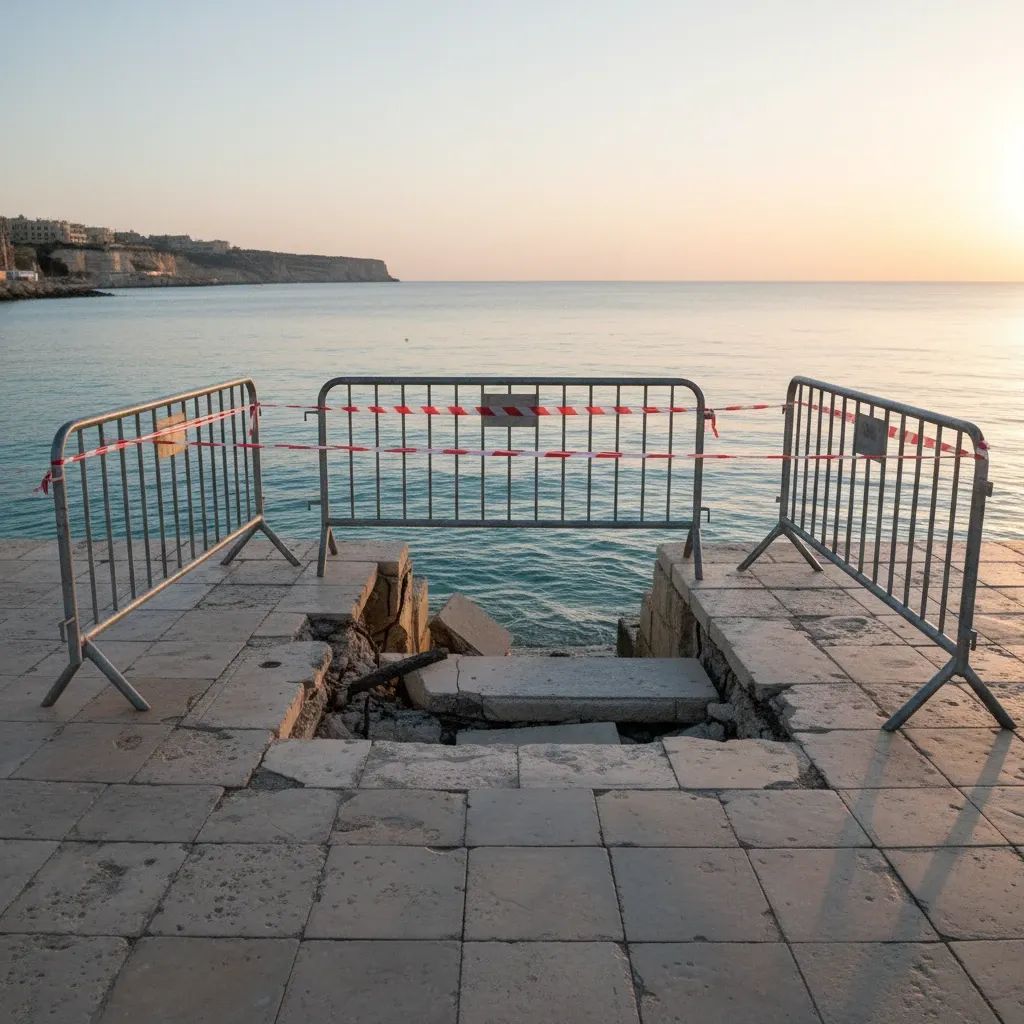
The Malta Public Works Department has sealed off a damaged staircase on Sliema’s Tower Road, a move that forces locals onto longer beach routes and spotlights the fragility of seaside infrastructure.
Key Takeaways
• Closed access point: The stairway between St Julian’s Tower and the outdoor gym is out of service after a 1.5 m void appeared in the concrete landing.
• Rapid response: Initial wooden pallets were swapped for industrial steel barriers within hours, following a call from Parliamentary Secretary Omar Farrugia.
• Underlying culprit: Engineers traced the failure to a deteriorated culvert beneath the steps, rather than the recent gale winds.
• Repair timeline: Mayor John Pillow promises that reconstruction will start “soon,” although no firm completion date has been announced.
An Unexpected Gap
Tuesday morning’s discovery of a sizeable hole—first flagged by residents on the "Sliema Residents" Facebook group—sent local walkers scouring for alternatives. Within hours, the Public Works Department cordoned off the scene after Sliema Mayor John Pillow alerted officials. Temporary wooden pallets gave way to metal fencing, and caution tape now spans the breach.
Though the promenade has endured weeks of heavy swells, Mayor Pillow emphasises that the collapse stemmed from years of unseen wear on a drainage culvert, not the stormy weather. The void measures roughly 1.5 m across, deep enough to pose serious risks for children, pets or inattentive pedestrians.
Ongoing Coastal Wear
Sliema’s foreshore has been under strain since Storm Harry in January, which stripped concrete from the former Chalet site and battered bus shelters near Għar id-Dud. In September 2024, the Public Works Department wrapped up a 90% revamp of the Qui-Si-Sana promenade, treating exposed beams and installing marine-grade coatings. Yet hidden caves and fissures beneath Tower Road remain a constant challenge for the Coastal and Storm Water Unit.
Experts point to a mix of globigerina limestone, salt spray and rising wave energy as culprits in the ongoing erosion. Without regular subsurface surveys, culverts and tunnels can degrade until a sudden collapse grabs headlines—just as it did this week.
What This Means for Residents
Residents should prepare for:
• Longer walks: The nearest descent to the sea now lies 180 m south at the Independence Gardens ramp.
• Route updates: Delivery vehicles and cyclists must avoid the fenced-off zone, or face tow-away enforcement.
• Noise and dust: Demolition of the old landing and excavation of the compromised culvert will bring machinery into the promenade, disrupting morning jogs and seaside cafés.
• Budget ripples: While repair costs remain unconfirmed, previous coastal fixes ran to €200,000–€400,000, suggesting possible pressure on the Sliema local fund.
Strengthening Sliema’s Shoreline
Engineers are expected to deploy ground-penetrating radar before rebuilding the stairs with marine-grade concrete, stainless steel rebar and a micro-cement overlay for salt resistance. But local geologists argue that true resilience requires a strategic shift:
• Bi-annual drone inspections to catch subsidence early.
• A centralised coastal asset register documenting every culvert, tunnel and beam.
• Embedding smart sensors that alert the Public Works Department when ground movement exceeds 3 mm.
The Malta Ministry responsible for infrastructure has indicated that every euro invested in preventive maintenance saves up to €7 in emergency repairs, underlining the need for foresight as winters bring stronger storms.
As Sliema braces for reconstruction, the staircase collapse offers a stark reminder: living by the Mediterranean’s beauty also means guarding against its unrelenting force.