
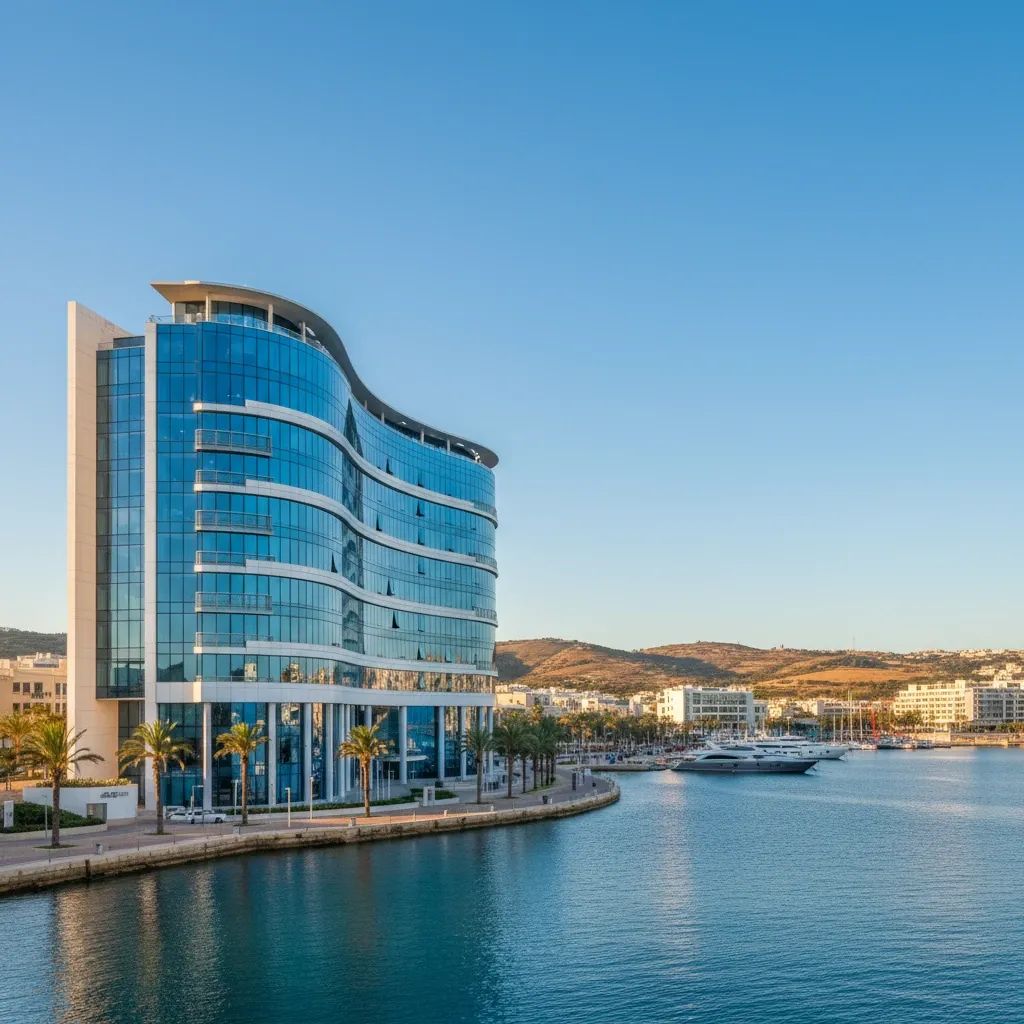
Malta Revenue Department data and independent market analysis place the Mediterranean island in a rare competitive sweet spot: comparable office pricing to Lisbon but with English as an official language, streamlined EU regulatory access, and a mature services ecosystem built for international expansion. For firms evaluating their 2026 European footprint, Malta delivers a cost-quality balance that challenges conventional office market hierarchies.
Why This Matters:
• Cost advantage: Prime office space in Malta's St. Julian's district runs €275–€550/sqm annually, roughly 5–6 times cheaper than London's West End for equivalent quality.
• Language barrier eliminated: Unlike Southern European alternatives, English holds official status, removing friction in legal, hiring, and client-facing operations.
• Tax optimization: Effective corporate tax rates can drop to 5% on trading profits through Malta's full imputation system—among the EU's most competitive structures.
• 2026 growth forecast: Malta's economy is projected to expand 3.8%, outpacing most EU peers and signaling sustained demand for commercial real estate.
The Pricing Reality Across EU Office Markets
Malta's commercial real estate sector operates in a fundamentally different price band than Northern European capitals while maintaining infrastructure standards closer to Tier 1 cities. In Sliema and St. Julian's—the island's established business districts—business center rents settle between €250–€550/sqm per year, while standalone offices range from €190–€300/sqm. The Mrieħel Central Business District offers even sharper value, with standalone offices starting at €150/sqm annually.
Lisbon's prime Central Business District, by contrast, now commands €32/sqm monthly (roughly €384/sqm annually), following a surge that pushed Portuguese rents above €30/sqm for the first time in Q4 2025. Yet Lisbon's CBD vacancy rate sits at just 3.6%, reflecting fierce competition for limited Grade A stock. Malta's residential vacancy metrics—around 5% island-wide and 3–4% in Sliema/Gżira—suggest similarly tight supply for quality commercial space, though comprehensive office vacancy data remains less transparent.
Madrid's prime core zones reach €35–€45/sqm monthly (€420–€540 annually), with CBD vacancy below 5% and vacancies within the M-30 ring road under 3%. Berlin, after a 10% decline in average rents to €25.47/sqm monthly through 2025, faces an 8.1% vacancy rate expected to rise as 634,000 sqm of new supply enters the market in 2026. Brussels holds steady at €400/sqm annually for prime space, but overall vacancy climbed to 8.8% by late 2025, signaling softer demand outside top-tier assets.
What This Means for Investors and Firms
The "flight to quality" phenomenon reshaping European office markets—where tenants prioritize modern, smart-enabled buildings over older stock—plays directly to Malta's strengths. The island has concentrated recent development on plug-and-play, designer-finished offices that eliminate the construction lag international firms face when entering new markets. Companies are choosing leaner, efficient layouts in premium locations over sprawling floor plates, a trend that aligns with Malta's physical constraints and urban density.
For financial services, iGaming, consultancy, and technology firms—sectors driving Malta's white-collar expansion—the equation is straightforward: equivalent-grade office space costs a fraction of Dublin, Amsterdam, or Paris rates, while full Eurozone membership and 80+ double taxation treaties preserve access to the EU single market's 500 million consumers. The island's Mediterranean location adds a logistics dimension, positioning Malta as a gateway to North African and Middle Eastern markets through Europe's third-largest transshipment port at Malta Freeport.
Malta's 2026 Budget reinforces this positioning with direct incentives for commercial expansion: a 60% tax credit on qualifying capital expenditure, a 175% deduction for R&D and innovation expenses, and accelerated write-offs for AI, automation, and cybersecurity investments. The newly announced Hal Far Innovation Complex targets SMEs in health, pharmaceuticals, and biotech, while the Malta Innovation Hub funnels early-stage funding and mentorship to startups through programs like B-Start and Accelerate.
English vs. Language Friction
The official English language status distinguishes Malta from every Southern European alternative. Lisbon, Madrid, and Milan require multilingual teams or reliance on external translators for legal compliance, contract negotiations, and regulatory filings—operational friction that compounds over time. Malta's workforce, shaped by decades of iGaming and financial services growth, delivers not just English fluency but sector-specific expertise in legal, accounting, and compliance functions.
This linguistic infrastructure matters acutely for regulatory-intensive industries. Malta's business registration process operates under EU and English common law frameworks, and regulators are described as accessible and responsive—a contrast to the bureaucratic opacity that slows market entry in larger jurisdictions. The government's 2025 revisions to its residency-by-investment program—raising thresholds and imposing a five-year holding period—signal a pivot toward attracting long-term corporate residents over transactional capital, which should stabilize the commercial tenant base.
Infrastructure and the Talent Pool Challenge
Malta has committed €100M to digitalization through 2026, prioritizing AI, blockchain, and cybersecurity—infrastructure that supports remote work, data center operations, and fintech. Road network upgrades and the Gozo Rural Airfield project address connectivity bottlenecks, while Project Green aims to add 8,000 sqm of urban green space, enhancing livability for the international workforce Malta's office expansion depends on.
Yet scalability constraints remain transparent. Malta's talent pool, while highly educated and multilingual, is smaller than continental hubs. Firms planning headcount expansions above several hundred employees will need to recruit internationally—a manageable challenge given the island's Mediterranean climate, safety, and healthcare system, but one that introduces visa and housing logistics. The government's planned special visas for esports athletes and the Business Innovation Hub pathway to permanent residency for entrepreneurs reflect awareness of this constraint.
Similarly, the availability of very large-floorplate Grade A offices is limited. Companies requiring single-floor spaces exceeding 2,000–3,000 sqm may find options concentrated in newer mixed-use developments in Mriehel and Gzira, where land availability permits horizontal expansion. Traditional business districts like Valletta and Floriana—where business center rents run €210–€450/sqm—offer prestige addresses but tighter footprints.
The 2026 Market Outlook
Malta's office market is expected to see stable to modestly increasing prime rents between 2026 and 2028, tracking the 3.7% average prime rental growth forecast across European markets. Demand for plug-and-play modern offices continues to outstrip supply, while older B/C stock faces extended vacancy unless repositioned. Properties failing to meet contemporary energy and connectivity standards are seeing asking rents pressured below €180–€190/sqm annually, creating a two-tier market that rewards quality and location.
For international firms balancing cost control with EU market access, Malta's proposition is unusually clear: Lisbon-level pricing with London-level language access, wrapped in a stable 3.8% growth economy and backed by tax structures designed for profit optimization. The island's physical and demographic limits constrain mega-expansions, but for firms targeting 500–1,500 employee European hubs, the cost-benefit calculus increasingly favors the Mediterranean over traditional continental anchors.
Older office stock not meeting modern standards will continue to struggle, but the sustained demand for Grade A space—particularly in St. Julian's, Sliema, and emerging mixed-use zones—suggests Malta's commercial real estate market is entering a maturation phase where quality commands premium pricing while overall affordability relative to Northern Europe remains intact. For 2026, that balance positions Malta as a practical alternative rather than a compromise.


