
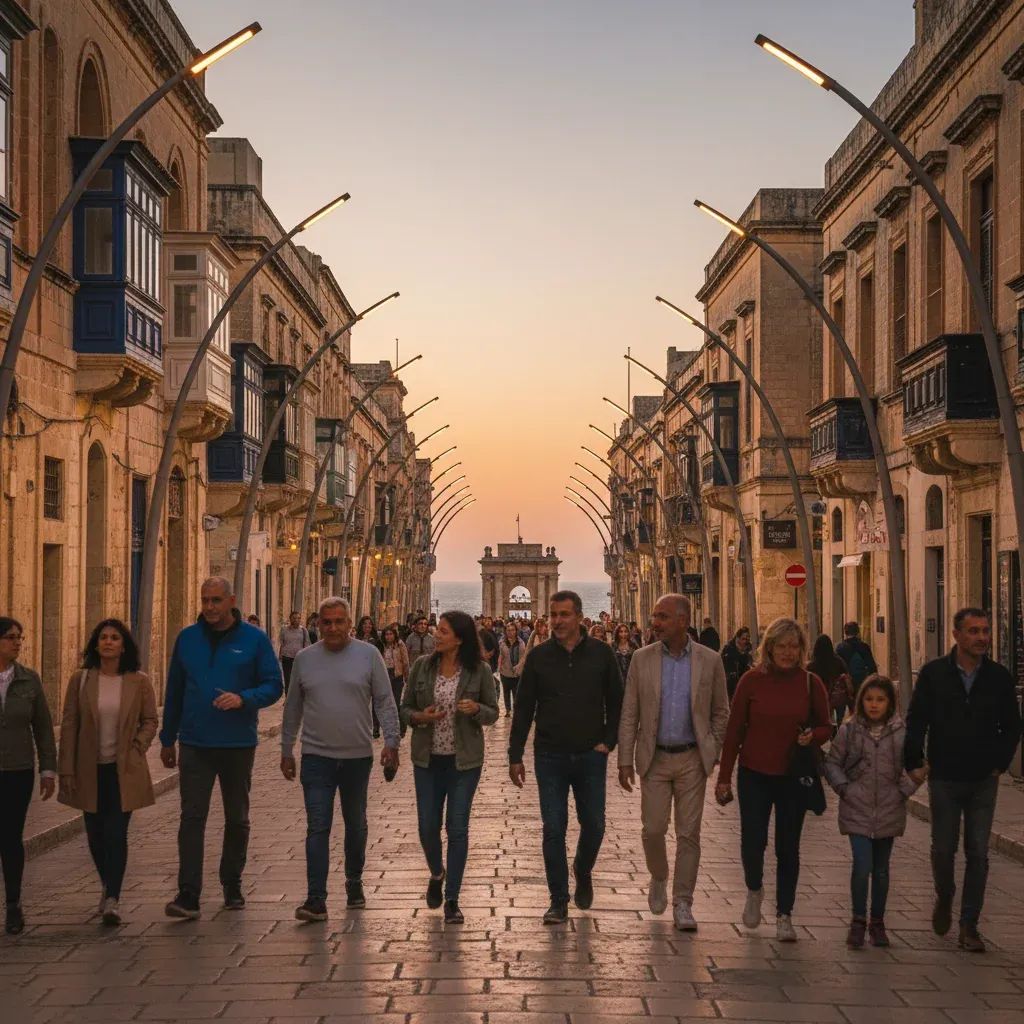
Walking the streets of Malta after dark has long been positioned as relatively risk-free, yet survey data from the National Statistics Office reveals a more fractured reality: nearly 3 in 4 residents feel confident navigating their neighborhoods alone past sunset, but the experience diverges sharply by gender and age, exposing structural anxieties that raw crime statistics fail to capture.
Why This Matters
• A 16-point gender divide: Women report feeling safe at 65%, while men reach 81%—a persistent gap despite Malta ranking among Europe's safest nations.
• Infrastructure shift underway: A €13M streetlight modernization affecting 34,000 fixtures across residential zones will proceed through 2028, directly addressing illumination gaps linked to avoidance behavior.
• Policing transformation: Thirty-four community support officers deployed in early 2026, with a specialized nightlife enforcement unit launching this summer to address tourist-dense corridors.
The Comfort-Fear Paradox
The National Statistics Office polled over 1,000 residents between September 26 and October 1, 2025, finding that 74% felt secure walking alone after dark in their neighborhoods. The finding appeared straightforward until disaggregated by demographic segments. Men's confidence level climbed to 81%, while women's assessment settled at 65%—a spread researchers describe as the "paradox of fear of victimization." This phenomenon appears across European capitals: women consistently express heightened security concerns despite lower statistical exposure to most crime categories. Malta mirrors this pattern faithfully.
Age compounds the anxiety landscape. Young adults aged 18 to 34 reported 78% comfort, which softened to 75% for those 35 to 64, then contracted sharply to 63% for residents over 65. The decline reflects both mobility constraints and evolving perceptions of vulnerability. Geographic variation, by contrast, remained minimal—71% in the Northern Harbour district versus 76% in the Northern district, a modest five-point variance suggesting that safety concerns distribute relatively evenly across the archipelago rather than clustering in identifiable hotspots.
When examining the home environment, the picture brightens considerably. 94% of respondents reported feeling secure inside their residences after dark, with negligible differences by gender (92% women, 95% men) and modest age-related variation (96% for adults aged 18 to 34, declining to 91% for those over 65). The telling statistic emerges when these two security measures intersect: 72% of the adult population felt safe both indoors and walking outside, but 21% described an asymmetry—they experienced their homes as refuges but perceived external spaces as hostile. This minority, predominantly female and elderly, effectively withdraws from evening commerce, cultural participation, and social engagement, imposing invisible costs on quality of life.
Environmental Factors and Perceived Safety
The disconnect between Malta's objective safety metrics and women's caution reflects broader research on how environmental and social factors shape security perceptions. Inadequate illumination, deteriorated pavements, and poorly maintained public spaces create what safety researchers term "avoidance zones"—areas residents deliberately bypass even when crime risk remains low. The Northern Harbour district's slightly lower perceived safety figure likely reflects higher urban density and infrastructure complexity. Underpasses, narrow alleyways, and poorly lit connecting routes become psychological barriers even when statistically safe.
Street harassment and anti-social behavior concentrate in high-foot-traffic zones, particularly Paceville and St Julian's, where nightlife density and tourist flows amplify both the likelihood of unwanted attention. The psychological toll of these environmental factors manifests tangibly: residents alter routes, adjust timing, avoid certain transport corridors during specific hours, and seek accompaniment—logistical and psychological costs borne disproportionately by women and elderly residents.
Malta's Actual Crime Landscape
Malta's international safety standing provides necessary context for interpreting these perceptions. The homicide rate stood at 0.7 per 100,000 residents in 2024, a figure below the EU average of 0.91 per 100,000. Violent crime incidents totaled 344 cases in 2024, positioning Malta among Europe's lowest counts. The Numbeo Crime Index for 2025 rated Malta at 43 out of 100, well below the European average of 52. Only 7.4% of residents reported experiencing crime, violence, or vandalism locally as of December 2023—the lowest recorded figure since 2019.
These objective metrics confirm Malta remains one of Europe's safest nations. Yet a curious paradox emerged in broader European sentiment: international anxiety regarding geopolitical tensions exists alongside personal safety concerns. This distinction clarifies that macroeconomic and international anxieties, rather than domestic crime patterns alone, drive overall unease among residents.
Government Intervention: Infrastructure and Enforcement
The Malta Ministry for Home Affairs is pursuing a three-pronged intervention strategy combining infrastructure, enforcement, and community engagement. The most visible initiative is the €13M LED streetlight replacement project initiated in October 2025. Over 34,000 conventional fixtures across residential and distributor roads will receive modern replacements by end of 2028, delivering not only energy efficiency but measurably improved illumination—a factor consistently cited in safety perception research as essential for reducing avoidance behavior and elevating confidence among evening pedestrians.
On personnel deployment, the Ministry for Home Affairs launched the Police Patrolling Community Support Officers (PPCSOs) service in January 2026, positioning 34 officers throughout communities with mandates for continuous patrols, early intervention in anti-social behavior, and relationship-building between residents and formal law enforcement. This model prioritizes de-escalation and preventive advice over purely reactive enforcement.
The specialized Paceville police squad begins operations by summer 2026, leveraging existing CCTV infrastructure with planned expansions to Swieqi, St Paul's Bay, Marsa, and Paola—localities where tourist density and evening commerce concentrate. Authorities have documented targeted crime reduction efforts in these high-traffic areas following intensified police presence and community engagement initiatives.
The Narrowing Window for Change
Whether the current intervention suite meaningfully narrows documented gender and age gaps depends on sustained, responsive implementation. LED lighting modernization addresses environmental cues triggering avoidance; the Paceville squad and PPCSO deployment increase human presence in both high-risk and routine spaces.
For now, Malta remains objectively safe by international standards. For a significant minority, particularly women and residents over 65, however, nighttime mobility carries a psychological toll that statistics alone cannot quantify. The emerging question is whether the current policy suite can genuinely bridge that gap or merely acknowledges the problem while behavioral restrictions persist. The answer will crystallize over the next 18 months as new lighting activates across residential zones, community patrols intensify their presence, and relationships between enforcement and residents deepen through sustained engagement.


