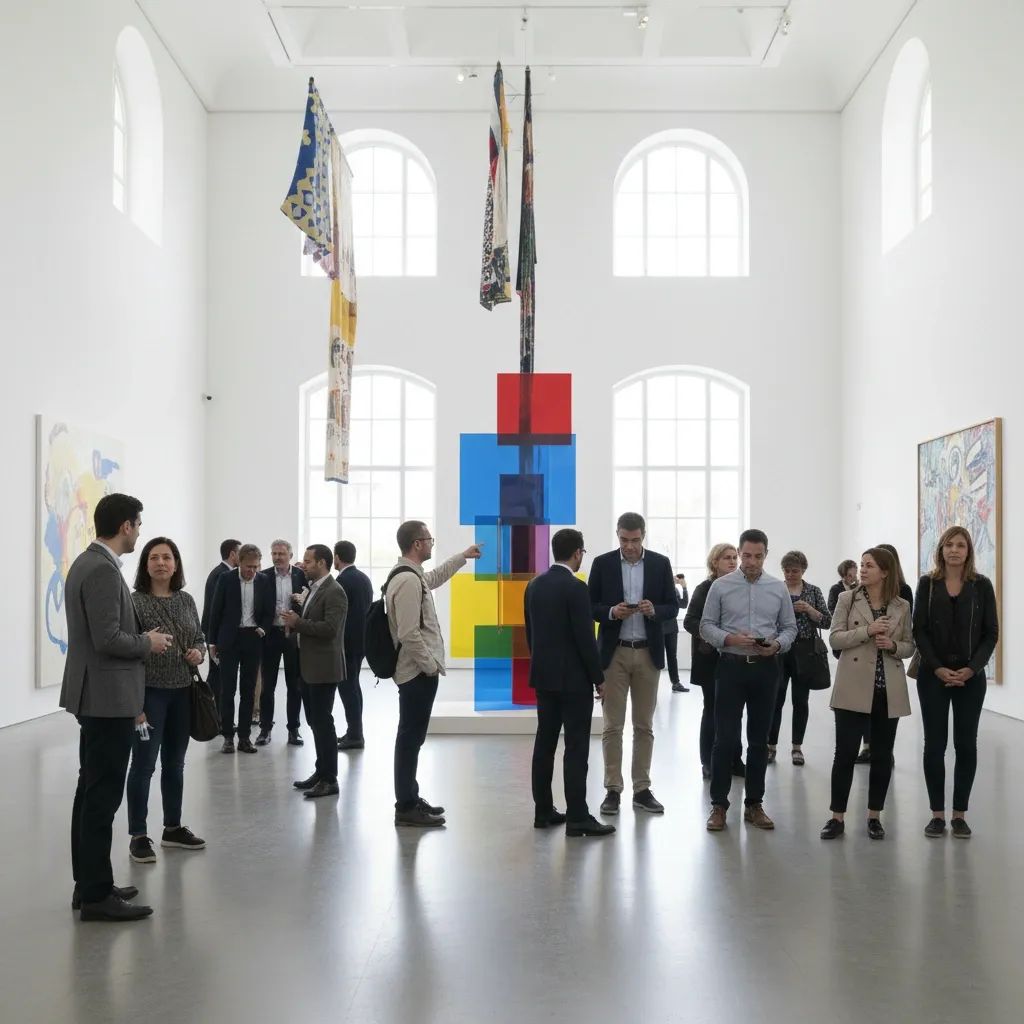
Thirteen contemporary Chinese artists are now occupying Fort St Elmo in Valletta through May 29, their 19 works anchoring one of the Malta Biennale 2026's most closely watched national pavilions. The exhibition arrives at a moment when Malta's cultural infrastructure is being recalibrated—smaller nations rarely host solo international pavilions without strategic calculation on both sides—and what happens over the next two months will test whether the islands can sustain credibility as a serious art venue rather than a stopover destination.
Why You Should Care
• Direct economic influx for Valletta hospitality: National pavilions historically attract international collectors, curators, and specialists who spend weeks rather than hours in the capital. The Chinese opening alone drew attendees from galleries across Europe, translating into occupied hotel rooms and restaurant bookings through May 29.
• Free access to state-level curatorial strategy: Watching how the Zhejiang Art Museum constructs and stages a national pavilion offers local Maltese curators rare insight into institutional approaches fundamentally different from grant-dependent European models.
• Entry point into Asian cultural networks: If successful, this pavilion may trigger follow-up residencies, artist exchanges, or institutional partnerships that position Malta differently within the rapidly reshaping international art system.
The Pavilion's Thematic Architecture
Ying Jinfei, curator at the Zhejiang Art Museum, structured the exhibition around the Malta Biennale's central mandate—"Clean / Clear / Cut"—but reframed it entirely through Oriental philosophical and ecological perspectives. This isn't passive alignment; it's active reinterpretation of Western curatorial language through an alternative epistemology.
The "Clean" component addresses environmental and ethical reckoning. Visitors will encounter works that visualize industrial scarring, resource exhaustion, and the visible consequences of extraction. Several pieces deliberately employ traditional materials—ink, rice paper, ceramic—which function symbolically as connectors to centuries-old ecological wisdom embedded in Asian cultural practice. Chen Qi, who specializes in water-based printmaking, directly engages the "Clean" directive through a medium literally dependent on liquid purity. Others like Li Hongbo construct deconstructed paper sculptures that physically reveal hidden layers when touched, transforming the gallery experience into a participatory act of archaeological uncovering.
The "Clear" pillar emphasizes discernment and vision. Rather than Western Enlightenment rationality, the pavilion positions Oriental philosophical frameworks—particularly concepts rooted in Buddhist and Daoist thought—as alternative lenses for cutting through contemporary confusion. Works by Wang Chao, Fang Limin, and others explore how traditional epistemologies offer navigational clarity in a destabilized moment. This isn't aestheticization of philosophy; it's a deliberate repositioning of non-Western knowledge systems as legitimate intellectual tools.
"Cut" pushes artists toward radical departure. The pavilion interprets this as deliberate disruption of Western-dominated art narratives. By presenting 13 voices working across installation, abstraction, ink practice, and conceptual forms, the exhibition resists any singular aesthetic identity. Zhang Dazhen, Cao Ou, Xu Chentao, and Dong Minjie contribute works that collectively argue against homogeneity—each artist cuts differently, following distinct conceptual and material logics. This proliferation of approaches is the statement: there is no single "Chinese contemporary art," only competing visions jostling for legitimacy within their own context.
Who Is in the Room
The 13 artists—Liang Quan, Chen Jian, Chen Qi, Fang Limin, Ying Jinfei, Wang Chao, Li Hongbo, Wang Xiao, Ji Renping, Cao Ou, Zhang Dazhen, Xu Chentao, and Dong Minjie—bring varying international profiles. Several have shown at major Asian biennales; others remain largely unknown outside China. This deliberate mixing of established and emerging voices reflects curatorial confidence in the work itself rather than reliance on pre-existing market reputations. For Maltese audiences, this means encountering artists on equal philosophical footing rather than navigating pre-packaged celebrity narratives.
The geographic span of the artists' practices also matters. Works originating from Shanghai, Beijing, Hangzhou, and beyond carry distinct regional sensibilities. A Shanghai-based artist's engagement with hyper-urbanization differs markedly from a rural practitioner's relationship to land and resource depletion. The pavilion doesn't flatten these differences; it presents them as integral to how Chinese contemporary art functions—contested, regionally inflected, philosophically diverse.
What This Means for Malta
China's participation in the Malta Biennale 2026 is not philanthropy. It reflects decades of strategic positioning by Beijing to secure cultural agency globally. Major Chinese biennales—the Shanghai Biennale, Beijing International Art Biennale—were explicitly constructed to counterbalance Western curatorial authority and establish Chinese institutions as legitimate arbiters of contemporary discourse. Smaller European venues like Malta offer distinct advantages: they provide credibility through EU anchoring without the intense media scrutiny that accompanies Venice or documenta.
For Heritage Malta and the Arts Council, the arrangement functions as institutional amplification. A state-backed pavilion confers legitimacy through association; it signals that Malta's biennale is taken seriously enough to warrant sovereign investment. Tourism machinery also benefits directly—Visit Malta's positioning of the biennale merges cultural programming with visitor economy calculations. International audiences drawn by the Chinese pavilion extend stays, generate restaurant spending, and populate Valletta's accommodation sector through May 29.
The asymmetry in reciprocity, however, remains unresolved. Will Heritage Malta gain substantive access to future Beijing Biennale programming? Will Maltese artists secure residencies or funding pathways through Chinese institutions? Or does the pavilion remain transactional—venue exchange with minimal institutional durability? The answer will determine whether this marks genuine cultural infrastructure development or merely strategic checkpoint positioning.
The Broader Biennale Context
The Malta Biennale 2026, now in its second iteration, includes eight national pavilions—Malta, China, Poland, Spain, Finland, Armenia, Serbia, and France—distributed across historic sites in Valletta, Vittoriosa, and Gozo. This geographic spread from Northern Europe through the Caucasus to East Asia creates an unusual curatorial effect: walking from pavilion to pavilion becomes a compressed seminar on how contemporary nations construct and project cultural identity.
Each pavilion functions simultaneously as artwork and geopolitical statement. The Chinese emphasis on ecological wisdom and philosophical clarity reads distinctly when juxtaposed against a Polish pavilion's potential engagement with historical memory or a Spanish exhibition's regional identity concerns. This collision of narratives is not incidental; it's the biennale's hidden intellectual apparatus.
Visiting and Logistics
Fort St Elmo operates under Heritage Malta's standard hours, with resident discount structures applying. The 19 works span multiple media—painting, sculpture, installation—across exhibition spaces designed to guide viewers through thematic progressions. Guided programming runs select weekends, detailed on the biennale's official platform.
Visitors should anticipate imagery oscillating between pastoral memory and industrial dystopia—common visual vocabularies in contemporary Chinese art grappling with environmental rupture. The deliberate use of historical techniques alongside modern conceptual concerns creates a recurrent visual tension: what lessons does ancient practice offer emergent crises?
For Maltese artists and curators, the pavilion functions as institutional case study. The state-backed, curatorially coherent model differs markedly from the fragmented, grant-dependent approaches typical in European institutions. Whether this represents admirable institutional clarity or concerning cultural centralization depends entirely on one's perspectives regarding state involvement in artistic production—but the model offers concrete comparative reference.
The Malta Biennale 2026 runs through May 29, 2026.