Malta's early 20th-century infatuation with the postcard came with a curious blind spot: the Art Nouveau movement, which had captivated continental Europe with its sinuous lines and organic flair, barely registered on the island's printing presses. While Valletta's architects would eventually flirt with Art Nouveau—most notably through Italian Stile Liberty influences—the postcard publishers who dominated the visual marketplace made a deliberate choice to stay anchored in straightforward documentary imagery, leaving the movement's revolutionary aesthetics largely unexplored.
Why This Matters
• Cultural identity: The postcard boom reveals how Malta's colonial legacy and architectural traditions shaped what citizens viewed as commercially viable, favoring baroque grandeur and British austerity over European avant-garde trends.
• Business lesson: The medium's explosive growth generated substantial economic activity, yet publishers instinctively understood that Maltese consumers and tourists preferred recognizable scenes over abstract stylistic experiments.
• Historical record: The rare Art Nouveau postcards that do exist now function as artifacts of a path not taken—windows into how local markets can resist even the most influential artistic movements.
The Postcard Revolution and Its Practical Impact
When postcards arrived in Malta in 1898, they transformed communication overnight. Cheaper than letters, faster than traditional post, and infinitely more visual, they became what historians aptly call the "Victorian Facebook"—a medium that moved thousands of units through the island's postal system daily. For working Maltese families, a postcard cost mere pennies. For businesses, they became an indispensable marketing tool.
The economic consequences rippled quickly through the island. British servicemen stationed at Valletta's military installations snapped them up as souvenirs. Hotels commissioned custom designs to promote their properties to tourists. Banks, wine merchants, and even emigration agencies recognized the postcard's reach and printed thousands of promotional versions. The industry didn't cannibalize postal revenue as feared—it multiplied it. Suddenly, ordinary citizens were exchanging visual documents of their communities, their celebrations, their daily streets.
This boom created opportunity for both established European firms and ambitious local operators. Raphael Tuck & Sons from London, G. Modiano e Co. from Milan, and Stengel of Germany brought their distribution muscle and design templates. But they shared shelf space—literally and figuratively—with Maltese publishers: Richard Ellis, a photographer who began producing cards in 1899 and became prolific; John Critien, Vincenzo Galea, and others who understood the local appetite for imagery. The market wasn't zero-sum; it was expanding, and there was room for everyone who could deliver what Maltese postcards buyers and collectors actually wanted.
Two Publishers, One Vision: Restraint Over Radicalism
Amid this thriving commercial landscape, only two Maltese publishers seriously experimented with Art Nouveau: John Schall and Joseph Howard, and both approached the style cautiously, almost apologetically.
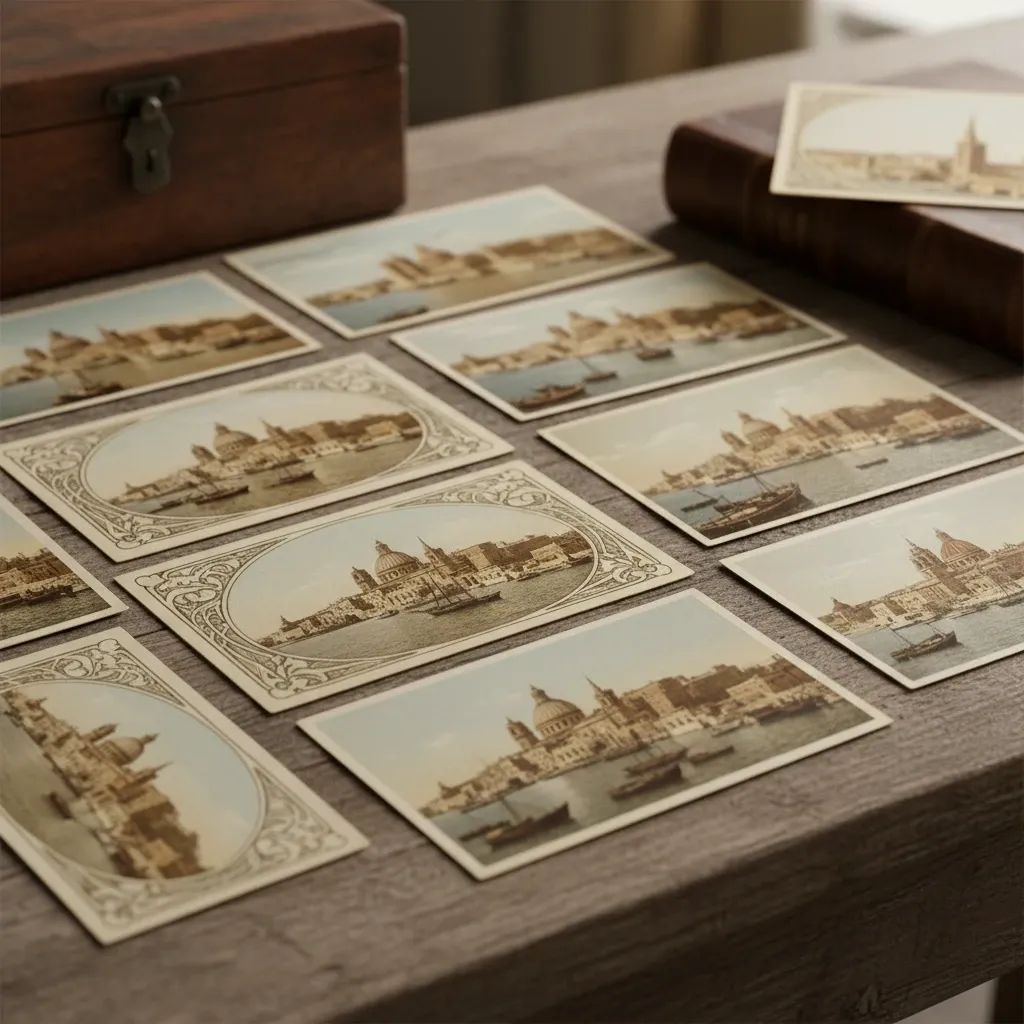
Schall's identity itself tells the story. For decades, collectors assumed he was German or Austrian—the mystique suited the aesthetic he dabbled in. In reality, Schall was a Valletta-based printer who married Anna Mifsud in 1904 and established himself as a publisher around 1902. His surviving work consists of six lithographed postcards featuring Maltese landmarks and scenes nestled within pre-fabricated Art Nouveau decorative borders. The frames weren't original; they were the same templates used for German and American cards. Schall, essentially, imported the European graphic language and dropped Malta's bastions, church domes, and harbor views into ready-made art nouveau containers. Competent execution, zero originality. The cards circulated quietly and left no lasting imprint on the market.
Joseph Howard's path was more pragmatic. Howard, who would later pilot Malta's transition to self-government as its first prime minister, was first a tobacco merchant. His Cousis tobacco company operated its own printing press—a valuable asset in the early 1900s. Rather than selling Art Nouveau aesthetics to the public, Howard deployed them strategically. He sponsored local band clubs and printed their musical programs on the backs of postcards adorned with elegant floral borders and curvilinear typography characteristic of the movement. These weren't art collectibles; they were working documents. Programs for the Queen Victoria Band in 1905, invitations for the La Valette Band Club in 1908 and 1915—all carried Howard's tobacco branding and subtle Art Nouveau graphics. The style served commerce; commerce didn't serve the style.
Why the Island Resisted a Continental Obsession
The gulf between European Art Nouveau fervor and Malta's postcard restraint reflects deeper structural realities. Continental Europe's Art Nouveau explosion—from 1871 through 1914, the Belle Époque—rode a wave of rapid industrialization, urbanization, and middle-class wealth accumulation. Paris, Vienna, Brussels, and Barcelona were building frantically, competing aesthetically, and remaking themselves as modern cities. Art Nouveau matched that energy perfectly: it was revolutionary, it was available to the masses through affordable design and decoration, and it promised to dissolve the boundaries between fine art and everyday objects.
Malta's economic trajectory was fundamentally different. As a British protectorate from 1800 to 1964, the island's prosperity was tethered to its value as a naval and military fortress, not as an industrial or commercial hub. There was no building boom driven by factory towns or speculative commerce. The skyline was governed by Baroque architecture inherited from the Knights of St. John, alongside Neoclassical and Neo-Gothic structures imposed by colonial administrators. The predominant construction material—Malta's distinctive golden-yellow Globigerina limestone—was worked using traditional methods that had little affinity with Art Nouveau's cast iron filigree, stained glass innovations, and decorative excesses.
When Art Nouveau finally gained traction in Malta, it arrived late (mostly during the 1910s-1930s) and arrived compromised. It merged with Art Deco influences and filtered through Italian Stile Liberty, producing hybrid buildings like the Balluta structures in St Julian's and Villa Roseville in Attard—visually distinctive but architecturally eclectic rather than doctrinaire. For the postcard industry, this delay and dilution meant that by the time Art Nouveau aesthetics were locally available, the market had already crystallized around a different visual language: documentary realism, architectural clarity, and recognizable subject matter.
The Psychology of Commercial Restraint
Publishers understood their audience instinctively. Richard Ellis and the anonymous Unione Tipo-Litog. Brescia firm occasionally attempted what collectors now describe as "approximate Art Nouveau imaging," but the results felt, by contemporary and modern accounts alike, diluted and unconvincing. There was a reason for the hesitation: Art Nouveau's complex botanical forms, its rejection of straight lines, its embrace of asymmetry and ornamental excess—these qualities could appear chaotic or pretentious to consumers accustomed to order, legibility, and documentary clarity.
Tourists arriving via the Suez Canal route wanted postcards that said "I was here" in the most direct visual language possible. They wanted Valletta's Grand Harbour, St. John's Cathedral, the Malta High Street. They wanted evidence of the exotic, not abstraction. British military personnel commissioned postcards to send home—images that justified their deployment to an important outpost, that showcased imperial infrastructure. Neither constituency was purchasing avant-garde decoration.
Local Maltese customers, who dominated the postcard market alongside tourists, shared this sensibility. Postcards commemorated band club events, family milestones, religious feast days, and local pride. They served as ephemeral snapshots of identity. Art Nouveau's aesthetic complexity, its association with European cosmopolitanism and aesthetic radicalism, actually worked against its commercial potential. It signaled foreignness, not belonging. Malta's postcard publishers, far from being unsophisticated, were reading their market with precision and responding rationally.
The Legacy of the Roads Not Taken
The handful of Art Nouveau postcards that survive from early 20th-century Malta function today as historical curiosities rather than artistic treasures. Schall's six cards and Howard's band club programs reveal something more interesting than the style itself: they document the moment when a revolutionary aesthetic met a provincial market and lost. Not because Malta lacked aesthetics or culture, but because Maltese commercial logic and cultural preference were rooted elsewhere.
The Malta National Library and Archives preserves small collections of these cards alongside the thousands of standard photographic postcards that dominated the market. For researchers studying Maltese visual culture, they illuminate how global artistic movements experience friction when they encounter local tradition, economic structure, and consumer taste. The postcard boom itself—profitable, culturally significant, economically generative—happened without Art Nouveau. It didn't need it.
What Malta chose to document and circulate through postcards tells its own story. Valletta's bastions, harbor traffic, parish churches, festa celebrations, military installations, commercial enterprises—these were the visual vocabulary that mattered. In choosing restraint over stylistic revolution, Malta's publishers weren't conservative in any pejorative sense. They were pragmatists responding to what their customers—local and visiting—actually valued. The postcard's real power, they seemed to understand, lay not in aesthetic rebellion but in honest documentation. That philosophy, reflected in millions of cards that circulated through Malta's postal system, left a more durable imprint on the island's cultural memory than Art Nouveau ever could have.