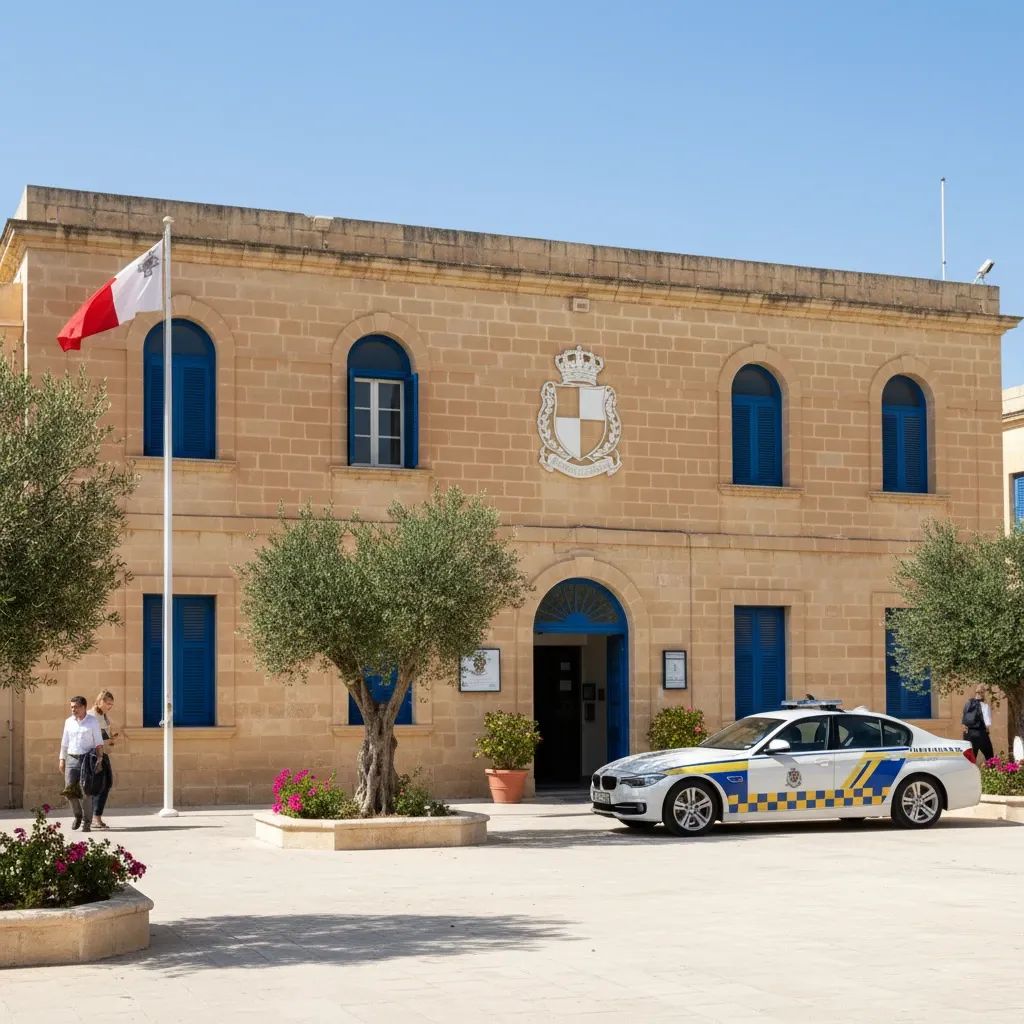
The Malta Police Force launched a public manhunt on Friday for Mahmoud Waqqa, a fugitive ordered into custody by a sitting magistrate over pending judicial proceedings. His continued absence underscores a recurring challenge for local law enforcement: tracking individuals who fail to appear for court-mandated obligations in a small, densely connected jurisdiction where traditional surveillance alone frequently falls short.
Why This Matters
• Time-sensitive case: Waqqa must be located to proceed with the magistrate's hearing; his absence delays judicial closure.
• Multiple reporting channels: Callers can remain anonymous via Facebook, phone (21 224001 or 119), or in-person at any local station using reference 22/2026.
• Community role critical: In previous 2026 cases, public tips have resolved searches within hours, making resident participation genuinely consequential.
The Nature of the Search
Courts typically issue magistrate orders for individuals when preliminary evidence suggests involvement in a criminal matter serious enough to warrant formal proceedings. In Waqqa's case, the judicial system has already moved beyond initial investigation stages—a magistrate has formally directed his apprehension, indicating that authorities possess sufficient grounds to proceed with charges. What remains unclear is Waqqa's specific whereabouts and whether he is evading law enforcement deliberately or has simply become unreachable.
The absence of detailed public disclosure about his alleged offenses is standard practice in Malta's judicial system. Charge specifications remain confidential until arraignment, protecting both the integrity of investigations and individuals' rights until formal court proceedings commence. This protective silence, however, leaves the public with limited context—a deliberate security measure, though one that can frustrate residents attempting to assess whether a fugitive poses direct neighborhood danger.
How the Force Adapted Its Approach
Rather than relying exclusively on internal police operations, the Malta Police Force has increasingly embraced crowdsourced intelligence. The strategy works in Malta's favor: population density, interconnected social networks, and the reality that most residents maintain stable residence patterns mean that word travels quickly through community channels. A sighting reported via Facebook or a phone tip can trigger rapid leads that formal surveillance protocols might miss entirely.
The multi-channel reporting system reflects pragmatic adaptation to communication preferences across Malta's demographic spectrum. Younger residents may gravitate toward Facebook direct messaging, while others prefer direct phone contact or face-to-face interaction at district police stations. By removing friction from the reporting process—including explicit anonymity guarantees—authorities reduce hesitation among witnesses who fear exposure or retaliation.
Precedent Suggests Effectiveness
The performance record of 2026 offers concrete evidence that public-led investigation works in the Maltese context. In early March, authorities sought Adel Ibrahim; within hours of issuing an appeal, community information led to his location. On March 10, a 49-year-old Italian national accused of attempted homicide was apprehended following a coordinated police operation in Baħar iċ-Ċagħaq, again after public engagement made the difference. More recently, on April 14, officials announced that Mahmoud Mesto—previously listed as wanted—was removed from the active manhunt roster, suggesting either apprehension or case resolution.
Currently, several other individuals remain active subjects of magistrate orders: Samuel Asmelash Sium (cases 16/2026 and 15/2026), Tomislav Kovacevic (case 7/2026), and Olena Ivanivna Hryhoryeva (cases 12/2026 and 11/2025). January appeals sought Ovi Tabi, Rishikesh Reddy Choda, and Hamza Farah Idris under reference 3/2026. The sheer volume of outstanding warrants highlights both the scale of judicial backlog and the reliance on citizen assistance to move cases forward.
What Residents Should Know
For those living in or near central Valletta and St George's Bay—the locations where the alleged incidents reportedly occurred—this appeal carries practical significance. Routine awareness and candid reporting strengthen the likelihood of swift resolution. The reference number 22/2026 is the critical detail linking reports to Waqqa's specific case file; using it ensures that information routes to the correct investigative team rather than becoming lost in general police communications.
Encounters with fugitives always warrant caution. While the Malta Police Force has not characterized Waqqa as violent or dangerous, direct citizen confrontation remains unnecessary and potentially counterproductive. Contacting authorities through established channels—rather than attempting personal approach—keeps both residents and officers safer and preserves investigative protocols.
The anonymity guarantee, prominently featured in police communications, addresses a real barrier in tight-knit Maltese communities where reputation and social standing carry weight. Residents who fear social fallout or family connections to Waqqa can provide credible intelligence without exposing their identity, lowering the psychological cost of civic cooperation.
The Broader System Context
When magistrates issue apprehension orders, they signal that formal judicial proceedings have commenced and that an individual's presence is legally mandated. Failure to comply escalates legal jeopardy—courts can add contempt charges, issue bench warrants, and complicate any eventual defense strategy. For Waqqa, every day of continued absence deepens his legal exposure and suggests that voluntary surrender becomes increasingly costly.
For the system itself, unresolved cases create administrative friction. Magistrates cannot finalize hearings without defendants present; prosecutors cannot proceed with full argumentation; and the courts cannot deliver judgments. Public cooperation thus serves not just law enforcement but the functioning of Malta's judicial infrastructure—a reminder that investigative success is fundamentally a collective responsibility, not solely a police function.
The Malta Police Force has made the reporting process deliberately accessible. Phone lines (21 224001 and 119) operate continuously. Facebook Messenger offers asynchronous communication for those who prefer not to call. Local police stations welcome in-person visits from residents with credible information. None of these channels require identifying information, removing the primary excuse for silence.
Anyone in possession of relevant intelligence—a sighting, knowledge of Waqqa's associates or frequented locations, or even secondhand information about his movements—should contact authorities immediately. In Malta's constrained geography and interconnected society, seemingly minor details often prove decisive.