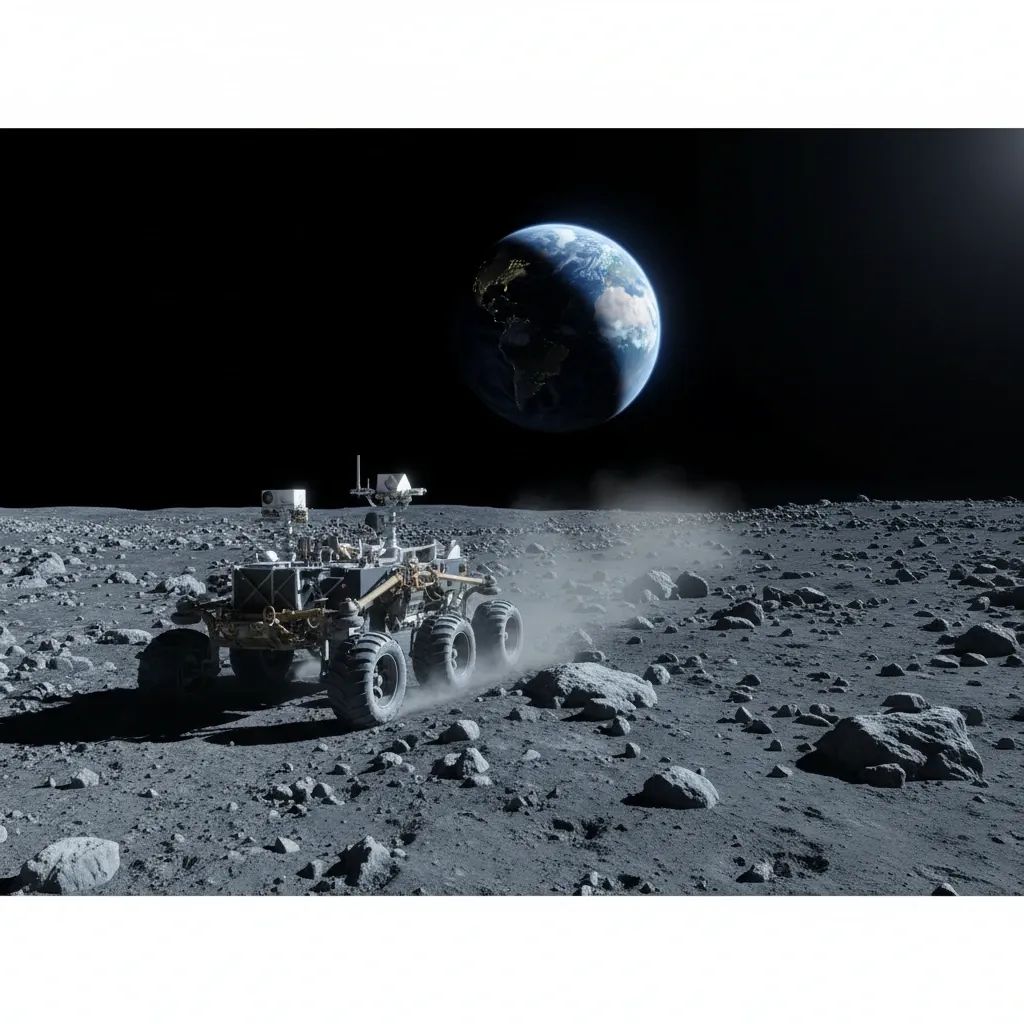
The Malta-based space research firm Spaceomix will send a specialized digital archive to the lunar surface in 2026, a mission that tests data-handling technologies in one of Earth's harshest environments. The project—called the Lunar BioVault—will evaluate how data storage systems perform under extreme conditions. Researchers say if successful, such technologies could eventually have applications for how institutions preserve critical information, though significant hurdles remain before any practical deployment in Malta's hospitals or schools.
Why This Mission Matters:
• The LUVMI-M lunar rover will carry Malta's archive to the Moon's south pole for a 10–14 day mission.
• Bioinformatics, AI, and machine learning systems will be tested under extreme conditions—providing data applicable to emergency response and remote infrastructure.
• Malta's participation builds on Project MALETH, which conducted biomedical research on the International Space Station between 2021 and 2023.
• This mission underscores Malta's commitment to the Artemis Accords, a framework for peaceful lunar exploration.
Testing Ground for Extreme Data Resilience
Spaceomix, led by Professor Joseph Borg, is collaborating with Space Applications Services of Belgium and Weill Cornell Medicine to engineer a solid-state storage device designed to survive the lunar environment. The south pole region—where the rover will operate—experiences temperature swings from -173°C in permanent shadow to 127°C in direct sunlight, alongside cosmic radiation levels 200 times higher than on Earth. The BioVault will carry genome data, educational content, public messages, and scientific records, all compressed into a format designed to endure without power or active cooling.
The mission will test data management protocols under conditions far harsher than typical server environments. Researchers will evaluate how bioinformatics algorithms can prioritize, compress, and transmit data when bandwidth is measured in kilobits per second and power budgets are razor-thin. Understanding these constraints has theoretical relevance to rural clinics with limited connectivity or emergency response teams operating in the field, though actual implementation would require years of additional development and regulatory approval.
Potential Applications—With Significant Caveats
While researchers suggest that successful testing could eventually inform archiving approaches for sensitive institutional data, important constraints must be understood. No Maltese hospitals have committed to adopting this technology, and a successful 2026 test would represent just the first step in a multi-year development process. Regulatory bodies like the European Medicines Agency would need to approve any system handling medical data, and healthcare institutions would need to conduct their own risk assessments before considering deployment.
Current electronic health record systems like those at Mater Dei Hospital require constant maintenance and periodic updates—challenges that any archiving solution would need to address. A storage system based on lunar-tested principles could theoretically create long-term backups, but the practical costs, integration challenges, and regulatory pathway from experimental technology to clinical implementation remain undefined and likely span a decade or more.
For laboratories, the potential is similar but speculative. Malta's pharmaceutical and biotech sectors generate significant genomic sequencing data tied to regulatory compliance timelines. If the Lunar BioVault's machine learning algorithms prove effective and if they can be adapted to terrestrial settings, they could eventually help research institutions manage long-term data retention. However, no Maltese research institution has signaled plans to pursue such technology, and any commercial application remains years away.
A National STEM Platform in Orbit
Spaceomix has positioned the BioVault as a case study for Malta's education system. Secondary schools and university programs will gain access to real telemetry data from the lunar surface, allowing students to track how the archive handles radiation events, temperature cycles, and dust accumulation. This provides authentic space mission data—valuable for physics, computer science, and biology curricula, though it's important to distinguish between educational access to mission data and claims that this directly transforms STEM outcomes.
The mission also invites public participation. Maltese citizens can submit messages to be included in the archive, creating a time capsule element that personalizes the technical endeavor.
How Malta Fits into Global Lunar Data Strategy
Malta's initiative occupies a distinct niche compared to commercial ventures like Lonestar Data Holdings, the US firm developing off-planet backup services for corporations. Lonestar's model focuses on disaster recovery for businesses, leveraging the Moon as an off-planet backup site. Spaceomix's BioVault, by contrast, is archival and scientific rather than commercial. The 10–14 day mission window limits real-time processing capacity, but the focus on bioinformatics and AI-driven data curation addresses fundamental questions about data preservation in extreme environments.
This aligns Malta with the Artemis Accords framework, which emphasizes transparency and scientific cooperation. Malta signed the accords in 2020, joining 30 other nations committed to peaceful lunar exploration—a policy stance that favors collaborative research missions over proprietary ventures.
Technical Challenges and Spillover Research
The LUVMI-M rover mission faces significant technical hurdles. Lunar dust—composed of electrostatically charged silicate particles—can infiltrate sealed electronics, while the lack of atmosphere means no convective cooling for processors. Spaceomix engineers are testing passive thermal management techniques using phase-change materials and reflective coatings. The research findings, if successful, could contribute to understanding thermal resilience in other demanding environments, though direct applications remain speculative pending test results.
The AI algorithms being validated will need to operate autonomously. This decision-making framework has theoretical relevance to Malta's emerging smart city initiatives, where sensor networks generate substantial data that benefits from intelligent compression and prioritization. Again, any actual deployment would require successful completion of the mission, subsequent development cycles, and institutional adoption decisions.
Economically, the mission positions Malta as a research partner for potential future European Space Agency contracts. Successful lunar deployment could strengthen Prof. Borg's team's track record for follow-on projects, though predictions about job creation or sector growth would be premature before mission outcomes are known.
Realistic Timeline and Questions for Residents
For residents evaluating the relevance of this mission, several questions remain unanswered:
• Timeline: How many years between successful 2026 testing and practical deployment in any Maltese institution?
• Costs: What is the total project cost, and who is funding it?
• Adoption: Has any Maltese hospital or research institution expressed concrete interest in this technology?
• Regulatory pathway: What approvals would be required before such technology could handle sensitive medical or research data?
These details matter for understanding whether the Lunar BioVault represents a near-term investment in Malta's infrastructure or a longer-term research contribution that may or may not yield practical applications.
What This Means for Residents—Practically Speaking
For anyone living in Malta, the Lunar BioVault offers three concrete outcomes:
First, educational value: Students gain access to genuine space mission data and can track real-world challenges in extreme-environment engineering and data management.
Second, international standing: Malta's participation in a collaborative lunar science mission strengthens the nation's profile in space policy and demonstrates capability in advanced research—connections that can open diplomatic and commercial channels.
Third, long-term research potential: If successful testing eventually leads to development and regulatory approval, insights from data management under extreme conditions could inform approaches to resilience in critical infrastructure. This is a multi-year possibility, not an imminent application.
The Lunar BioVault represents Malta's contribution to international space research and a genuine test of data preservation technologies. However, residents should understand that the path from successful 2026 testing to practical adoption in Maltese hospitals or laboratories is neither guaranteed nor imminent. The mission's real value lies in advancing scientific knowledge and positioning Malta as a credible research partner—outcomes that merit support independent of speculative applications that may never materialize.