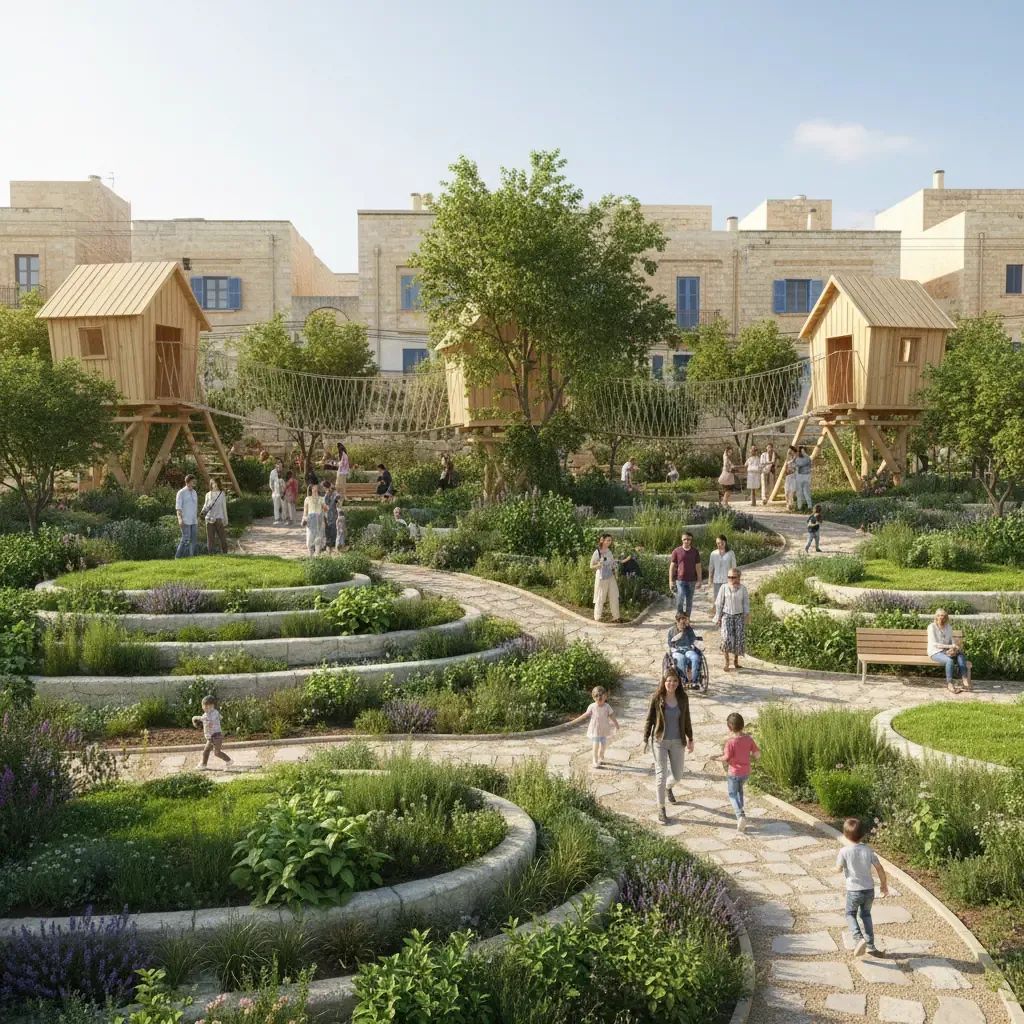
Kirkop's gamble—abandoning 11 apartment blocks to plant trees and build a community gathering space—has crystallized how Malta's priorities are quietly shifting. The government is now willing to leave money on the development table if the alternative is open space for residents within walking distance. What was earmarked for construction through the 1990s and 2000s has become Ġnien il-Koppin, an invitation for neighbors to simply exist outdoors without purpose or profit.
Why This Matters
• Development zoning abandoned deliberately: A 1,600-square-meter plot legally reserved for residential blocks has been permanently reclassified as public green space—a decision that reverses decades of densification policy favoring construction revenue.
• Accessibility reshapes where families spend time: The garden sits within the 10-minute walk target from most Kirkop homes, altering how residents navigate routine—school pickups, evening exercise, weekend leisure now have a traffic-free anchor.
• €500,000 reframed as infrastructure investment: What might otherwise have generated municipal tax revenue through building permits now exists as community asset requiring ongoing maintenance and operational spending.
• Sustainability infrastructure embedded: Solar power and rainwater harvesting (110-cubic-meter capacity) mean the site operates with minimal dependence on mains utilities—a rare pilot for public space self-sufficiency in Malta.
The Site Itself: What Residents Actually Encounter
On a typical May afternoon in 2026, Environment Minister Miriam Dalli and Kirkop Mayor Matthew Agius Zammit cut the ribbon on what amounts to a deliberate rejection of intensity. The space occupies a stretch along Triq Nerik Scerri—a central location within the village but immediately surrounding street-level and pedestrian-oriented rather than towering.
The garden accommodates discrete zones that prevent chaos. Toddler equipment sits isolated from adolescent pathways. Herb gardens labeled with plant names and uses cluster together for educational browsing. A viewing platform elevated slightly above ground offers sightlines across the village. Fifty-five mature trees—not saplings that require decades to mature—provide immediate canopy coverage, a design choice acknowledging that people want shade now, not in 2045. Indigenous species predominate, selected for their tolerance of Malta's dry conditions and minimal irrigation demands once established.
Pathways are poured from recycled composite materials rather than traditional concrete—a practical decision rooted in Malta's drainage reality. Summer storms arrive suddenly and intensely; conventional hardscaping channels water problematically. Composite pathways disperse moisture more effectively, reducing pooling and surface deterioration. Structurally, the site slopes subtly toward subsurface drainage, an engineering detail invisible to casual visitors but essential to longevity.
The 110-cubic-meter underground reservoir captures roof runoff and storm drainage, supplying automated irrigation that operates via sensors triggered by soil moisture levels. Solar panels power the irrigation controllers, lighting (on until 22:00), and potential future electrical additions. The infrastructure is designed for hands-off operation once calibrated—a significant advantage given municipal budget constraints across local councils island-wide.
An insect hotel—essentially a wooden structure with hollow stems and stacked wood providing habitat—sits integrated into the landscaping. It functions as both ecological intervention and teachable object; school groups visiting the site often gather around it, learning about pollinator dependency and food web relationships. Aromatic herb sections include mint, rosemary, and oregano varieties, labeled for identification and occasionally harvested by residents for domestic use (within reasonable limits, enforced by the Kirkop council).
Children's play equipment meets European safety standards with impact-absorbing surfacing beneath climbing structures. The age range accommodated is 3–12, eliminating conflict between toddlers and teenagers—a basic zoning principle implemented by Project Green's architect Cheryl Camilleri throughout the design.
Why Development Land Was Sacrificed for Open Space
The decision requires context. Malta's population density stands at approximately 1,672 people per square kilometer—among Europe's highest. Housing shortages persist despite decades of construction. First-time buyers face prices that require household incomes of €80,000+ annually to service mortgages on starter properties. Renters navigate an increasingly constrained market with limited protections. Against this backdrop, withdrawing a plot capable of accommodating 11 residential blocks reads as economically irrational to some observers and morally necessary to others.
The Kirkop conversion is not an improvisation. It forms part of Project Green, an agency launched in 2023 with a €700 million budget and mandate to oversee 118 environmental initiatives spanning nearly two million square meters across Malta and Gozo. The agency operates as the implementing arm for what government statements call the "Green Infrastructure Revolution," a policy framework embedded within Malta Vision 2050—the long-term strategic document adopted by the cabinet.
Dalli's framing during the May 2026 inauguration carried explicit policy weight: "This was land marked for construction. We chose differently." That statement signals intention beyond a single site. It telegraphs that future development-zoned parcels may face similar conversion proposals—a structural shift away from permitting maximum residential intensity toward balancing density with liveability.
The Portfolio Strategy: Four Sites, Two Million Square Meters Across Phases
Kirkop represents the first completed project from a four-site portfolio transferred from the Malta Lands Authority to Project Green. The parcels in Lija, Luqa, and Ta' Ġiorni (San Ġiljan) remain in various stages of development. Collectively, they exceed 6,000 square meters, though individual timelines differ.
The broader output reflects institutional acceleration. Park l-Inħawi in Fgura, currently under construction, spans 50,000 square meters—equivalent to seven football pitches. The €4 million investment, partially EU-funded, will create one of southern Malta's largest family recreation zones, with picnic infrastructure, social activity areas, and sustainable pathways. Tender awards have already been issued for an €11 million car park conversion near the American University of Malta in Cospicua, transforming a surface parking facility into landscaped recreational area. The decommissioned San Antnin recycling plant in Marsaskala is being repurposed as a community garden. An undeveloped Għaxaq plot within a development zone is simultaneously undergoing transformation.
During 2025 alone, Project Green opened or refurbished 100,000 square meters of public space, completing 25 projects from its 118-project portfolio. Fifteen new projects received funding approvals backed by a €22 million investment incorporating partial EU co-financing. The total project roster spans nearly two million square meters when completed—roughly equivalent to 280 football pitches of public space ultimately created or regenerated.
This velocity has been enabled by regulatory reform. The Malta Planning Authority previously demanded full planning applications for urban greening projects within development zones—a process consuming three to six months. Legislative changes introduced in late 2025 permit Project Green to proceed via simple development notification, eliminating bureaucratic friction and accelerating timelines substantially. What took a year now requires weeks.
The Tension Underlying Policy: Housing Crisis Versus Quality of Life
Yet this success exists in productive tension with competing objectives. Housing advocates and rental-market analysts openly question whether withdrawing development-capable land addresses urgent residential needs or worsens them. Malta's residential crisis operates at multiple levels: insufficient units for expanding population, insufficient affordable units for younger cohorts entering rental markets, insufficient rent-controlled units for vulnerable residents, and insufficient owner-occupied options for first-time buyers navigating mortgage qualification barriers.
The government acknowledges this tension explicitly. Policy documents assert that green infrastructure delivers measurable public health returns—reduced urban heat island effects, improved air quality, enhanced mental health indicators, stress reduction—that justify opportunity costs. Research from other Mediterranean cities supports this claim empirically. Yet no comprehensive land-use strategy has been published clarifying how many additional development sites face reclassification for public benefit or where the boundary lies between acceptable conversions and necessary housing density. That ambiguity fuels legitimate skepticism about whether the government has resolved the tension coherently or simply chosen a preferred framing without confronting tradeoffs directly.
Accessing Ġnien il-Koppin: Practical Details for Kirkop Residents
The garden sits centrally, accessible via multiple pedestrian entrances along Triq Nerik Scerri. No on-site parking exists—a deliberate policy emphasizing walkable access. Street parking occupies nearby residential areas. The site operates daily at no cost. Lighting ceases at 22:00, rendering evening hours impractical for access without external light sources.
Dogs on leash are permitted. Cycling is allowed on designated pathways but prohibited on soft surfaces and within play equipment zones. School groups and organized activities require advance booking through the Kirkop council to manage capacity without overwhelming maintenance systems. Play equipment accommodates ages 3–12 with safety surfacing meeting European standards.
For residents accustomed to planning around car journeys, the garden's positioning matters practically. The 10-minute walk distance represents deliberate calculation—far enough to preserve low-traffic pedestrian character within residential zones, proximate enough that families with young children or elderly members can reach green space without transport logistics. This philosophy underpins the broader Project Green mandate and explains why multiple site conversions distribute across villages rather than concentrating in a single district. The goal is cumulative access normalization: green space should become background infrastructure rather than destination attraction requiring planning.