
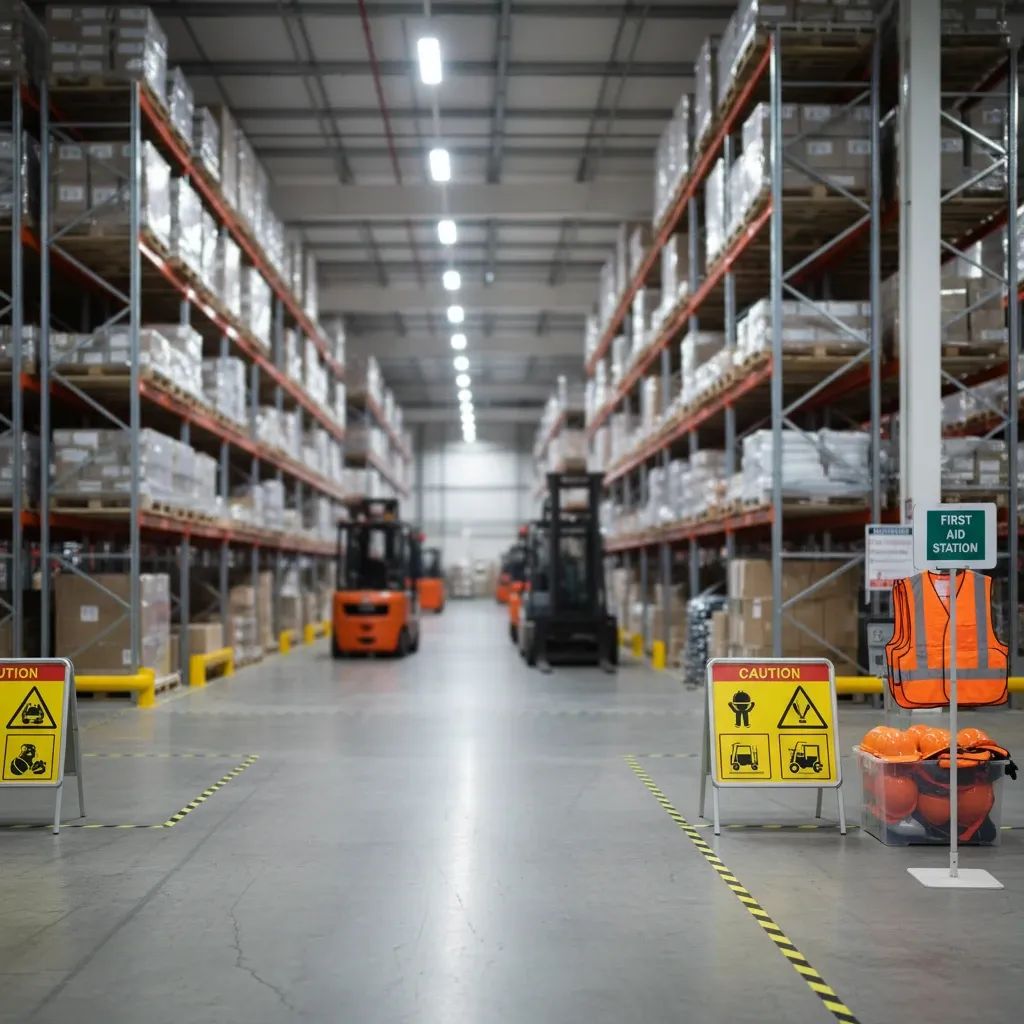
A fatal warehouse accident on Monday morning in Naxxar has thrust Malta's warehouse sector into sharp focus, signaling the second occupational death of 2026. The first 2026 fatality has not been publicly detailed by authorities. This follows a troubling 2025 that saw 9 workplace deaths—more than double 2024's toll of 4. A 34-year-old resident of Qormi died in a forklift incident at an industrial facility on Triq Burmarrad around 10 AM. While routine investigations are underway, the incident lands against a backdrop of surging fatality rates that make workplace safety the defining labor issue facing the island.
Why This Matters
• Fatality momentum is reversing course: Malta recorded 9 workplace deaths in 2025—more than double the 4 recorded in 2024. The Naxxar incident continues an upward trend that experts fear will worsen without targeted intervention.
• Forklift operators must hold current certification: Under Law L.N. 293 of 2016, only workers holding an MQF Level 2 Certificate of Competence can operate warehouse equipment legally. Employers who cut corners face imprisonment, substantial fines, and operational shutdowns.
• Three separate inquiries are now active: The Occupational Health and Safety Authority (OHSA), local police, and a magisterial investigator are examining whether proper safety procedures existed, whether equipment was maintained, and whether the employer met legal obligations.
The Growing Crisis in Warehouse Operations
The wholesale, retail, and transport sectors have produced half of Malta's 2025 fatalities—four deaths concentrated in these industries. Warehouse operations, which fall under the "transport and storage" classification, present a particular hazard cluster. Equipment-related accidents involving heavy machinery remain underreported as isolated incidents, yet their cumulative effect has transformed industrial warehousing into one of the island's riskier occupations.
The shift is striking. In 2024, only one death occurred in transport and storage combined. By mid-2025, the toll had doubled. The National Statistics Office (NSO) notes that while the "transport and storage" sector accounts for just 10.3% of non-fatal accidents overall, it produces a disproportionate share of fatal outcomes—suggesting incidents in this sector are more severe or occur under conditions where intervention is impossible.
Construction remains statistically the most dangerous sector, responsible for 33% of 2025's fatalities. Yet warehouses lack the same regulatory visibility. Construction sites host regular OHSA inspections and carry mandatory safety committees. Warehouses, by contrast, operate with less formal oversight unless an accident triggers scrutiny.
What the Regulations Actually Require
The Work Equipment Regulations are explicit: forklift operation is restricted to individuals who have completed accredited training and obtained a Certificate of Competence. Malta's approved providers, including Professional Driver Training Malta (PDTM), deliver the standard "Award in Operating a Forklift," an MQF Level 2 qualification. The course covers load stability, racking procedures, hazard identification, and pre-shift equipment checks. Candidates must achieve 60% on both written and practical exams.
Yet certification alone is insufficient. Employers must conduct formal risk assessments identifying hazards unique to their facility layout. They must establish documented maintenance schedules for each vehicle, ensure workers understand emergency procedures, and appoint Health and Safety Representatives who can escalate concerns without retaliation. The OHSA can issue immediate stop-work orders if conditions violate safety standards, and enforcement actions include criminal prosecution.
The regulatory framework mirrors EU Directive 2009/104/EC, ensuring alignment with European standards. Yet compliance surveys suggest many small and medium-sized warehouse operators remain unaware of these obligations or underestimate enforcement consequences.
Inside the Investigation
Magistrate Franco Agius is leading a judicial inquiry into Monday's incident. The Malta Police Support Response Team and OHSA inspectors will reconstruct the exact sequence of events: Was the operator performing a routine maneuver when struck? Did the forklift malfunction or experience visibility obstruction? Were pre-use safety checks conducted?
Magisterial inquiries in Malta are thorough but protracted, often spanning months. Forensic analysis of the equipment, witness testimony, maintenance records, and certification documentation will all feed into the final determination. If the employer knowingly or negligently breached occupational health law, criminal liability extends beyond monetary penalties. Company directors can face imprisonment, civil lawsuits from the victim's family, and forced operational suspension.
For workers observing these proceedings, an important protection exists: you hold a legal right to refuse work you reasonably believe poses imminent danger. This safeguard applies regardless of employer pressure. Health and Safety Representatives can escalate concerns directly to the OHSA without fear of retaliation—a principle that Maltese law explicitly protects.
The Demographic Vulnerability Pattern
Workers aged 25 to 34 represent the largest share of accident victims, accounting for 26.6% of all non-fatal incidents in late 2025. This age cohort typically includes early-career warehouse staff, junior operators, and temporary workers. The overrepresentation suggests potential gaps in foundational safety training, inadequate mentoring from experienced personnel, or pressure to prioritize productivity over caution.
Foreign workers face disproportionate risk in fatality statistics despite comprising a smaller percentage of the overall workforce. Language barriers, inadequate onboarding protocols, and precarious employment arrangements that discourage safety reporting all contribute. The OHSA has identified this pattern and now coordinates targeted outreach with migrant advocacy groups and the Building and Construction Authority (BICC).
Nearly 30% of workers injured in non-fatal accidents remained absent from work for 7 to 13 days, suggesting moderate-to-severe trauma. Back injuries, including spinal and vertebral damage, accounted for over 30% of reported injuries in the second half of 2025. These figures hint at underlying hazard control failures that workers are experiencing even when incidents do not prove fatal.
Tools Available, But Uptake Remains Incomplete
The OHSA operates a free online OiRA (Online Interactive Risk Assessment) platform specifically designed for small operations without dedicated safety staff. The tool guides companies through sector-specific hazard identification and control hierarchies in plain language. Despite availability, many smaller warehouse operators have not engaged with the system, suggesting either unawareness or a cultural assumption that accident risk is unavoidable.
The regulatory environment also imposes broader employer duties. Maltese occupational health law mandates that employers provide "suitable information, instruction, training, and supervision." This standard is expansive and interpreted broadly by enforcement bodies and courts. When accidents occur, regulators examine not merely whether workers held certifications but whether employers created a culture where safety was prioritized, questions asked, and hazards addressed before tragedy struck.
The OHSA has articulated a "zero preventable incidents" vision, framing workplace safety as a shared cultural responsibility rather than a box-ticking obligation. This aspirational goal requires genuine engagement from both employer leadership and the workforce.
A Parallel Monday Crisis
While emergency services were responding to the Naxxar warehouse incident, a separate emergency unfolded kilometers away. At 9:30 AM, a 70-year-old resident of Mġarr was struck by a Ford Transit van on Triq iż-Żebbiegħ, sustaining serious injuries. The 39-year-old driver, also from Mġarr, remained at the scene. Emergency responders provided initial care before transporting the woman to Mater Dei Hospital in stable condition.
The Malta Police have opened a magisterial inquiry into the traffic incident separately. Monday's dual crises—one industrial, one traffic-related—underscore that risk permeates multiple sectors of daily life. Both incidents triggered regulatory investigation, both involved emergency response systems, and both now occupy the inquiries of magistrates and enforcement officers.
What Employers Must Do Now
The OHSA investigation may require weeks or months to conclude. For warehouse operators across Malta, the immediate implication is unambiguous: verify that every forklift operator currently holds a valid MQF Level 2 Certificate of Competence and has completed refresher training within the required interval. Conduct documented equipment inspections and maintain records. Ensure workers understand their right to refuse unsafe tasks and know how to contact Health and Safety Representatives or the OHSA directly if concerns arise.
Smaller operators should access the OiRA platform without delay and complete a formal risk assessment. This step is free, practical, and creates a defense if an incident occurs—demonstrating that the employer took hazard identification seriously.
The Longer Arc
The year 2022 remains Malta's deadliest occupational year on record, with 15 workplace fatalities producing an incidence rate of 5.3 per 100,000 workers—the highest in 18 years. Progress was made in 2023 and 2024, bringing the incidence rate down to 1.7 and 1.25 per 100,000 respectively. But 2025's nine deaths reversed that trajectory decisively, climbing back toward 2.7 per 100,000.
Whether 2026 stabilizes or worsens depends partly on whether Monday's incident galvanizes genuine behavioral change. Regulators have the tools and legal authority to enforce compliance. Employers have clear obligations and practical resources to implement them. Workers have rights to refuse unsafe conditions and channels to escalate concerns. Whether all three actors align sufficiently to break the current upward trend remains an open question. The OHSA has not released a timeline for concluding its investigation, but the political and social pressure for clarity—and meaningful change—is mounting rapidly.


