
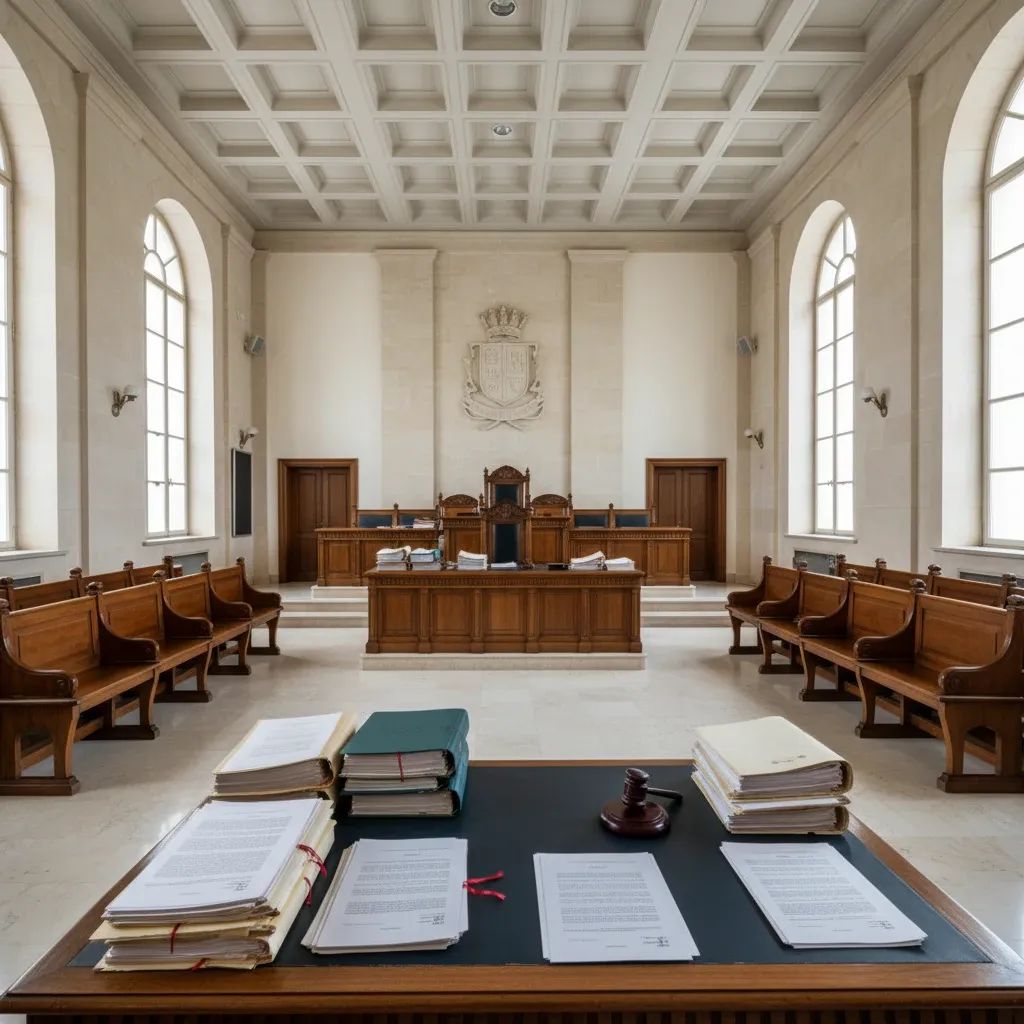
The Maltese government and Nationalist Party opposition remain locked in a standoff over who should lead the country's judiciary, a deadlock that has left the top judicial post vacant for three weeks and transformed what should be a merit-based appointment into a spectacle of political brinkmanship.
Why This Matters
• Malta's Chief Justice Mark Chetcuti, who reached mandatory retirement age on February 4, remains in office because no successor has been confirmed due to parliamentary gridlock. Under Maltese constitutional law, a Chief Justice continues in office until a successor is appointed, even after reaching retirement age.
• The delay affects pending court cases and the administration of Malta's entire court system, potentially causing delays in civil and criminal proceedings.
• The Chamber of Advocates has publicly labeled the process a "public farce," warning that politicization undermines judicial independence and public trust.
• Judge Lawrence Mintoff has accused Prime Minister Robert Abela of blocking his candidacy to avoid displeasing Labour Party supporters, raising serious questions about executive interference.
• European institutions, including the Venice Commission (formally the European Commission for Democracy through Law) and the European Commission, have repeatedly warned Malta that its Chief Justice appointment system is defective and incompatible with judicial independence.
From Constitutional Reform to Political Theatre
The 2020–2021 constitutional amendments were supposed to introduce checks and balances by requiring a two-thirds parliamentary majority for the Chief Justice appointment. Instead, the reform has created a system where political parties negotiate behind closed doors while candidates' names circulate publicly, exposing jurists to unwarranted scrutiny and pressure.
The Venice Commission, an advisory body of the Council of Europe, explicitly recommended in 2018 that Malta should depoliticize the process by empowering the Judicial Appointments Committee (JAC) to propose candidates, with a majority of committee members drawn from the judiciary itself. The Maltese government ignored this advice when drafting the 2020 reforms and has since overlooked repeated calls from the European Commission's Rule of Law Reports since 2022 to remedy the defects.
The current system excludes the judiciary entirely from the Chief Justice selection, a glaring contrast to the procedure for appointing other judges and magistrates, where the JAC plays a central role in ensuring merit-based selection.
The Collapse of Consensus
On February 6, Prime Minister Robert Abela initially proposed Judge Consuelo Scerri Herrera for the Chief Justice role. The nomination failed to secure the necessary two-thirds parliamentary majority and was withdrawn within days.
On February 20, the government put forward its second candidate, Judge Miriam Hayman. The following day, the Nationalist Party countered with its own nominee, Judge Lawrence Mintoff, escalating the standoff.
What followed was an extraordinary public intervention by Judge Mintoff himself. In a letter reportedly sent to the Cabinet Secretary, he alleged that the Prime Minister had privately indicated Mintoff was being excluded because his nomination by the Opposition would anger Labour supporters and politically strengthen Opposition Leader Bernard Grech. Mintoff further claimed Abela preferred to delay the appointment until after the next general election, prioritizing "money and political calculation over judicial independence."
These allegations, if accurate, suggest that the appointment process has been subordinated to electoral strategy rather than the constitutional duty to appoint the most qualified candidate.
What This Means for Malta's Judicial Independence
The ongoing impasse exposes a fundamental flaw in the 2021 constitutional amendments: there is no legal mechanism to break a deadlock if the government and opposition cannot agree on a candidate. The system presumes consensus will naturally emerge, but in practice, it has incentivized political gamesmanship.
Civil society organizations, including Repubblika and Partit Momentum, have argued that the current system is incompatible with the separation of powers. They contend that the judiciary itself should appoint the Chief Justice, free from parliamentary horse-trading.
The Chamber of Advocates has been even more blunt, stating that the failure to reach consensus demonstrates a "serious lack of leadership and national responsibility" on the part of both political parties. It has condemned the public circulation of candidates' names before formal nomination, which subjects prospective Chief Justices to media speculation and politically motivated attacks.
International Context: How Other European Countries Avoid This Problem
Most European democracies employ safeguards to prevent political capture of supreme court appointments. In the United Kingdom, an independent selection commission led by senior judges recommends Supreme Court justices, with the Lord Chancellor's power to veto recommendations sharply limited to minimize political interference. France relies on the Superior Council of the Magistracy—a mixed body including judicial members—to propose Court of Cassation appointments, with binding approval power over final selections. This structure stands in stark contrast to Malta's reliance on direct parliamentary negotiation without any independent judicial body in the loop, creating a process that resembles coalition-building for a cabinet post rather than the selection of the country's highest judicial officer.
The Cost of Political Calculation
Legal scholars and European institutions agree on the criteria that should govern a Chief Justice appointment: extensive judicial experience, unblemished ethical conduct, international stature, and organizational capability. The appointment should be merit-based, with objective qualitative benchmarks, and insulated from partisan considerations.
The current standoff suggests none of these criteria are operative. Instead, candidates are being evaluated on their perceived political alignment, their likelihood of pleasing party bases, and their potential impact on upcoming electoral contests.
The Chamber of Advocates has warned that this approach risks producing a "lowest common denominator" appointment—a candidate who is politically palatable but not necessarily the most qualified.
Practical Concerns: What Happens Next?
Malta residents may be wondering about concrete implications of this ongoing vacuum. The extended absence of a formally appointed Chief Justice creates administrative complications for the court system. Case management, appellate decisions, and judicial scheduling all remain affected while the post sits vacant. Constitutional experts note that this situation cannot be sustained indefinitely—political pressures or legal challenges could eventually force a resolution, but the timeline remains unclear. Both the government and opposition have shown little willingness to compromise, suggesting the standoff could persist for weeks or even months unless one party significantly shifts its position or a compromise candidate emerges with broader support across the legal profession.
A Constitutional Crisis in Slow Motion
While Mark Chetcuti remains in office beyond his retirement date, the situation is constitutionally ambiguous and cannot be sustained indefinitely. Court administration, appellate case management, and judicial leadership all depend on a Chief Justice with a secure mandate and clear legitimacy.
More fundamentally, the spectacle of two political parties publicly trading rival candidates—while a sitting judge accuses the Prime Minister of interference—sends a damaging signal about the rule of law in Malta. It reinforces the perception, already noted by European monitors, that Malta's institutions remain vulnerable to political capture.
The 2021 constitutional amendments were intended to prevent unilateral executive appointments and ensure national consensus. Instead, they have created a system where consensus is impossible to achieve without backroom deals, and where judicial candidates must navigate political calculations that have nothing to do with their legal qualifications.
What Needs to Change
The immediate priority is for the government and opposition to set aside partisan posturing and agree on a candidate who commands genuine respect across the legal profession. That requires both parties to accept that the Chief Justice is not a political prize but a constitutional officer whose legitimacy depends on independence and competence.
In the longer term, Malta must revisit the 2021 amendments and align its system with European best practice. That means empowering the Judicial Appointments Committee to propose Chief Justice candidates based on merit, with the JAC composed predominantly of judges chosen by their peers. The final appointment could still require parliamentary approval, but the selection process itself must be insulated from political negotiation.
The alternative is a system that degenerates further into public theatre, where judicial candidates are treated as political contestants and the appointment process becomes a referendum on party loyalty rather than legal excellence. That outcome would not only violate the spirit of Malta's Constitution—it would undermine the foundation of the rule of law itself.


