
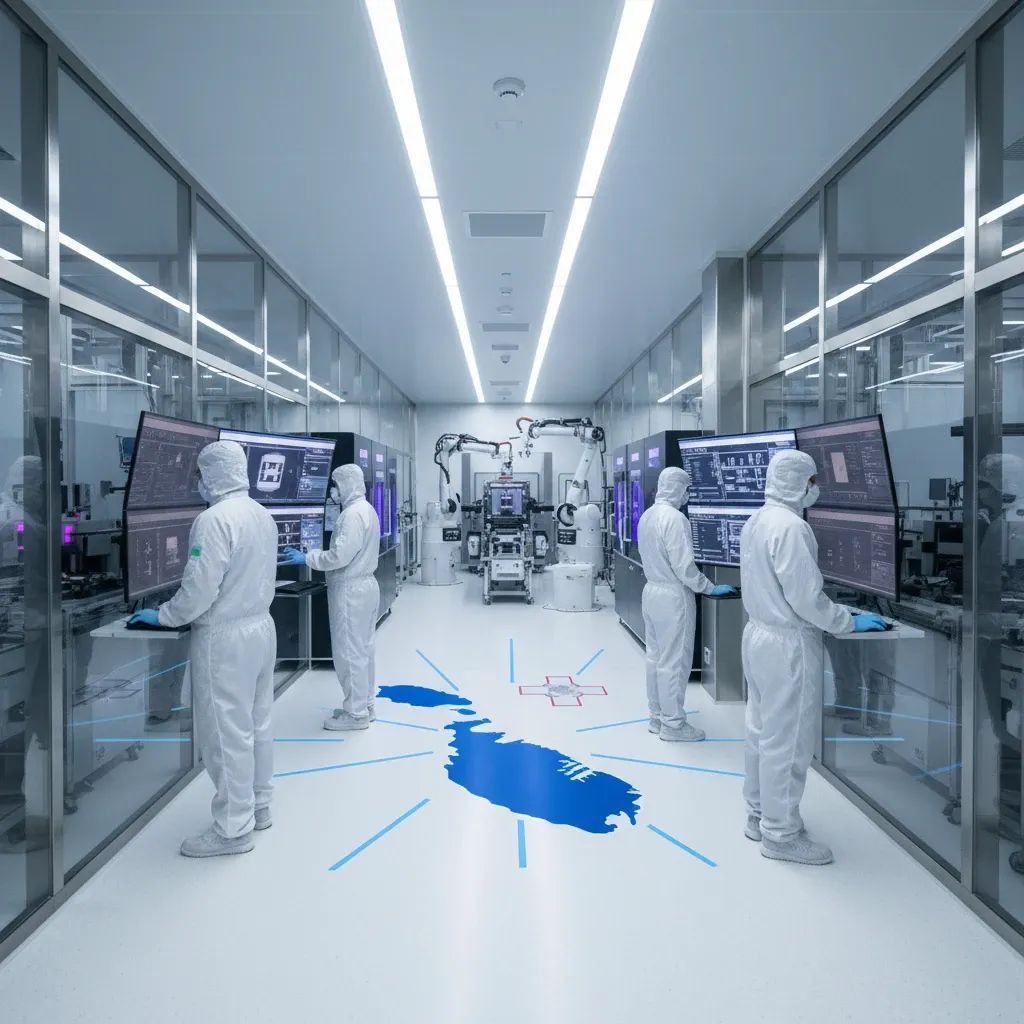
Malta's strategy for sustained prosperity rests no longer on sheer headcount. The Economy Ministry has moved decisively away from labor-driven expansion toward specialized, high-revenue sectors—a recalibration that signals both confidence in future stability and acknowledgment that the old growth model has reached its practical limits.
What You Need to Know
• STMicroelectronics €200M investment is expected to be inaugurated imminently, representing the largest single FDI project in Malta's history and signaling robust recovery in advanced manufacturing.
• Tourism and gaming sectors remain twin engines, with visitor spending hitting €3.9B in 2025 (up 18.6% annually) and the gaming industry representing 7% of national output.
• Housing affordability remains strained despite new subsidies; Vision 2050's implementation has been set for public consultation in mid-2025, with final policy rollout expected early 2026.
• Foreign workers now represent 40% of the workforce, with projections reaching 45.9% by 2035—a dependency the IMF warns is bumping against infrastructure ceilings.
The Three-Act Economic Narrative
When the Labour Party assumed office in 2013, Malta faced what might charitably be called stagnation. Unemployment was elevated, the budget bled red ink under an excessive deficit procedure, and the private sector had stalled. Economy Minister Silvio Schembri frames those early years as a survival pivot: the government prioritized job creation over job quality because families needed income before policy sophistication could matter.
That first phase ran roughly five years—raw stimulus, labor absorption, fiscal stabilization. Results came, but they came at a cost. Construction boomed, retail expanded, accommodation surged. Employment recovered. But the economy remained fundamentally vulnerable to external shocks and cyclical downturns.
The COVID-19 pandemic interrupted momentum and forced a defensive repositioning. Between 2020 and 2022, the state's task was not growth but preservation—keeping payroll intact, preventing business collapse, maintaining economic tissue for eventual restart. Unlike larger, resource-rich neighbors that stumbled more visibly, Malta emerged from those two years with employment still broadly stable and corporate balance sheets intact.
By late 2023, with foundations restored and labor markets tightening, policymakers signaled a third act: a systematic tilt toward sectors where value per employee trumps raw job volume. The semiconductor facility, aviation infrastructure investment, pharmaceutical hubs, and blockchain-related fintech ventures represent the practical expression of that shift.
Where Growth Is Actually Happening Now
Semiconductors have become the flagship. The Malta Semiconductor Competence Centre, launched in September 2025 with €8M in EU co-financing, anchors what amounts to a industrial-scale bet on the chip ecosystem. Partnering the University of Malta with Belgium's IMEC and other European research hubs, the initiative targets workforce training, startup acceleration, and technology transfer. Its crown jewel is STMicroelectronics' Smart Factory expansion—€200M injected into what is already Europe's largest backend chip operation. The facility represents not just additional capacity but a signal that global semiconductor leaders view Malta as strategically reliable.
The financial arithmetic works. Malta's electricity costs remain competitive versus continental peers, and wages undercut most eurozone benchmarks. The 2026 budget sweetened the offer further with a 175% tax deduction on research and innovation spending, effectively subsidizing companies that embed R&D locally. Manufacturing output rose 5.1% in January 2026 alone, the fastest quarterly pace in years, driven almost entirely by semiconductor-linked activity.
Aviation mirrors the story. Ryanair's commitment of a ninth aircraft translates to a $900M exposure on the island. Four new routes launching in summer 2026 will push passenger forecasts to 6M annually, a 20% bump—and passenger terminals don't fill themselves. Malta International Airport's €345M capital program (2025–2029) targets €90M in expenditure for 2026 alone. The 6,000 square-meter terminal expansion comes online within two years. Air traffic control infrastructure received a €500,000 refresh in March 2026. These are not prestige projects; they represent physical bottleneck-removal.
The broader constellation includes pharmaceutical manufacturing, medical devices, and digital services—gaming, fintech, AI-adjacent roles. Combined, these sectors are pulling the economy toward a different customer base: international B2B clients willing to pay premium rates, not price-sensitive tourism consumers.
Tourism and Gaming: Still Delivering
Tourism remains resilient but showing signs of maturation. Total visitor expenditure hit €3.9B in 2025, an 18.6% surge over 2024. Notably, off-peak arrivals climbed 19%, suggesting the sector is shifting from seasonal concentration toward year-round distribution—a positive from an infrastructure perspective.
Yet growth rates are moderating. The European Commission forecasts slower real GDP expansion for 2026 and 2027, partly attributable to capacity constraints in hospitality and tourism pricing power hitting realistic ceilings. 6M tourist arrivals is approaching saturation for an island of 535,000 residents; further expansion will require different types of tourism (high-spend, low-volume) rather than volume growth alone.
Gaming occupies a different perch. As a non-cyclical sector representing 7% of gross value added, it underpins Malta's economic baseline independent of tourism fluctuations. The industry was capital-intensive to develop—frameworks enacted in 2018–2019 are only now producing industrial scale—and it runs on regulatory efficiency rather than physical footfall. However, sector maturation is evident by 2026; further growth will depend on market share capture from competitors rather than category expansion.
The Labor Reality: More Foreigners, Lower Wages, Rising Friction
Here is where Schembri's optimism collides with demography. Nearly 40% of Malta's workforce is now foreign-born, predominantly from outside the EU. Projections suggest this figure reaches 45.9% by 2035. This is not a policy choice; it is a mathematical consequence. Malta has the lowest birth rate in the EU. The native working-age population is shrinking. Without immigration, unemployment would soar and the economy would contract.
Yet foreign workers bear the cost. In 2024, non-Maltese employees earned an average of €18,278 annually, compared to €22,260 for Maltese workers—a €4,000 gap. In construction and hospitality, the disparity widens further. The reason is mechanical: foreigners fill roles locals avoid, and those roles pay less because they are less valued, not because workers are less skilled.
More troubling are systemic vulnerabilities. The single work permit system ties legal residence to a specific employer, creating asymmetrical power dynamics. This means a foreign worker who leaves an abusive employer must typically leave Malta unless they can secure a new sponsor within a tight timeframe, creating leverage for exploitative practices. Workers cannot simply quit difficult situations; they risk deportation. Human rights organizations document cases of wage theft, unsafe conditions, verbal abuse, and systematic wage suppression. It is not slavery by legal definition, but the precarity is real.
The International Monetary Fund has sounded the alarm repeatedly: labor-driven expansion has hit infrastructure ceilings. Malta has one of the highest population densities in the EU, with traffic gridlock, hospital queues, classroom overcrowding, and housing scarcity no longer minor inconveniences—they are binding constraints on growth. Further economic expansion on a labor-volume model is mathematically impossible.
Schembri's answer is the sectoral pivot: higher-value jobs pull fewer people but pay better and occupy less physical space. A semiconductor engineer in a climate-controlled fab requires less infrastructure overhead than 500 construction workers. If the strategy works, it solves both the wage inequality problem and the infrastructure strain simultaneously. If it stalls, Malta faces a grinding productivity crisis and social fracture.
Housing, Urban Planning, and Vision 2050
The rapid growth of the past decade uglified Malta visibly. High-rise developments proliferated without coordinated planning. Green space disappeared. Infrastructure lagged. The government concedes this in broad strokes; Schembri has acknowledged planning could have been "managed more effectively"—diplomatic language for missed coordination.
Vision 2050 is the attempted corrective. Launched as a long-term strategy targeting the top 10 global Human Development Index positions by 2050, it reorients policy from expansion to quality. Urban regeneration, adaptive reuse of existing buildings, and spatial intelligence replace greenfield development as the default mode. A Programme Management Office was established in 2025 to operationalize the vision, with public consultation completed in mid-2025 and final policy implementation now underway.
Housing subsidies have been extended modestly. First-time buyers receive €1,000 annually for ten years and a permanent stamp duty exemption on the first €200,000 of property value. The Housing Authority's deposit assistance threshold rose from €225,000 to €250,000. A public-private partnership aims to deliver 260 affordable units at 30% below market rate, with gradual ownership transfer over 20 years. Malita Investments plans 752 apartments by 2026, emphasizing energy efficiency.
These measures will provide relief at the margins. They do not solve the fundamental problem: housing supply has not kept pace with demand (partly foreign, partly expatriate-driven, partly speculative). Prices remain elevated. Younger Maltese professionals face genuine squeeze in affording main residence purchases.
Inflation, Geopolitics, and the "War Chest" Logic
On cost-of-living pressures, Schembri has leaned on two mechanisms: energy and fuel subsidies and the Stabbilta scheme, which stabilized essential goods prices. He frames this as a "scientific approach" rather than populist reactivity, arguing that fiscal intervention must target the type of inflation (imported, supply-side, demand-induced) rather than scattering stimulus broadly.
The government's argument rests on its "war chest"—accumulated reserves built during the pandemic that now provide cushion for selective intervention. Fuel hedging is credited with maintaining price stability in the near term. The mechanism works if inflation is indeed temporary or import-driven; it fails if domestic wage-price spirals take hold.
Geopolitical risks loom moderately. Malta imports 70% of consumed goods, making supply chain disruption genuinely consequential. Middle East tensions have already prompted Malta Freeport to reroute logistics. Experience from the pandemic and the Russia-Ukraine conflict has equipped the administration to manage such shocks, though another global disruption would test resilience sharply.
The Political Wager
Schembri has essentially asked the electorate to trust a three-to-five-year transition window. Gaming industry maturation took years under multiple administrations before scaling. Semiconductor ecosystems require patient capital. Aviation hubs compound their advantages gradually.
The wager could pay off. 79% of surveyed investors find Malta an attractive FDI destination, citing digital readiness, firm size advantageous for specialization, and corporate tax competitiveness. If STMicroelectronics' investment succeeds, if aviation infrastructure keeps pace with demand, if fintech and medtech clusters solidify, then Malta's labor market gradually shifts toward higher-wage positions requiring skills, not just availability.
If the pivot stalls—if semiconductors remain a single-company play, if aviation capacity maxes out, if gaming regulation tightens globally—then the old model of labor-driven growth persists. Wage gaps widen, infrastructure creaks, and social tensions between residents and foreigners intensify.
For people living in Malta, the coming 18 months matter. Vision 2050 becomes either a genuine planning framework or another consultancy report gathering dust. The semiconductor facility either becomes a proof point or an anomaly. If you're a foreign professional, the shift toward semiconductors and aviation may open higher-wage opportunities in 2026-2027; if you're in construction or hospitality, wage stagnation may continue until supply-demand dynamics shift. Either way, the economy's next chapter is being written now.


