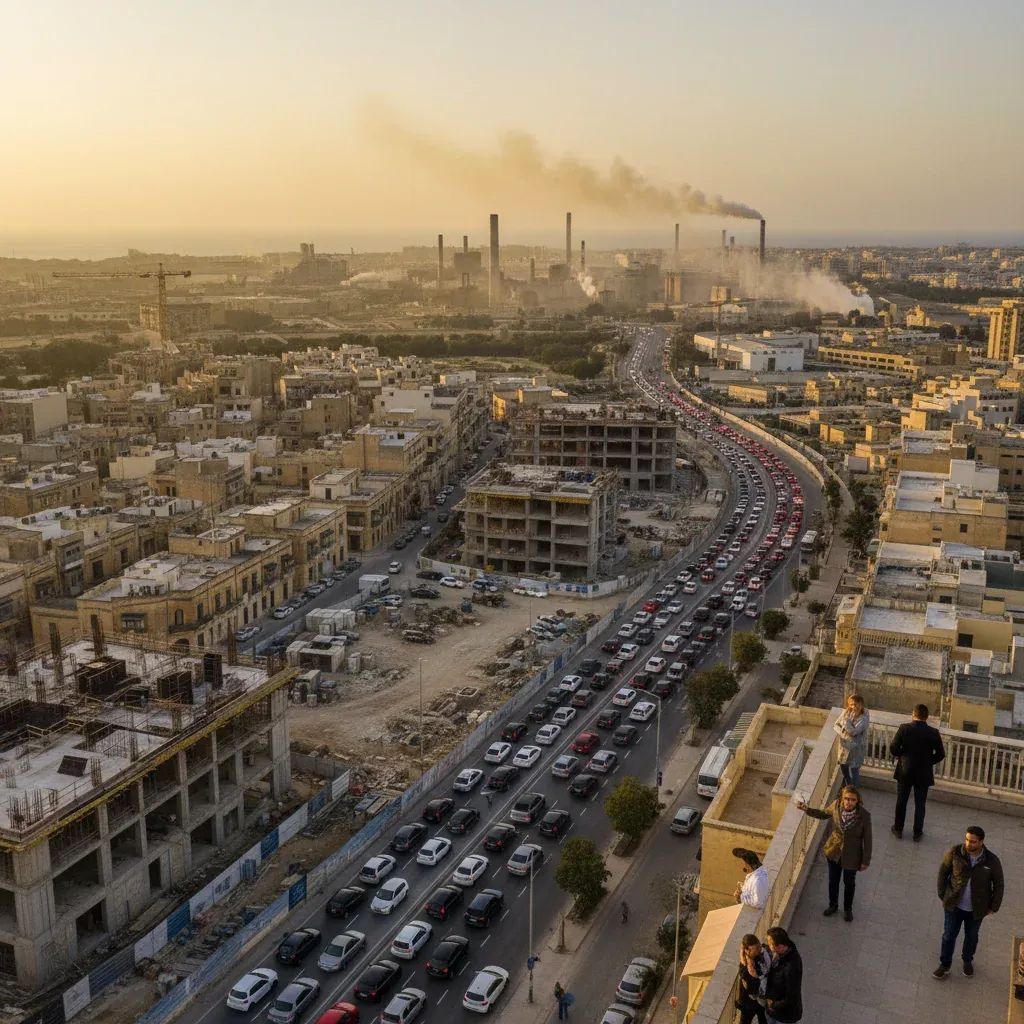
Malta's surging economy and swelling population have come with an unseen cost: a measurable erosion of both physical and mental health among residents, according to public health expert Stanley Farrugia Randon. His warning arrives as global research in 2026 underscores that environmental degradation now ranks among the most severe threats to public health worldwide—a shift from distant forecasting to present-day reality for densely populated jurisdictions like the Maltese islands.
Why This Matters:
• Air pollution alone caused 7.9 million deaths globally in 2023, making it the second-leading risk factor for premature death after hypertension.
• Mental health impacts are accelerating: children exposed to high pollution show a 27% rise in emotional regulation issues, while adults report increased anxiety, fatigue, and eco-grief.
• Climate-driven health emergencies—heatwaves, vector-borne diseases, and extreme weather—could claim nearly 15 million lives by 2050 without robust adaptation measures.
The Hidden Toll of Rapid Growth
Malta's breakneck development trajectory—marked by construction booms, vehicle congestion, and industrial expansion—mirrors patterns observed in countries now grappling with what the World Health Organization (WHO) classifies as an environmental public health emergency. Research published in January 2026 confirms that climate extremes and pollution are accelerating faster than health systems can adapt, particularly in geographies with limited physical space to absorb environmental stressors.
For Malta, this translates into acute vulnerability. The archipelago's compact size and high population density amplify exposure to airborne particulates, noise pollution, and heat islands—all factors proven to degrade quality of life. Approximately 36% of the global population breathes air exceeding the WHO's interim safety threshold for PM2.5 pollutants; in densely built environments, that figure often climbs higher, compounding risks for respiratory disease, cardiovascular events, and cognitive decline.
The consequences extend beyond emergency room visits. Long-term exposure to PM2.5 particulates carries a life-expectancy penalty comparable to smoking, according to 2023 data linking air pollution to 232 million healthy years of life lost worldwide. In Malta, where traffic congestion and construction dust are daily realities, residents face compounded risks from nitrogen dioxide, ozone, and ultrafine particles—pollutants that infiltrate bloodstreams, cross blood-brain barriers, and trigger systemic inflammation.
Mental Health: The Overlooked Front Line
While physical ailments grab headlines, the psychological burden of environmental degradation is emerging as a parallel crisis. Studies up to 2026 reveal that polluted air significantly worsens anxiety, depression, and cognitive function, with higher pollution days correlating to spikes in emergency psychiatric visits in major cities.
For younger Maltese residents, the phenomenon of "eco-anxiety" and "climate grief" is particularly pronounced. A longitudinal study from 2024 found that children and adolescents exposed to elevated pollution levels exhibited a 27% increase in emotional regulation problems—issues that cascade into academic performance, social relationships, and long-term mental health outcomes. Adults, too, report greater irritability, reduced focus, and a sense of environmental helplessness as green spaces disappear and urban sprawl encroaches.
The WHO now recognizes global environmental trends as a major threat to mental well-being, especially for vulnerable communities living near industrial zones or lacking access to nature. In Malta, where urban density leaves little room for restorative green corridors, the risk of "solastalgia"—distress caused by the degradation of one's home environment—looms large. This psychological toll compounds economic pressures, as residents grapple with rising living costs while witnessing the erosion of the quality of life that once defined the islands.
Vector-Borne Diseases and Climate Creep
Beyond pollution, climate change is reshaping disease geography in ways that directly threaten Malta. Rising temperatures, altered rainfall patterns, and more frequent flooding are expanding mosquito habitats, pushing arboviruses like dengue, chikungunya, and malaria into higher latitudes. Updated risk maps from 2025 show these diseases advancing into Southern Europe, the Middle East, and Mediterranean regions—precisely where Malta sits.
By 2050, the global population at risk of mosquito-borne illnesses could swell by half a billion, reaching 6.5 billion people. For Malta, with its growing expatriate population and robust tourism sector, this means heightened surveillance demands, increased healthcare costs, and the need for vector-control infrastructure that barely exists today. Heat-related mortality is also accelerating; among adults over 65, heat deaths have surged 167% compared to the 1990s, a trend that disproportionately affects older Maltese residents during summer peaks.
What This Means for Residents
The intersection of environmental stress and public health is not abstract—it demands immediate, localized action. For Malta, the implications are threefold:
Healthcare System Strain: Climate shocks and pollution-related illnesses are placing unprecedented pressure on health systems worldwide. In Malta, where hospital capacity is already stretched, rising rates of asthma, cardiovascular events, dementia (linked to air pollution), and mental health crises threaten to overwhelm existing resources.
Vulnerable Populations at Risk: Low-income communities, older adults, and those with pre-existing conditions bear the brunt. In Malta, residents near industrial zones or high-traffic corridors face disproportionate exposure, while limited green space and walkable infrastructure exacerbate social inequities.
Economic and Social Costs: The WHO estimates that climate change could cause 250,000 additional deaths annually by 2050 from malnutrition, malaria, diarrhea, and heat stress alone—not counting air pollution. For Malta, the economic toll includes lost productivity, surging healthcare expenditures, and the intangible cost of diminished quality of life.
Global Responses and Malta's Position
Governments and health authorities worldwide are racing to integrate environmental protection into public health policy. The WHO's Water, Sanitation, Hygiene, and Waste Strategy 2026–2035, launched this year, now includes climate-resilient systems and wastewater surveillance to detect health threats early. The European Union's Zero Pollution Action Plan, reviewed in January 2026, calls for swift action to meet 2030 targets, emphasizing that cutting air, water, soil, and noise pollution delivers immediate health benefits.
In March 2026, the European Chemicals Agency backed a sweeping restriction on PFAS "forever chemicals", signaling the EU's commitment to eliminating long-lasting toxins. Meanwhile, 59 countries have pledged to develop climate-resilient, low-carbon health systems under the COP26 Health Programme, a framework that continues into 2026.
Malta, as an EU member state, stands to benefit from these initiatives—but also faces pressure to accelerate implementation. The One Health approach, which integrates human, animal, and environmental health strategies, is gaining traction across Europe. Countries like Sweden and the UK have embedded net-zero targets into healthcare legislation, requiring hospitals to produce "Green Plans" for carbon reduction. France aims for eco-responsible care by 2030, while Saudi Arabia's Vision 2030 mandates environmental health policies in all healthcare facilities.
For Malta, adopting similar frameworks would mean mandating environmental assessments for new developments, investing in public transit and cycling infrastructure, expanding green spaces, and enforcing stricter air quality standards. The alternative—continuing on the current trajectory—risks transforming the islands from a Mediterranean jewel into a cautionary tale of unchecked growth.
The Science-Policy Gap
Despite the urgency, global attention remains fragmented. The 2026 Global Risks Report notes that geopolitical fragmentation and conflict are competing for short-term focus, even as environmental impacts intensify. The WHO marked World Health Day 2026 with a call to "Stand with science", urging governments to strengthen investment in science-based policy and collaborative action.
Yet policy lags behind research. In the United States, the Trump administration's EPA finalized a rollback of authority to regulate greenhouse gas emissions in 2026, while proposing to weaken safeguards against chemical emergencies—a move criticized as contradictory given escalating climate-related health harms. Conversely, the U.S. launched a $144 million program to measure and remove microplastics from the human body, reflecting growing alarm over novel contaminants.
For Malta, the lesson is clear: waiting for global consensus invites local disaster. The islands' small size and dense population make them a laboratory for integrated environmental health policy—if authorities act decisively.
What Comes Next
Stanley Farrugia Randon's assessment demands a reckoning. Malta's residents are already living the consequences of environmental neglect: poorer air quality, vanishing green spaces, rising mental health burdens, and a healthcare system under strain. The question is whether policymakers will recognize the emergency before it becomes irreversible.
International frameworks offer a roadmap: intersectoral collaboration, evidence-based regulation, climate-resilient infrastructure, and a commitment to Health in All Policies. The EU's Zero Pollution targets, WHO's climate strategies, and the One Health model all provide proven templates. But implementation requires political will, public pressure, and a willingness to prioritize long-term well-being over short-term economic gains.
For Malta, the path forward must include comprehensive air quality monitoring, stricter emissions controls, expanded public transit, protected green corridors, and mental health services equipped to address eco-anxiety and climate grief. It also requires transparency: residents deserve access to real-time environmental data, as seen in Colorado's "EnviroScreen" tool, which identifies communities most affected by pollution and guides resource allocation.
The evidence is in. The crisis is here. Whether Malta rises to meet it will determine not just the health of current residents, but the viability of life on the islands for generations to come.