
Why This Matters
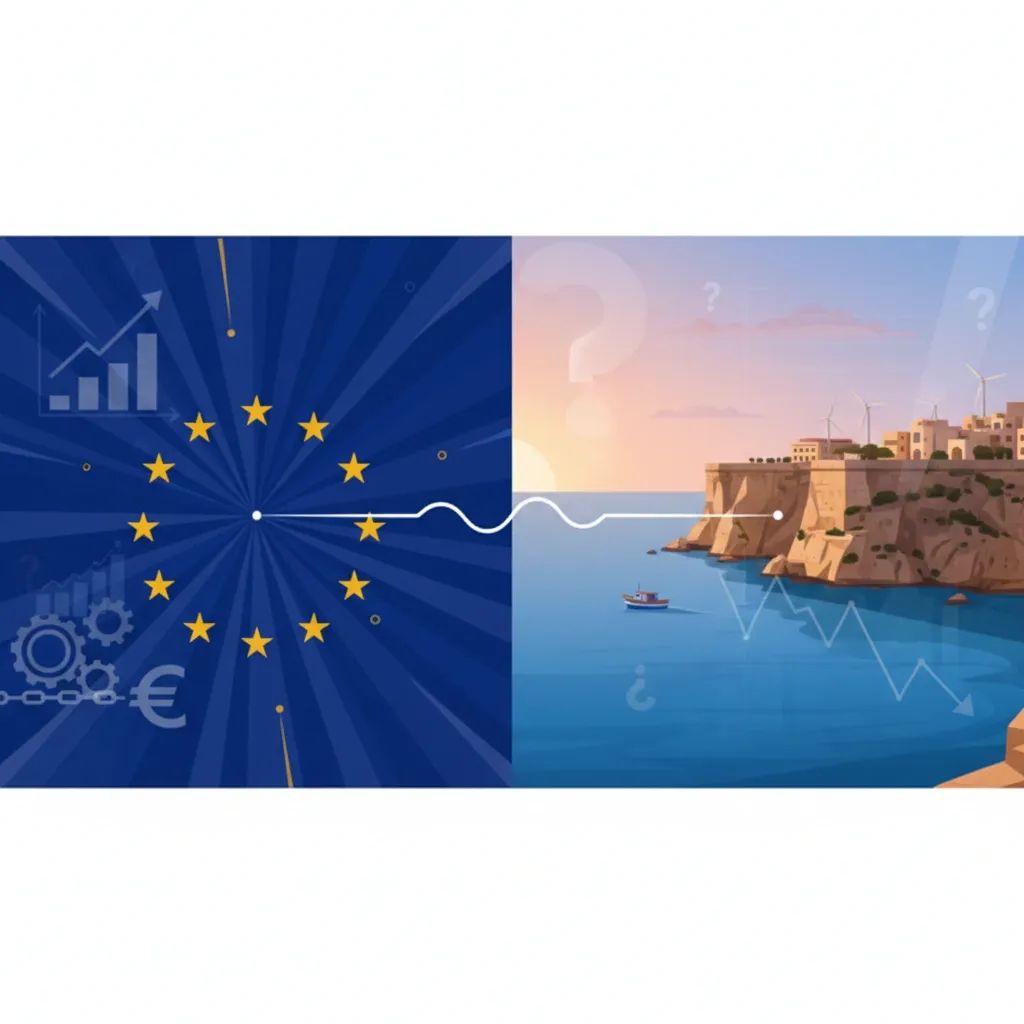
Maltese citizens are sending Brussels a clear message of confidence at a time when European unity is being tested across the continent. But that enthusiasm masks a troubling disconnect: the same people who champion EU integration have lost faith in the institutions meant to hold their own government accountable.
• EU membership remains exceptionally popular: 91% of respondents believe Malta has benefited, consistently ranking among the top three member states for EU support over the past five years.
• Economic gains are real and measurable: 88% credit the EU with a positive economic impact—the highest score in the 27-member bloc (compared to a 43% EU average), driven by market access, structural funding, and labor mobility.
• Media credibility has eroded significantly: Only 33% trust local media, compared to a 43% EU average, placing Malta among the lowest performers in the union. Written press trust lags further, positioning Malta's print media among the least trusted in the EU.
• Citizens want action, not platitudes: Maltese respondents prioritize EU involvement in migration management, energy infrastructure, and security—practical concerns, not abstract principles.
The EU's Strongest Votary in Europe
Malta has become the European Union's most reliable constituent, according to the latest Standard Eurobarometer Survey published on 8 May. The data tells a story less about ideology than about survival strategy: a small island economy has bet its future on integration, and the gamble has paid off.
When 60% of Maltese residents trust the EU, they are expressing more than political preference. They are reflecting lived experience. Access to a single market of 450 million consumers has transformed Malta's economy. Structural funds have financed infrastructure. The freedom of movement has allowed Maltese professionals and entrepreneurs to operate across an entire continent. For a nation that occupies less than 250 square kilometers, this is not marginal benefit—it is existential leverage.
The 88% approval rating for the EU's economic effect on Malta is the highest recorded across all member states. That figure deserves scrutiny because it represents something distinctive: concrete prosperity, not abstract enthusiasm. Citizens routinely cite access to skilled labor pools, supply chain reliability, and investment inflows as tangible advantages. When a Maltese resident boards a flight to Paris or Berlin for work, or when a Valetta startup reaches customers across 26 other countries without regulatory friction, the abstract becomes personal.
The stability dividend matters equally. For a Mediterranean island nation historically vulnerable to external pressure, EU membership offers security architecture that no independent state could replicate. The union's framework for managing irregular migration, ensuring food and medicine availability, and coordinating response to crises like energy disruptions represents insurance that Maltese citizens value viscerally. In surveys, residents explicitly name these as priorities—not trade or regulation or political theater, but tangible protection against disruption.
Optimism about the union's future is running 68% in Malta, eight percentage points above the continental average. This divergence reflects an economy riding a wave while others struggle. Yet it also reflects something else: Malta's policymakers and public understand that their prosperity is coupled to Brussels. That interdependence breeds loyalty in ways that mere benefit-sharing cannot replicate. Euroscepticism flourishes where voters feel left behind; it withers where the alternative—isolation—looks worse than any Brussels regulation.
The Credibility Crisis That Nobody Discusses Publicly
While Maltese citizens embrace the European project with near-consensus, they regard their own media ecosystem with significant skepticism. At 33% trust, Malta's media occupies territory typically inhabited by deeply dysfunctional states—yet the archipelago simultaneously hosts a functional economy and functional public administration.
The paradox is not accidental. It reflects specific pathologies that have calcified over a decade.
The Malta public broadcaster operates under conditions that would trigger independence reviews elsewhere. Political pressure shapes coverage. Governments use advertising budgets—unregulated, opaque, and substantial—as a tool to influence editorial tone. A media outlet dependent on state advertising has a perverse incentive to remain complacent. No legislation governs the allocation of these funds, meaning operators control the money flow with minimal oversight. The result is a system where state favor becomes an invisible subsidy, and the lack of transparency becomes a feature, not a bug.
Ownership opacity compounds the problem. The Maltese media landscape lacks any credible disclosure requirement for company ownership structures. Readers cannot readily identify who owns a publication, who owns that owner's parent company, or what financial entanglements exist. This vacuum breeds legitimate suspicion. When a property tycoon owns a newspaper, or when a political figure's family trust controls a media group, the absence of public documentation means these relationships become subjects of rumor rather than fact. Public distrust is rational when transparency is absent.
Independent journalists have been subjected to sustained campaigns of political vilification. Politicians publicly describe critical outlets as "forces of darkness" and "fake news blogs." These statements do two things simultaneously: they delegitimize specific reporters and they erode public confidence in investigative journalism generally. A politician attacked for corruption has immediate incentive to label the journalists reporting on that corruption as liars. The public, observing this warfare, reasonably concludes that someone is lying—and in the absence of institutional credibility, defaults to skepticism toward everyone.
The legal framework offers limited protection. Anti-SLAPP legislation—which prohibits abusive lawsuits designed to silence journalists—has been transposed into Maltese law, but critics argue it represents the bare minimum. Strategic litigation remains a tool for intimidation. A journalist with limited financial resources faces immense pressure when sued by wealthy interests, even if the lawsuit is meritless. The chilling effect is measurable: reporters self-censor not out of direct censorship, but out of rational fear of financial ruin.
Perhaps most striking: 56% of Maltese respondents report encountering disinformation regularly—the highest figure in the European Union. This statistic reflects either a genuinely severe disinformation problem or a population so convinced of media unreliability that they interpret normal disagreement as falsehood. Either way, it indicates that citizens cannot reliably distinguish between accurate and inaccurate information. The system has failed them.
What This Means for Daily Life in Malta
The trust gap creates practical consequences that ripple through daily decisions.
Maltese residents increasingly bypass local media and consume news directly from EU-level sources, international outlets, and social platforms. This behavior is rational given the credibility differential, but it produces a pathological outcome: local accountability declines. When a Maltese politician or business leader commits wrongdoing, and local journalists cannot be trusted to report it credibly, the story often fails to reach the public or reaches it distorted. The politician faces scrutiny from European media instead—which may not care about Maltese detail—or no scrutiny at all.
For businesses and investors operating in Malta, this distrust complicates reputation management. An international company announcing a major investment in Malta cannot rely on local media to communicate its intentions accurately to the public. Official statements may be ignored or misinterpreted. Reputation must be built through direct communication, international media engagement, and circumventing traditional news channels. This is inefficient and creates friction in the relationship between business and civil society.
Where residents can find reliable information:
For local news with international perspective, Reuters and Associated Press maintain correspondents covering Malta. Euractiv provides EU-focused reporting with Maltese context. Times of Malta and Malta Today, despite broader credibility concerns, maintain newsroom sections where investigative work receives scrutiny from peers and international observers. International outlets including BBC and Politico Europe occasionally cover Maltese governance. Residents seeking to verify claims can cross-reference local sources against these international outlets—a time-intensive practice, but one that builds a more complete picture. Fact-checking initiatives including Newsguard assess media credibility transparently.
The paradox also exposes a civic blind spot. Citizens demand transparency, accountability, and independent oversight at the European level. They champion the European Parliament, they support stronger EU security architecture, and they advocate for more rigorous EU oversight of member states. Yet they tolerate or fail to demand equivalent accountability mechanisms domestically. Reform proposals circulate, procedural adjustments are announced, and substantive change remains elusive. The status quo persists because neither voters nor policymakers have made media independence a priority equal to EU integration.
For vulnerable populations—including migrants and persons with limited Maltese proficiency—the credibility void is especially damaging. Disinformation spreads more readily when no trusted source exists to counter it. Public health campaigns, legal notices, and critical information depend on a media ecosystem that people trust. When that system fails, the marginalized suffer disproportionately.
How Malta Drifts Farther from European Norms
Over the past five years, Malta's trajectory has diverged sharply along two axes.
EU support has remained consistently exceptional. In March 2023, 92% believed Malta had benefited from membership. By September 2025, that figure reached 93%. December 2025 recorded a peak of 96%. The latest reading of 91% represents normalization from that height but still places Malta at the top tier of European member states. This stability is striking. While other nations oscillate, driven by economic cycles or populist sentiment, Malta's pro-EU consensus has held firm. The reason is structural: a small, open island has no credible alternative to integration.
Media trust has moved in the opposite direction—downward, and stuck. In December 2023, trust stood at 26%. By May 2026, it reached 33%. The increase is real but glacial. More troublingly, trust in written press lags the overall figure significantly, positioning Malta's print media among the least trusted in the EU. The persistence of low trust despite minimal improvement suggests that marginal reforms are insufficient. Citizens have concluded that the system itself is compromised.
The Liberties Media Freedom Report published in April 2026 reinforced this assessment, confirming written press credibility remains exceptionally low by European standards.
Why Maltese Voters Want Brussels to Act
The Eurobarometer findings reveal that Maltese citizens do not view EU membership as a completed project. They regard it as unfinished and requiring enhancement.
An absolute majority believe the EU should strengthen its role in security and defense, managing international crises, and protecting economies from external shocks. These priorities reflect island-specific vulnerabilities: exposure to Mediterranean geopolitics, dependence on imported energy, and vulnerability to tourism disruptions. Residents are not voting for European federalism as an abstract ideal. They are voting for practical protection they cannot secure alone.
Citizens also prioritize clean energy development, jobs creation, and continued immigration management. These issues directly affect household budgets, career prospects, and social cohesion. The EU is valued not as a symbol but as a problem-solving apparatus. When Brussels delivers results on energy transition or labor market integration, confidence rises. When it appears paralyzed or ineffective, support can erode.
The 56% satisfaction rate with Malta's own public administration, among the highest in the EU, suggests that citizens do not reject institutions entirely. They distinguish between a well-functioning national bureaucracy (which delivers services competently) and a compromised media system (which fails to hold that bureaucracy accountable). The combination is unstable. Eventually, unaccountable power corrodes even competent administration.
The Structural Problem Malta Cannot Avoid
The high EU confidence paired with low media trust creates a civic equilibrium that appears stable but is actually brittle.
On the positive side, Malta's integration into Europe provides economic stability, regulatory predictability, and security frameworks that keep the society functioning. Foreign investment continues. Tourism remains robust. Professional mobility attracts talented residents. The material benefits of membership are substantial and visible.
On the negative side, the absence of a credible domestic media ecosystem means that this prosperity occurs with minimal public scrutiny. Corruption, inefficiency, and poor governance can fester because the institutions designed to expose them have lost legitimacy. Disinformation spreads unchecked because no trusted authority exists to debunk it. Citizens increasingly turn to international media or avoid news consumption altogether, withdrawing further from civic participation.
For Malta to resolve this tension, reform must be structural, not procedural. Public broadcaster independence requires legal shields against political interference and transparent governance. State advertising regulation requires legislation defining the process and capping the sums available to any single outlet. Media ownership transparency requires companies to disclose structures in accessible formats. Journalist protection requires enforcement mechanisms with teeth, not aspirational language.
The Eurobarometer data suggests that most Maltese citizens would support these reforms. They want to believe their media. They want accountability at home while maintaining confidence abroad. But reform requires political will, and political will has been absent. Procedural adjustments are announced; substantive change is deferred.
Until that dynamic shifts, Malta will remain a nation divided between confidence in EU institutions and skepticism toward domestic media.


