
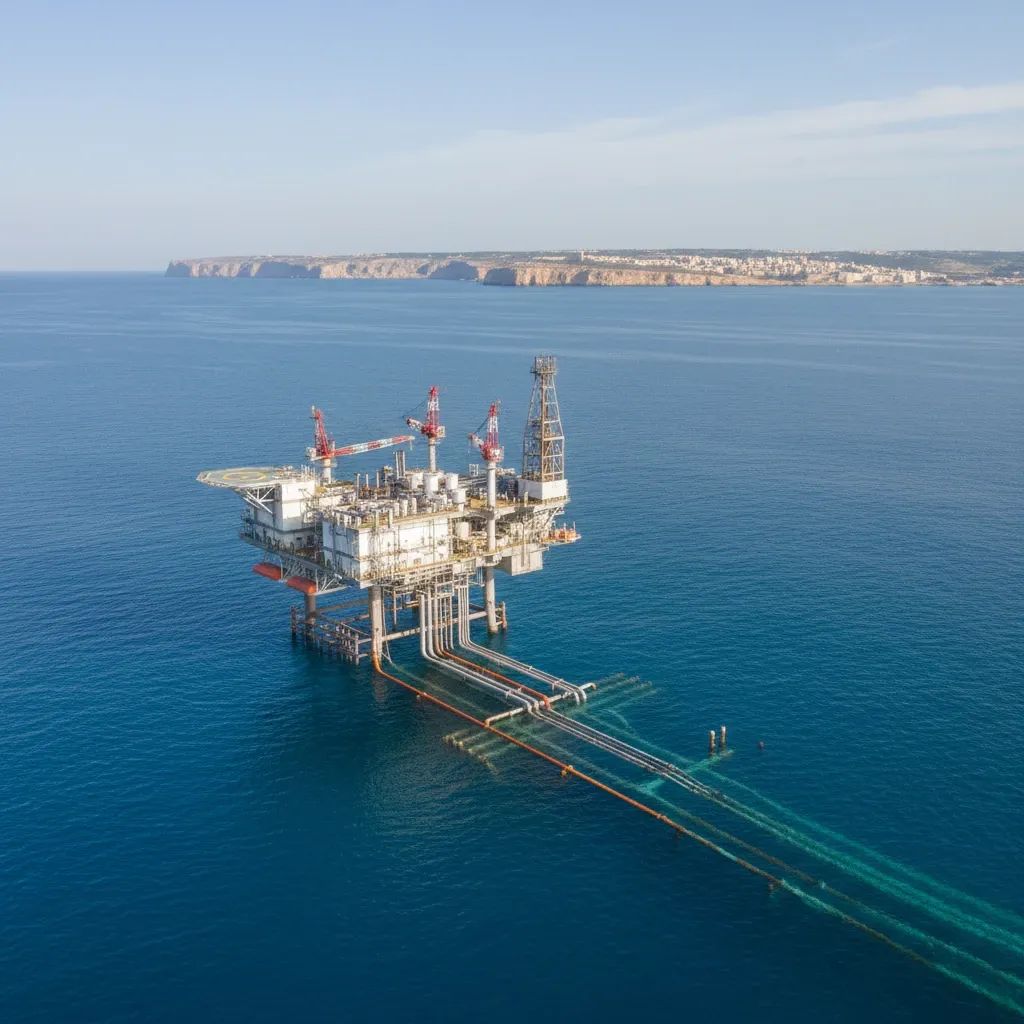
The Nationalist Party in Malta has put a maritime fuel hub at the center of pre-election discourse, offering a sharp contrast to campaign promises centered on quick cash transfers. As voters prepare for the May 30 general election, the proposed Mediterranean Maritime Fuel Hub at Hurd's Bank has become a litmus test for whether Malta's political class can engage with industrial-scale economic policy rather than retail handouts.
Why This Matters
• €450M revenue claim within 3 years—or €105M, depending on which party's figures you believe.
• Hurd's Bank, an underwater plateau located approximately 30 nautical miles east of Malta, sits in Malta's Exclusive Economic Zone (the maritime area where Malta has resource rights). Currently a free anchorage zone linked to fuel smuggling, it would be regulated and developed with offshore bunkering infrastructure.
• Environmental groups warn of risks to marine ecosystems, water security, and tourism—Malta's economic backbone.
• The Marsaxlokk Bay LNG tanker, moored in the bay for several years, would be relocated offshore as part of the plan.
What the PN Is Proposing
The Nationalist Party's blueprint calls for constructing a fixed offshore fuel hub on Hurd's Bank, an underwater plateau in Malta's Exclusive Economic Zone (the maritime area beyond territorial waters where Malta controls resource rights). The facility would serve vessels crossing the Mediterranean, offering bunkering services—the supply of fuel to ships at sea—via a subsea pipeline to Delimara power station. The PN says the project would be "future-proofed" to handle emerging fuel types, including hydrogen, and financed through a blend of EU funds and public-private partnerships.
According to PN leader Bernard Grech, the proposal emerged from more than a year of consultation with maritime professionals, technocrats, and the Malta Maritime Forum. The party projects the hub would generate roughly €450M in its first 3 years and create around 150 jobs. A flagship element is the removal of the LNG tanker currently moored in Marsaxlokk Bay, which residents have complained about for years due to safety concerns and its visual impact on the bay.
The PN argues the initiative would carve out a new economic niche for Malta, leverage its strategic Mediterranean position, and bring regulatory control to an area that has functioned as a de facto "no man's land" tied to illicit fuel transfers and vessels evading international sanctions.
Labour's Counterattack and the Smuggler Allegation
Prime Minister Robert Abela, representing the Labour Party, has mounted a fierce offensive against the proposal. He alleged the concept originated from an individual he characterized as involved in fuel smuggling, claiming this person previously sought a 100-year concession for a similar project, which Abela says he personally rejected.
The Prime Minister also contested the PN's revenue projections, asserting that a presentation he reviewed indicated the hub would generate €105M over 3 years—substantially less than the PN's estimate. The difference in figures may reflect different assumptions: the PN's €450M could represent gross revenue projections, while the €105M may represent net profit or a more conservative operating scenario. Abela's line of attack frames the proposal as potentially tainted by association with smuggling interests.
Bernard Grech has vigorously denied any contact with fuel smugglers, and challenged Abela to substantiate his claims with evidence. Grech characterised the Labour attacks as a sign of "panic" over the PN's substantive policy proposals. Oliver Cini, a PN candidate and maritime engineer, also rejected the smuggler allegation outright.
What This Means for Residents
For Maltese voters weighing the proposal, the debate boils down to economic opportunity versus environmental and security risk. If the PN's revenue figures hold, the hub could inject significant capital into the economy and provide high-value technical jobs—a rare commodity in Malta's service-heavy labour market. The relocation of the Marsaxlokk LNG tanker would address a longstanding local complaint and free up visual and operational space in the bay.
However, the risks are material. Offshore fuel operations carry inherent dangers: fire, explosion, and leaks that could devastate Malta's coastal marine ecosystems. For an island nation that depends on reverse osmosis plants—desalination facilities that convert seawater to fresh water—contamination from a fuel spill poses a direct threat to drinking water security. Environmental organisation Momentum has called for the proposal's withdrawal, warning of thermal and ecological damage and potential harm to the tourism sector, which relies on clean waters and an unspoiled coastline.
The political rhetoric has also raised governance questions. If the project's origins involve illicit fuel interests—as Abela alleges—voters must consider whether the proposal can be insulated from regulatory capture or corruption. Conversely, if Abela's claims are baseless, the episode underscores how ad hominem attacks can obscure substantive policy debate.
The Wider Context: Europe's Maritime Decarbonisation Push
Malta's fuel hub debate unfolds against a backdrop of urgent decarbonisation pressure across European shipping. Maritime transport accounts for 3-4% of the EU's total CO2 emissions, with projections suggesting a 130% increase by 2050 if current trends persist. The International Maritime Organization has set a net-zero target by or around 2050, forcing ports and fuel suppliers to rethink infrastructure.
The European bunker fuel market is expected to reach $65.4B by 2034, driven by stringent environmental regulations and a shift toward cleaner fuels like LNG, hydrogen, ammonia, and methanol. However, the transition is expensive: experts estimate an additional $8B to $28B annually is needed for vessel decarbonisation, with fuel infrastructure investments requiring €28B to €90B per year to scale up carbon-neutral production and distribution.
Ports are evolving into energy hubs, providing infrastructure for low- and zero-emission fuels. Green shipping corridors—dedicated routes where vessels use clean fuels—are proliferating across Europe, creating concentrated demand that makes large-scale infrastructure projects more viable. Malta's geographic position could allow it to capture a slice of this market, but only if the hub is designed to accommodate future fuel types and not lock the country into LNG dependency.
Risks Beyond the Environment
Environmental concerns dominate headlines, but the economic calculus is equally complex. Even without a catastrophic spill, the perception of industrial activity in offshore waters could damage Malta's brand as a pristine Mediterranean destination. Tourism is the island's economic backbone; any erosion of its coastal image translates directly into lost revenue and jobs—potentially far exceeding the 150 positions the fuel hub would create.
There are also safety and labour concerns. Offshore fuel operations, especially in rough weather, present hazardous working conditions. The quality and sustainability of jobs created matter as much as the headcount. If the hub relies on low-wage migrant labour or precarious contracts, the social dividend diminishes.
Furthermore, the fuel hub would sit in an area currently associated with smuggling and sanctions evasion. Bringing regulatory oversight to Hurd's Bank is a stated goal, but success depends on enforcement capacity and political will. If oversight is weak, the hub could inadvertently legitimise existing illicit networks rather than displace them.
The Case for Serious Debate
What sets this proposal apart from typical campaign fare is its scale and complexity. Unlike one-off tax rebates or utility subsidies, a maritime fuel hub involves long-term capital commitments, environmental risk modelling, international regulatory alignment, and infrastructure planning. It also intersects with Malta's broader energy security, given the subsea pipeline link to Delimara power station.
The revenue gap between the PN's €450M estimate and Labour's €105M figure is glaring. Voters deserve transparency: independent financial modelling, environmental impact assessments, and clarity on funding sources and risk allocation between public and private partners. The PN's claim that the project is "future-proofed" for hydrogen and other fuels must be substantiated with technical detail, not just aspirational language.
Civil society's role is also critical. Momentum's intervention reflects broader public concern that large-scale infrastructure decisions should not be made in electoral haste. Meaningful consultation with coastal communities, marine scientists, and tourism stakeholders is essential to ensure the project—if it proceeds—aligns with Malta's environmental and economic priorities.
Judging on Merit, Not Mudslinging
In an election cycle dominated by short-term giveaways, the Mediterranean Maritime Fuel Hub proposal demands a different kind of scrutiny. Whether the concept is visionary or reckless depends on details the public has yet to see in full. The smuggler allegations, while politically explosive, are ultimately a sideshow unless substantiated with evidence. What matters more is whether the project can deliver sustainable economic value without compromising Malta's water security, marine environment, or tourism appeal.
For voters, the choice is not simply between the Nationalist Party and Labour, but between two visions of economic development: one that bets on industrial infrastructure in a decarbonising global economy, and one that prioritises caution in the face of environmental and reputational risk. Both positions have merit. The question is whether Malta's political system can deliver the transparent, evidence-based debate the decision requires—or whether the hub will become another campaign promise lost to partisan noise.


