
Why This Matters
• Boosted grid diversity: Malta's third power cable will connect to a 380-kilovolt transmission circuit in Sicily—a different connection point than the two existing cables—eliminating the risk of losing all imports if a single line fails.
• Capacity expansion: The new link provides 200 megawatts initially, scaling to 400 MW without fresh submarine trenching, bringing Malta's total Sicilian import potential to 850 MW by 2030.
• EU money unlocked: Inclusion in the 2026 European Network of Transmission System Operators Ten-Year Plan puts the project on track for Project of Common Interest status, opening doors to billions in Brussels co-financing.
• North Africa option: Feasibility work is advancing on a direct submarine link to Tunisia or Morocco, designed to import 0.8 terawatt-hours of solar and wind annually—enough to cover one-quarter of Malta's current electricity consumption.
Malta's electricity grid, long dependent on a single lifeline to Sicily, is about to gain breathing room. Prime Minister Robert Abela and Energy Minister Miriam Dalli announced on April 30 that the Malta Government intends to construct a third interconnector to the Italian island, reinforcing an energy strategy that prioritizes redundancy and renewable flexibility over the precarious reliance on imported gas.
This announcement came during Malta's election campaign period. With the Prime Minister citing global energy uncertainty as the reason for calling snap elections, residents should consider both the technical merits and political context when evaluating the proposal's likelihood of execution. While unveiled at a government event rather than a party rally, the timing is significant for assessing the credibility and timeline of infrastructure commitments made during campaign season.
The unveiling signals a structural shift: rather than manage scarcity through pricing and fuel hedging alone, Malta is now building infrastructure to absorb renewable flows from across the Mediterranean and distribute risk across multiple grid connection points.
The Three-Cable Strategy
Today's electricity infrastructure looks like this. The first interconnector, installed in 2015, carries 225 megawatts across the strait between Malta and Sicily on a 220-kilovolt line. It remains the lifeline: without it, the island would fall back entirely on domestically generated power, drawn from aging gas turbines and shrinking rooftop solar capacity.
The second interconnector, now under construction, mirrors the first's voltage class but trebles the total capacity. Also 225 MW, it is due to enter service in the first quarter of 2027. The European Investment Bank has loaned €100 million toward its €296.68 million total cost, with the European Union contributing €165.78 million in regional development grants. Italy's authorities blessed the project in December 2024, and cable-laying began in Sicily in September 2025.
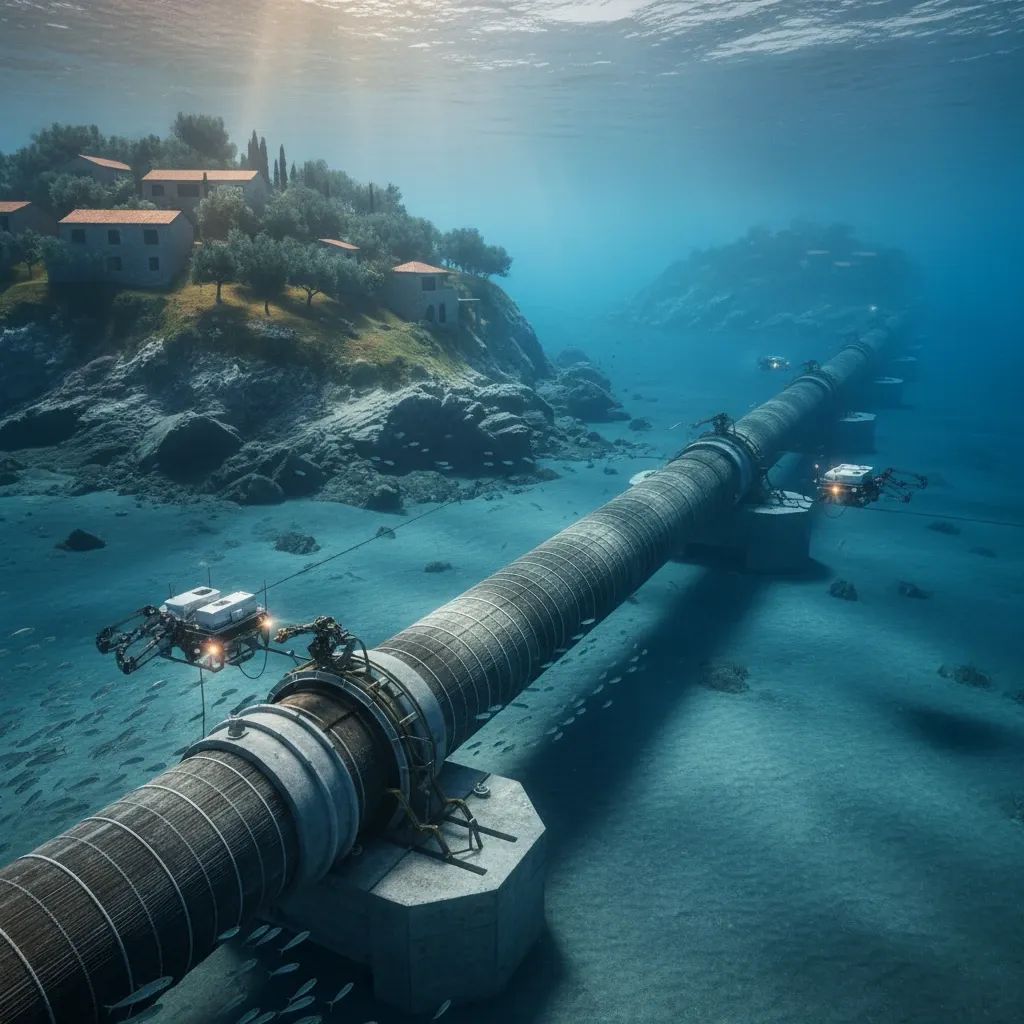
The third link represents a technological departure. According to Dalli, the cables will connect to a 380-kilovolt transmission circuit in Sicily—distinct from the grid nodes serving the first two interconnectors—with an initial capacity of 200 megawatts, expandable to 400 MW without laying entirely new submarine infrastructure. This voltage specification clarifies the technical design: 380kV refers to the voltage class of the Sicilian grid connection point, while the transmission capacity is 200 MW initially. This diversification mirrors practices in Greece, Italy, and Spain, where multiple connection points absorb shocks that would cripple a single-point system.
Engineering tenders are expected within weeks. Marine surveys in both Maltese and Italian waters will map seabed geology and environmental constraints. Interconnect Malta, the state entity managing the project portfolio, is coordinating with Italian grid operators to finalize landing sites and converter station locations. No construction timeline has been released, but inclusion in the European Network of Transmission System Operators' Ten-Year Development Plan—announced in early 2026—positions the project for formal Project of Common Interest designation by 2028, unlocking EU co-financing mechanisms.
What This Means for Residents
For the average Maltese household, this infrastructure matters in three concrete ways: bill stability, supply reliability, and future pricing optionality.
Hedging agreements have been Malta's financial weapon against volatile global energy markets. According to Dalli, these contracts have saved the state approximately €116 million over recent years by locking in gas prices before spot market spikes. Yet those agreements expire this summer. The Malta Energy Ministry is negotiating short-term bridge deals to cover the gap, but such temporary measures leave the island exposed if international gas prices surge again during autumn heating season or Gulf geopolitical crises.
The interconnector expansion addresses this vulnerability differently: instead of betting on fuel prices, Malta gains the ability to import electricity from multiple European wholesale markets. During periods when Spanish wind generation floods the grid, or French nuclear plants export surplus capacity, Malta can buy cheaply and store energy in batteries for later use. When Sicilian hydro dams are full, their excess flows eastward. By diversifying both the source of power (multiple European countries, not just Sicily's gas plants) and the physical entry point (three cables instead of one), Malta reduces exposure to any single market's volatility and helps stabilize energy costs.
Energy Minister Dalli has pledged that the distribution network—the poles and wires delivering power to homes and businesses—will remain under government ownership and control. This means the state retains pricing authority and service continuity guarantees, preventing the price shocks that can occur when private operators prioritize shareholder returns over affordability. Opposition parties had previously proposed liberalizing the distribution sector; Dalli's announcement rules that out, at least for the current government's tenure.
For businesses and foreign residents, predictable energy costs translate to lower operating expenses and stable real estate valuations. Data centers, financial services firms, and gaming operators—sectors that dominate Malta's private economy—rely on uninterrupted, reasonably priced electricity. Grid resilience reduces the risk of service disruptions that would damage their international competitiveness.
The Renewable Acceleration
Alongside the third interconnector, the government is executing a parallel strategy to increase domestic renewable generation. By 2030, renewables are targeted to represent 25% of Malta's electricity mix, up from the current 17%. This sounds modest compared to northern Europe, but reflects the island's geographic constraints: Malta has limited wind resources and dense urban settlement, leaving rooftop solar as the primary renewable frontier.
Two recent initiatives address the rooftop scarcity problem. First, the government is pursuing an offshore wind farm, still in early feasibility studies. Unlike onshore wind, which faces fierce opposition in Malta's compact landscape, offshore installations would tap consistent Mediterranean breezes without displacing residents or occupying land. Second, the state has launched a community solar program allowing renters and people without south-facing roofs to invest in panels installed on government buildings—warehouses, schools, municipal parking structures—effectively creating a distributed generation marketplace.
Storage systems are the third pillar. Large-scale battery installations, expected to come online in phases through 2030, will capture excess renewable output during midday hours when solar generation peaks. That stored energy can be released during evening demand surges, smoothing the grid and reducing the need to fire up gas turbines. Malta's current proposal includes multiple sites: land-based battery parks and potentially containerized systems at port facilities.
A €45 million submarine cable linking Malta and Gozo, announced by Abela during campaign events, will replace the ageing ferry-dependent connection with a modern conduit capable of exporting Gozo's abundant solar potential back to the main island. Though modest in capacity, it exemplifies the mindset shift: rather than see the sister island as a burden on grid stability, the government now views it as a generation asset.
The North Africa Question
Beyond Sicily, Malta's strategic vision extends to Africa. In late March 2026, Interconnect Malta launched a Preliminary Market Consultation inviting developers to propose and cost a direct submarine interconnector to North Africa—likely Tunisia or Morocco—designed to import approximately 0.8 terawatt-hours annually.
The original submission deadline was May 5, but on April 24, the deadline was extended by ten weeks due to "significant international interest." This suggests that major European utilities, renewable energy developers, and financial institutions view the proposal seriously, not as political theater.
The structure under consideration is a 25-year Contract for Difference, a financial mechanism where developers agree to supply renewable electricity at a fixed price, regardless of whether market prices rise or fall. For Malta, this locks in predictable costs. For developers, it provides investment certainty. Such arrangements are common in Denmark, Germany, and the United Kingdom for onshore wind and solar; applying the model to a cross-Mediterranean cable would be unprecedented for a small island.
If the consultation yields viable proposals, Malta could move to formal procurement in late 2026 or early 2027. However, subsea cables crossing international waters require bilateral treaties with Tunisia or Morocco, environmental impact assessments, and harmonization of grid codes between three different power system operators—a process typically spanning five to seven years from concept to first electron flowing.
Still, the geopolitical timing is favorable. Morocco already operates two 700-megawatt interconnectors to Spain and is constructing a third link to Portugal. Egypt is building cables to Saudi Arabia and exploring connections to Greece and Cyprus. The entire Mediterranean is recognizing that interconnectors are not luxuries but strategic infrastructure, as vital as ports or airports.
Comparisons and Context
Greece's Ariadne interconnector to Crete, commissioned in 2017, transformed the island from a diesel-dependent outpost into a renewable-ready node. It slashed CO2 emissions and eliminated blackout risk. Italy's ELMED project to Tunisia is designed to carry North African solar power northward, unlocking the Sahara's vast renewable capacity. Spain's Biscay Bay power line to France is meant to end its historical status as an "energy island," allowing it to monetize world-class solar and wind resources.
Malta's approach is smaller in scale but strategically identical: redundancy equals resilience. By diversifying the voltage classes and geographic landing points of its Sicilian cables, and by actively exploring a North African link, Malta hedges against technical failure, political risk, and market concentration.
One structural vulnerability remains: the island's total annual electricity demand is approximately 3.2 terawatt-hours. A single 400-megawatt interconnector theoretically supplies one-third of consumption during off-peak hours. This means Malta is vastly more dependent on cable reliability than larger continental grids, where a single line failure is absorbed by surrounding capacity. Hence the redundancy strategy—three cables instead of one, and a vision of four if the North Africa project materializes.
Timeline and Execution Risk
The second interconnector is the immediate priority, with Q1 2027 commissioning marking a critical inflection point. Once operational, Malta's import capacity from Sicily rises to 450 megawatts, sufficient to cover peak demand on most days and eliminate gas generation during off-peak hours, a major emissions reduction.
The third cable enters design phase this summer. Construction is unlikely before 2029, assuming permitting progresses smoothly in Italy and no subsea environmental surveys trigger delays. Commissioning by 2031 is an optimistic scenario; 2032 is more realistic given the typical pace of cross-border infrastructure projects.
North Africa feasibility studies are proceeding on a parallel track. If the Preliminary Market Consultation yields commercially viable proposals by late 2026, Malta could move to formal procurement by early 2027. But subsea cables crossing international waters involve multilateral grid code harmonization, environmental permitting in two countries, and potentially third-country financing if EU funds are unavailable—a process that routinely spans half a decade.
The Near-Term Test
Between now and summer 2027, two critical events will determine Malta's energy trajectory. First, the expiring hedging contracts must be replaced with new short-term agreements—a delicate negotiation given global gas market volatility triggered by Gulf conflict. Energy Ministry officials have framed this as a bridge to the structural hedge provided by expanded interconnector capacity.
Second, Italy must grant final permits for the third interconnector's marine survey phase. Political relations between Malta and Italy remain stable, and energy infrastructure projects enjoy broad support across Italian political spectrum. But any diplomatic friction or environmental litigation could delay site surveys by months, cascading into design delays and later commissioning.
For residents, the message is continuity: no imminent blackouts, no tariff shocks, and a government roadmap that prioritizes infrastructure over improvisation. The longer-term test is execution: can Malta's state entities and Italian grid operators coordinate smoothly enough to deliver three functioning cables by 2032? Can the North Africa consultation convert political ambition into bankable projects? Answers to these questions will determine whether Malta transforms from a grid endpoint into a genuine Mediterranean energy crossroads—or remains a consumer of everyone else's surplus.


