
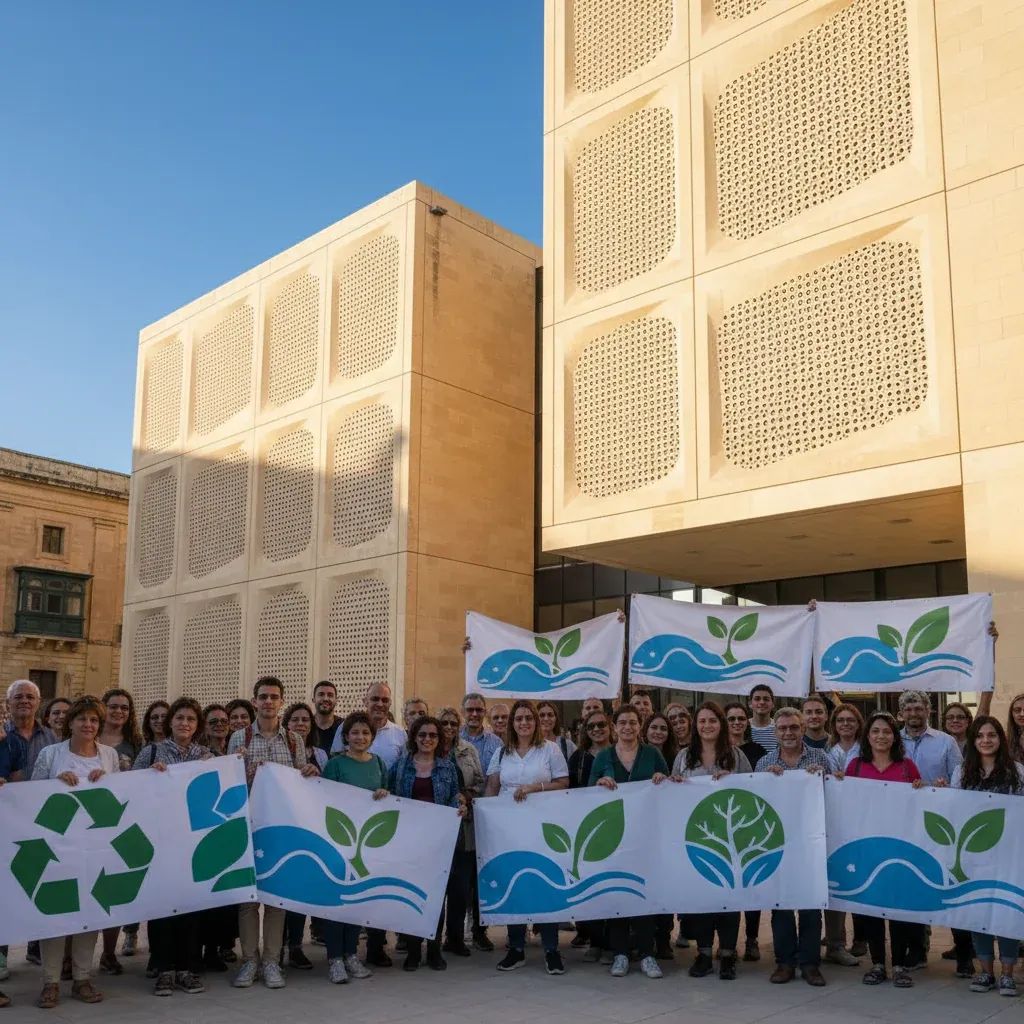
Momentum unveiled its roster of seven professional outsiders this morning, betting that Malta voters tired of the Labour-Nationalist duopoly will back candidates explicitly positioned outside traditional party networks. The announcement comes as Prime Minister Robert Abela prepares to detail his government's renewable energy strategy later today—two competing visions for Malta's future taking shape as the compressed May 30 campaign enters its third day.
Why This Matters
The timing is deliberate. Momentum's candidate roll-call signals a deliberate departure from the political family networks that traditionally dominate Maltese representation, while Abela frames energy independence as national economic resilience. These represent competing priorities for voters: governance reform versus infrastructure investment.
• Seven professionals challenging entrenched networks: If Momentum converts protest sentiment into actual votes, Malta's governance model could shift from party loyalty to merit-based representation—a structural change voters have signaled appetite for, but rarely acted on.
• Energy costs frame household economics: Abela's renewable plan (detailed today) will signal whether current €1 billion subsidies continue or transition accelerates—directly affecting every household's monthly bills.
• Third parties face structural barriers: Momentum's electoral pact with environmental party ADPD attempts mathematical workaround to Malta's modified proportional system, but voters must decide if supporting a third option is strategic or symbolic.
A Fresh Political Roster Taking Shape
Momentum's candidate roll-call this morning spans community organizing, software development, mathematics, academia, and banking—each candidate explicitly framed not as rising party loyalists but as professionals answering a civic call.
Billy McBee, community organizer with decades of Valletta grassroots activism, contests Districts 1 and 6, territory Labour has held since the party's modern founding. Matthew Agius, academic, positions himself in Districts 2 and 8 in mixed urban-suburban constituencies. Mark Camilleri Gambin, software engineer and party secretary general, contests Districts 3 and 11 as a symbolic anchor among digitally-literate younger voters. Alastair Farrugia, mathematician, takes Districts 4 and 5. Pierre Schembri-Wismayer, university professor, runs Districts 7 and 10 near academic institutions. Arnold Cassola, party chair and longtime environmental activist, contests Districts 9 and 10. Carmel Asciak, retired banker and party treasurer, competes in Districts 12 and 13, traditionally Nationalist strongholds.
Cassola's launch rhetoric framed the election as a choice architecture problem. "One-third of the electorate feels politically orphaned," he stated, arguing that Labour and Nationalist governance cycles have become interchangeable exercises in consolidating patronage networks. Momentum's counter-narrative: a roster of merit-based professionals untethered to party dynasties, offering governance redefined around technical competence rather than inherited tribal affiliation.
The campaign slogan—"Bidla ta' Vera" ("Real Change")—deliberately echoes populist sentiment while remaining calibrated for business professionals and middle-class voters simultaneously skeptical of radical disruption. This reflects Momentum's centrist positioning.
Critically, Momentum has locked an electoral pact with ADPD, the environmental party. Rather than competing for the same pool of dissatisfied voters, both parties are encouraging supporters to split preference votes across both rosters, maximizing district-level penetration. Recent polling shows Momentum at 5.3% and ADPD at 3.1%, suggesting combined 8%+ support—still far behind Labour's 43.1% lead, but theoretically sufficient for guaranteed parliamentary presence if voting discipline holds.
Policy Substance: Where Momentum Translates Frustration
Frustration alone wins no seats. The party has articulated measurable proposals addressing specific cost-of-living pressures residents encounter daily.
A minimum wage increase to €360 weekly targets in-work poverty, particularly acute in hospitality and retail. A 15% flat tax rate for university graduates during their first five years of employment attempts to reverse Malta's professional brain drain. A secondary property vacancy tax addresses speculation dynamics in a housing market where foreign investment has priced residents out of urban cores.
On governance transparency, the party commits to automatic publication of all magisterial inquiries once completed, replacing discretionary frameworks where sensitive reports can languish indefinitely. An "Open Malta Act" would impose daily penalties for delayed government information disclosure, structurally shifting burden from citizens proving they deserve access to government proving why secrecy is justified. Key public appointments would require two-thirds parliamentary majorities—a safeguard against executive stacking of civil service leadership.
Environmental commitments include a two-year moratorium on new high-rise construction and strict enforcement of existing Sunday construction bans. A 2% public art allocation requirement for major development projects attempts cultural reframing toward community-centered aesthetics.
A structural question shadows these proposals: can policy substance overcome the coordination problem inherent to third-party voting in small electoral systems? A March 2025 MaltaToday survey found 30.7% of respondents believe Momentum representation would benefit Parliament, yet only 5% reported voting intention—a gap characteristic of third-party dynamics where abstract approval rarely converts to actual ballot commitment.
What This Means for Your Vote
For Malta residents deciding how to vote, understanding third-party mechanics is essential. If Momentum or ADPD individually polls at 5-8%, what actually happens? Under Malta's modified proportional representation system, either party could theoretically fail to secure even a single parliament seat if that support distributes inefficiently across districts. This is why Momentum's pact with ADPD matters: coordinated preference voting attempts to concentrate support geographically, maximizing both parties' chances of clearing the poorly-defined national threshold.
The tactical voting question: Does voting third-party dilute your preferred major option's majority-building power, or does it add a stabilizing voice to parliament? If you want Labour or Nationalist to remain strongest, voting third-party mathematically reduces their overall percentage—though not necessarily their seat count. If you want genuine coalition leverage or believe parliament needs voices outside the Labour-Nationalist cycle, then third-party support becomes a negotiating asset rather than wasted vote.
In practice: When filling your ballot, if you're drawn to Momentum's merit-based positioning, the electoral pact with ADPD means you could allocate preferences across both rosters to maximize both parties' penetration. Local campaign teams will provide guidance on optimal preference ordering. The May 30 result will clarify whether this coordination strategy successfully translated 8-10% combined polling into actual parliamentary presence or dispersed into symbolic protest vote.
Energy as Campaign Context
Prime Minister Abela's renewable energy announcement today provides backdrop for understanding the election's economic stakes. Energy policy has become the campaign's most concrete battleground because it directly affects household budgets and business competitiveness.
The Malta government has committed to indefinite energy subsidies, functionally decoupling domestic energy costs from global market volatility. Since 2022, this commitment has required over €1 billion in fiscal transfer—essentially using national revenue to absorb liquefied natural gas price shocks that crippled European households in 2022–2024. Abela's renewable announcements today will signal whether subsidies continue as permanent protective measure or transition accelerates toward self-sufficiency—a critical distinction with implications for long-term tax burdens.
Infrastructure elements include a €15.3 million package allocating €11.2 million for battery storage systems and €4.1 million for residential and industrial photovoltaic installations, targeting 61 megawatts of generation capacity. The logistical challenge is acute: dense urban apartment living makes individual roof access impossible for many residents. A second subsea cable with Italy (€100 million European Investment Bank backing) scheduled operational in 2027 functionally triples Malta's electricity import capacity.
For residents, this means energy policy will likely determine government composition proportionally to ideology. Stability voters will reward Labour's subsidy model; reform voters will question its long-term viability; and those dissatisfied with both will test Momentum's governance reform positioning.
Electoral Arithmetic and Campaign Timeline
Parliament dissolved April 27, officially inaugurating the one-month campaign period. Most recent polling (mid-April) shows Labour maintaining 43.1% lead, Nationalist Party at 37.8%, Momentum at 5.3%, and ADPD at 3.1%—a tightening compared to February surveys suggesting campaign dynamics are compressing margins rather than fundamentally restructuring voter preferences.
Labour campaigns under "Int Malta" ("You Are Malta"), emphasizing continuity and distributed benefits. The Nationalist counter-message, "Nifs Ġdid" ("A Breath of Fresh Air"), attempts rebranding opposition as reform-capable rather than merely oppositional.
With less than one month remaining and polling showing tightening, every policy rollout carries measurable weight. The real electoral contest may not be between Labour and Nationalist—collectively holding 80%+ support—but whether Momentum successfully converts sympathy approval into sufficient tactical voting to claim genuine parliamentary presence and negotiating leverage, or remains a symbolic protest vote.


