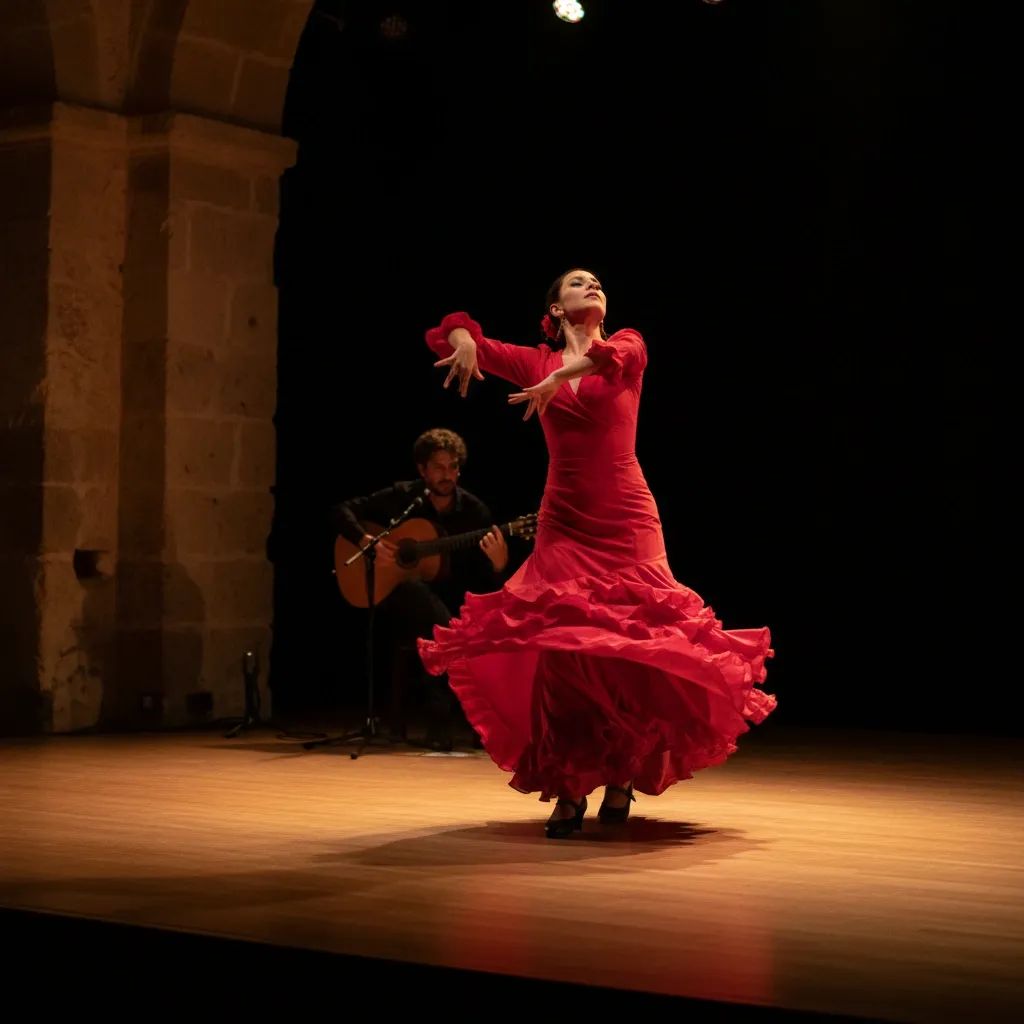
When a Spanish flamenco artist brings traditional work to Malta's cultural venues, it reflects the island's growing engagement with serious international programming. Marta de Troya performed Rojo Carmesí at the Valletta Campus Theatre in March 2026, her residency demonstrating how Malta's cultural infrastructure can deliver European-caliber artistic work through institutional partnerships.
Why This Matters
• Traditional artistry at professional caliber: A Jerez-based dancer trained at prestigious institutions brought a full solo production to an intimate venue—traditional flamenco executed without fusion or compromise.
• Direct training access: The Deborah McNamara School of Dance hosted collaborative performances where local graduate dancers worked alongside de Troya, functioning simultaneously as performance and mentorship opportunity.
• Institutional backing validates partnership: The Andalusian Regional Government's Professional Training Programme presented this production, meaning European institutional validation extended to local programming and training standards.
De Troya's base remains Puro Arte Flamenco Tablao in Jerez de la Frontera, where she directs professional ensembles and performs regularly. Her professional training included study at the Patricia Ibáñez school, María del Mar Moreno school, Jerez Dance Center, and the Maribel Gallardo Professional Conservatory in Cádiz—credentials establishing her within Spain's formal flamenco training network. Her residency in Malta reflected her commitment to bringing traditional flamenco to international audiences through serious artistic partnerships.
The Production: Precision Over Spectacle
Rojo Carmesí stripped performance down to its essentials. A single dancer. Acoustic guitar. Footwork amplified only by wooden flooring and architectural acoustics. No amplification. No lighting design beyond basic stage illumination. The black-box configuration at Campus Theatre—housed within a 16th-century structure on Merchants Street and adapted by the University of Malta—provided exactly the reverberant environment flamenco demands.
This aesthetic approach represented a distinct artistic position within Malta's flamenco landscape. Alegria Flamenco Malta, the island's most established academy, has developed hybrid forms. Puerto Flamenco at Teatru Salesjan features zapateo merged with electronic soundscapes and contemporary choreography. These experiments engage audiences, yet de Troya's production offered a different approach: traditional technique executed without compromise, allowing the art form's disciplinary rigor to sustain attention across a full evening.
The production traced flamenco's regional vocabulary—alegrías, soleá, bulerías—each explored as a vehicle for expressing resilience and autonomy. Thematically, the work centered on female empowerment through technical mastery and presence rather than narrative. The body became the argument: a woman dancing alone, supported only by rhythm and skill, asserting presence through discipline.
The title functioned deliberately. Crimson red connects to Spanish folk tradition around passion and intensity. The blood-red skirts dominating the choreography became a language of their own—movement vocabulary made textile.
For Maltese dancers trained primarily in ballet or contemporary forms, exposure to this rigorous approach offered technical education. Flamenco emerged here not as decorative element but as demanding discipline requiring footwork precision, phrasing alignment with cante (vocal melody), and sophisticated relationship between body and rhythm.
Local Collaboration: Mentorship and Performance
De Troya's visit extended beyond solo performance. She guest-performed in Inspiración, a production by the Deborah McNamara School of Dance that blended Irish contemporary technique with Andalusian flamenco vocabularies. The collaboration brought graduate dancers from McNamara's program—several with prior study in Seville—to share the stage with de Troya, combining performance with mentorship.
This residency model reflects increasingly common practice across European arts networks. Touring artists now typically provide masterclasses and rehearsal observation to local talent, maximizing artistic engagement while building knowledge networks. The Andalusian Regional Government's institutional endorsement of this partnership carried weight within flamenco training circles, essentially validating that the McNamara school's curriculum meets standards recognizable within Spain's formal flamenco structure. For a Malta-based institution, such external validation strengthens credibility and distinguishes serious training from recreational instruction.
Malta's Evolving Dance Landscape
The island's flamenco ecology has developed considerably. Flamenco now appears alongside ballet, hip-hop, and experimental contemporary work within multidisciplinary programming frameworks. This reflects Europe-wide trends integrating flamenco into national programming rather than treating it as specialized content.
Malta's advantages for touring artists extend beyond cultural appetite. The island's compactness, concentrated cultural infrastructure, and bilingual population make it logistically attractive. Tourism creates audiences valuing both authenticity and accessibility. De Troya's residency satisfied both constituencies: serious enough for dance professionals seeking genuine technical engagement, accessible enough for observers new to the art form.
Puerto Flamenco at Teatru Salesjan continues building audiences for fusion work. Alegria Flamenco Malta's past production CARMEN – Flamenco meets Contemporary reflects institutional openness toward hybrid forms. De Troya's traditional approach thus occupied distinct programming space—not mainstream preference, but intellectually substantive and aesthetically serious.
Practical Access and Programming
The Valletta Campus Theatre operates within specific constraints. Capacity reaches approximately 80–100 patrons. Booking requires advance planning. Location on Merchants Street sits roughly 7 minutes from the Valletta bus terminus but offers limited parking in the historic quarter.
Pricing ranged €15–€25, positioning de Troya's performances below commercial theatre rates. This pricing reflected Andalusian government subsidization of touring costs through the official training programme. Such arrangements enable audiences to access world-class programming at accessible prices when cultural agencies prioritize artistry over commercial optimization.
Performances attracted substantial audience interest from both professional dancers and general audiences seeking serious international programming.
What This Means for Residents
For people living in Malta interested in dance, de Troya's residency demonstrated that the island's cultural infrastructure can deliver European-caliber programming through institutional partnerships. The University of Malta's programming at Campus Theatre reflected commitment to acoustic integrity and artistic substance.
For aspiring dancers in Malta, collaboration with professional artists offers legitimate access to international training networks. The McNamara school's participation in the Andalusian Regional Government's formal training programme carries external institutional validation extending beyond local reputation.
For general audiences, the programming affirmed that flamenco on the island encompasses multiple approaches. Both fusion experiments and uncompromised traditional forms executed at professional level deserve platform within Malta's cultural calendar.
Looking Ahead
Whether de Troya's residency catalyzes sustained appetite for traditional flamenco—or remains a significant artistic event—depends on institutional programming choices, audience engagement with future Orthodox flamenco productions, and enrollment trends in advanced flamenco programmes.
For now, the March performance anchors a studied example: how Malta's cultural infrastructure leverages institutional partnerships to deliver world-class programming through venues optimized for acoustic integrity. That approach, when executed thoughtfully, creates programming serving both serious practitioners and curious audiences simultaneously.