
Why This Matters
Asset freezes now trigger automatically at arraignment in Malta's drug trafficking cases, blocking bank accounts and property nationwide. This financial tool allows authorities to dismantle trafficking operations faster than conviction timelines would permit.
The 75 sachets seized in this operation point to a potential larger network. Police are investigating whether the arrests connect to broader trafficking infrastructure rather than isolated street dealing.
St Paul's Bay ranked second nationally in dealing arrests during 2024, with 15 cases recorded. This pattern suggests the resort town has become a significant trafficking corridor as police intensified operations in traditional nightlife districts.
Sentencing for trafficking convictions can reach life imprisonment, though rehabilitation pathways exist for lower-threshold quantities under Acts VII and XII of 2025.
Two foreign nationals now face an extended custody arrangement following a coordinated law enforcement response in the northern coastal district. On February 24, the Malta Police Force executed simultaneous warrants across geographically separated locations—part of a broader pattern showing how authorities have refined their approach from random patrols to intelligence-driven targeting of supply networks.
The scale and coordination of this operation, combined with the immediate asset freeze, signals the enforcement machinery's evolving sophistication. Residents watching police activity intensify in their neighborhoods should understand what is happening: authorities are targeting financial networks that sustain trafficking infrastructure, not simply removing individual dealers from streets.
The Operation: What the Seizure Pattern Reveals
Ousman Manneh, 27, from Gambia, was arrested in the Ta' Fra Ben waterfront zone after officers observed him conducting what appeared to be successive quick transactions with passersby—behavior consistent with street distribution. When approached, he possessed suspected cannabis. Separately, investigators discovered a plastic bag wedged beneath nearby vegetation containing pre-packaged sachets of the same substance. Police distinguish trafficking quantities from user supplies by examining storage methods and packaging patterns.
Simultaneously, another unit executed a residential warrant at Triq ix-Xolfa, arresting Lamin Keita, 34, from Mali. Property searches recovered additional sachets arranged in patterns consistent with distribution preparation. The operation netted approximately 75 sachets total—a figure well above thresholds suggesting personal or casual social supply.
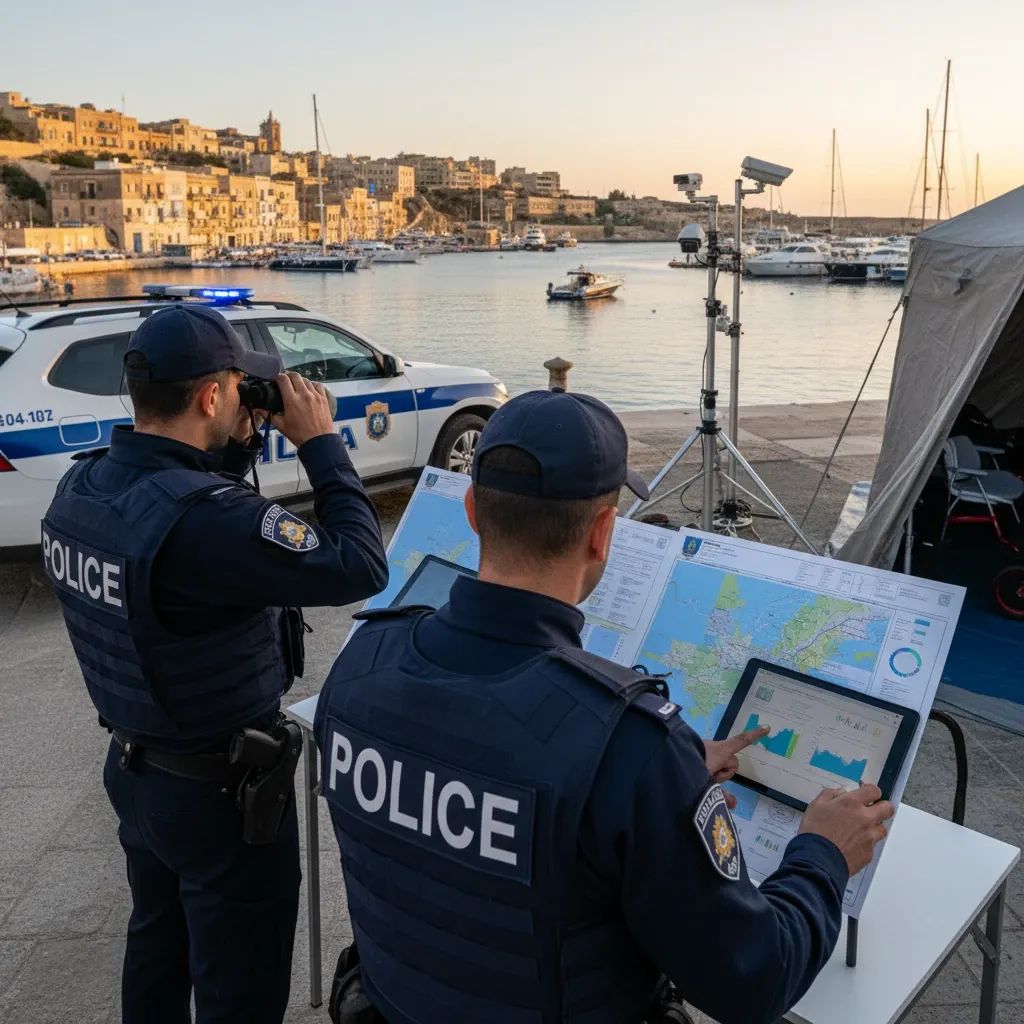
Police had conducted multiple days of surveillance and intelligence work before committing personnel to the operations. This represents a deliberate strategic shift away from visibility-focused patrol tactics that characterized earlier anti-drug campaigns. The new model relies on intelligence gathering before enforcement action.
Both individuals pleaded not guilty before Magistrate Marsanne Farrugia. The court issued an immediate asset freeze order—a procedural mechanism that locks all identifiable property, bank balances, and vehicles the accused hold across Malta or through Maltese financial institutions. This freezing persists from arraignment through final judgment, regardless of acquittal or conviction outcome.
The Custody Framework and Legal Representation
Inspector Gabria Gatt prosecuted on behalf of law enforcement, joined by Julian Scicluna representing the Attorney General's office. The accused received representation from Sarah Ciliberti and Axel Camilleri, both working under Malta's legal aid mandate. This detail carries practical weight for residents: Malta's criminal legal aid system operates without means testing or employment verification. Anyone facing criminal charges receives full court representation from first appearance through final judgment, covering all registry fees, lawyer costs, and associated court expenses.
A formal inquiry has been appointed under the supervision of Magistrate Monica Borg Galea, permitting deeper investigative work into whether the arrested individuals operated as part of a wider trafficking network or connected to larger supply chains.
The two accused remain in preventive custody pending subsequent court hearings. The inquiry process will generate investigative findings that prosecutors may deploy to establish network connections, identify co-conspirators, or reveal supply-chain patterns linking these arrests to broader trafficking operations across the island.
St Paul's Bay as a Secondary Trafficking Corridor
The northern coastal district has undergone a transformation in the past five years. What was traditionally a summer holiday destination has evolved into a significant trafficking corridor—a consequence of its high concentration of short-term rental units, transient expatriate populations, and nocturnal hospitality venues operating year-round.
St Paul's Bay ranked second nationally for street-level dealing arrests during 2024, recording 15 arrests. By comparison, Paceville and St Julian's—the island's traditional nightlife epicenter—recorded 24 arrests in 2024. These numbers demonstrate an important pattern: as police intensified operations in leisure districts, trafficking activity has shifted to secondary coastal towns perceived as lower-enforcement areas.
For residents scattered across St Paul's Bay's hillside neighborhoods and seafront apartment blocks, the implications are immediate. Police presence in the district is likely to remain concentrated in areas where surveillance has flagged ongoing activity. This targeted intelligence approach differs from previous random patrol strategies.
The Broader Drug Market and Emerging Threats
Across Malta and Gozo, police executed 180 significant drug seizures in 2025, confiscating 1,000+ kilograms of illicit substances valued at approximately €87 million at street-level retail prices. Cannabis represented 314.46 kilograms of dried plant material, 4.33 kilograms of concentrated resin, and 249 live plants. Cocaine seizures reached 668 kilograms—roughly equivalent to the weight of 13 small cars.
Current enforcement challenges reflect potency increases rather than volume changes alone. Cocaine available on Maltese streets now averages 20-30% purity, a measurable increase from earlier years. Ecstasy pills sold through online channels and retail outlets have become noticeably stronger. Beyond the traditional trio of cocaine, cannabis, and heroin, the Malta Police Force has flagged emerging substances as rising concerns: 2CB (Pink cocaine), Molly (MDMA powder), and Ketamine/Tusy. A synthetic compound labeled CC9 drew particular attention after clusters of acute hospital admissions in April 2025 were linked to its consumption.
The distribution landscape has fundamentally shifted. Online platforms now serve as primary marketplaces rather than supplementary channels. Cannabis-infused edibles marketed as legally compliant products often carry THC concentrations well above safe consumption limits, sold through e-commerce platforms and brick-and-mortar shops without consistent labeling or potency disclosure. This regulatory gap creates a market where consumers face potential overdose through misrepresentation—a public health challenge layered atop the criminal enforcement response.
Sentencing Reality and Drug Court Eligibility
Malta's legal architecture distinguishes sharply between possession-for-personal-use and trafficking. For trafficking convictions, the maximum penalty remains life imprisonment, though courts retain full sentencing discretion based on seized quantity, the defendant's role within any network, prior criminal history, and behavioral evidence.
The Attorney General functions as a critical decision-maker: this office determines whether a case proceeds to the Court of Magistrates (sentencing range: six months to ten years) or the Criminal Court (four years to life).
Recent legislative reform under Acts VII and XII of 2025 raised Drug Court eligibility thresholds. Individuals arrested with up to 500 grams of cannabis, 500 ecstasy pills, or 200 grams of heroin or cocaine may now qualify for treatment-focused court proceedings—a pathway leading to rehabilitation prioritization rather than incarceration. This represents an upward shift from the prior 300-gram cannabis threshold.
Cases involving 75 sachets and observed street transactions—as in the current St Paul's Bay arrests—typically exceed Drug Court thresholds and proceed directly to either the Court of Magistrates or Criminal Court, depending on Attorney General routing decisions.
Recent case outcomes illustrate the varied sentencing landscape. In one recent case, an individual convicted of supplying cocaine and heroin, where offenses were attributed primarily to severe drug addiction coupled with successful rehabilitation completion, received a two-year probation order. In another case, a man convicted of aggravated cannabis possession and association for trafficking faced potential life imprisonment.
Rehabilitation Infrastructure and Government Incentives
Three primary organizations operate rehabilitation programs across Malta: Caritas Malta, Aġenzija Sedqa (the national anti-dependency agency), and the OASI Foundation. Services range from residential detoxification through community-based counseling and employment reintegration support.
Caritas Malta operates the "New Hope Project," specializing in cocaine, cannabis, and heroin addiction cases. The organization also operates a dedicated Prison Inmates Programme for incarcerated individuals whose sentences stem directly from addiction-related offenses.
Aġenzija Sedqa administers a 14-month residential program and manages the Santa Marija Community program, which bridges detoxification and workforce reentry by providing structured transition support.
The government has introduced tangible incentives for rehabilitation completion. Individuals who complete accredited rehabilitation programs secure access to €10 weekly increases in social allowance. Upon securing permanent employment, they receive four years of accredited social security contributions. Employers hiring rehabilitated individuals receive a two-year contribution waiver.
This infrastructure exists because Maltese policy explicitly recognizes drug addiction as a public health challenge alongside its criminal dimensions. Sentencing discretion and rehabilitation eligibility reflect this dual-track approach—a recognition that some traffickers are themselves affected by addiction, and that sustainable crime reduction requires addressing both individual circumstances and criminal enterprise.
Asset Seizure as Enforcement Strategy
Asset freezes issued at the moment of arraignment represent a procedural enforcement tool targeting criminal infrastructure. The strategy is direct: incarceration addresses individual offenders; asset seizure disrupts the financial networks supporting trafficking.
Officers now routinely trace financial flows, identify property transfers linked to traffickers, and pursue enablers and beneficiaries. This network-level approach reflects European policing modernization, where financial investigations complement criminal convictions.
In a jurisdiction like Malta—where property ownership and rental markets are tightly interconnected—this asset-targeting strategy has begun affecting real estate investment patterns. Banks now scrutinize property transfers more carefully. The financial ecosystem supporting trafficking has become less permissive.
What Comes Next
If convicted on trafficking charges, both men face imprisonment terms ranging from years to life, permanent deportation from Malta, and forfeiture of all assets acquired through or linked to trafficking activity. The intersection of criminal sanction, financial asset loss, and removal from the jurisdiction represents Malta's comprehensive enforcement response against drug trafficking networks.
The inquiry process underway will determine whether these arrests represent isolated street operations or connections to larger trafficking networks. Either outcome requires sustained enforcement attention in affected neighborhoods.


