A Romantic Vision Unfolds at Valletta's Flagship Cultural Hub
Palazzo Ferreria in Valletta is currently presenting the artistic perspective of Anthony Lucian Cauchi, whose exhibition "Showcare" reinstates a fundamental question about what it means to create work rooted in both emotion and place. The collection, now accessible to the public through this season, brings together paintings and ceramics that resist the contemporary drift toward irony and detachment. Instead, Cauchi's compositions—seascapes, maritime subjects, still-life arrangements—invite viewers into a deliberate act of feeling rather than merely observing.
Why This Matters
• The Practical Visit: Palazzo Ferreria sits centrally on Republic Street in Valletta, reachable by public transport or short walk from most neighborhoods; the historic building itself adds architectural context to the experience.
• What's on Display: Oil and acrylic works on canvas and wood alongside ceramics, all driven by the artist's technique of translating emotional intensity directly into color and form.
• Why Now Matters: In an era dominated by conceptual approaches, this exhibition anchors itself in handcraft and narrative—a deliberate counter-movement within contemporary art practice.
The Education Behind the Brushstroke
Understanding Cauchi's work requires understanding his training. Born in Qormi in 1948, he entered formal study at Malta's Government School of Art in Valletta and later the Msida Polytechnic, where instructors like Harry Alden and Esprit Barthet shaped his foundational technique. His ceramics education at St Joseph Technical School under Ganni Bonnici introduced him to three-dimensional thinking—a skill that surfaces throughout his practice, even in his two-dimensional paintings.
The real turning point came abroad. In 1985, Cauchi received a scholarship to the Accademia Pietro Vannucci in Perugia, where Professor Bruno Orfei reframed his entire philosophy. Rather than treating art as a closed historical narrative, Orfei presented it as a living conversation—one where the artist participates as both witness and creator. Cauchi returned to Italy in 1994 for intensive study in figure work and pottery, returning to Malta with expanded technical vocabulary and conceptual ambition.
Parallel to his artistic development, Cauchi pursued qualifications in youth psychology—a background that informs his understanding of how images communicate emotion and trigger memory. His lifelong engagement with mythology and classical history appears consistently in his thematic choices, layering symbolic depth into seemingly straightforward subjects like seascapes or domestic objects.
How Romanticism Functions in Cauchi's Work
Romanticism as a movement traditionally emphasizes individual emotion, nature's power, and reverence for history. Cauchi inherits this language but filters it through a distinctly Maltese sensibility. His seascapes, for instance, don't present the sea as an abstract sublime force; instead, they carry the specific weight of Malta's maritime heritage—centuries of shipbuilding, trade routes, naval conflict, and exploration. A vessel under sail becomes more than a formal study; it embodies collective memory.
Similarly, his still-life compositions—the arranged objects, the carefully composed corners of domestic space—refuse to be merely decorative. They become charged with narrative possibility. The color palette itself operates emotionally rather than descriptively. Cauchi has consistently emphasized that his hues reflect the intensity of his emotional state during creation—not what the subject demands, but what the artist feels compelled to express.
His thematic vocabulary draws from Greek and Roman mythology, religious iconography, local architecture, and folklore. The Maltese countryside and coastal cloud formations serve as recurring visual anchors. This synthesis of classical reference and local observation creates work that functions simultaneously as portrait of place and personal meditation.
A Career Navigating International and Local Landscapes
Cauchi's exhibition history reveals an artist comfortable moving between contexts. Early in his career, he participated in Maltese artist collectives during the 1960s and 1970s, establishing himself within the local scene. Solo exhibitions at prestigious venues followed: the National Library in Valletta (1975), the Archaeological Museum of Malta (1985), and the National Museum of Fine Arts in Valletta at multiple points through the 1990s. These weren't peripheral gestures; they represented institutional validation of his contributions.
Internationally, his work circulated through London, San Francisco, New York, Lugano, Helsinki, and Perugia. He received Bronze Medals at the International Postal Union Art Competition in both Lugano, Switzerland and Rome, Italy—recognition that positioned him among artists working across continents. More recent exhibitions—"Live Wire" at Il-Ħaġar Museum (2019), "Inspiration" at the Wignacourt Museum (2023)—demonstrate sustained institutional interest in his practice as he enters his eighth decade.
His works reside in collections across Malta, Europe, and North America, a geographic reach that speaks to the portability of his themes and their resonance beyond any single cultural context.
The Mechanics of Emotional Creation
Cauchi's creative process operates intuitively rather than conceptually. He moves between traditional, modern, and abstract modes depending on emotional register and message. This flexibility distinguishes him from artists wedded to a single visual language. One body of work might emphasize historical allegory and figurative precision; another might prioritize pure abstraction and color interaction.
His 2019 exhibition "Chains on Fire" exemplified this thematic reach. Rather than presenting finished polish, Cauchi examined the tension between inherited technique and personal voice—the struggle of academically trained artists to break through formal instruction toward authentic expression. The result was deliberately raw, technical skill balanced against emotional transparency. This tension between mastery and vulnerability runs through much of his output.
His 2022 exhibition "Outside Looking In" similarly positioned ceramics as vessels for inner feeling and introspection, with the title itself suggesting the artist's position as observer and participant simultaneously. Critics noted how his work refused sentiment while embracing genuine emotion—a crucial distinction often lost in contemporary practice.
What the Exhibition Reveals About Artistic Conviction
"Showcare" carries significance beyond its contents. In choosing to exhibit seascapes, sailing ships, and still-life arrangements—subjects that might seem outmoded to contemporary art discourse—Cauchi makes a deliberate statement about artistic value. He insists that emotional authenticity and handcrafted skill remain legitimate modes of practice, even when the broader conversation has moved elsewhere.
For residents of Malta, this exhibition functions as direct encounter with an artist who has spent decades translating the island's visual character and emotional landscape into tangible form. It's an opportunity to reconsider familiar subjects—the harbor, the vessel, the arranged object—through the lens of someone who has dedicated his life to understanding how feeling becomes form.
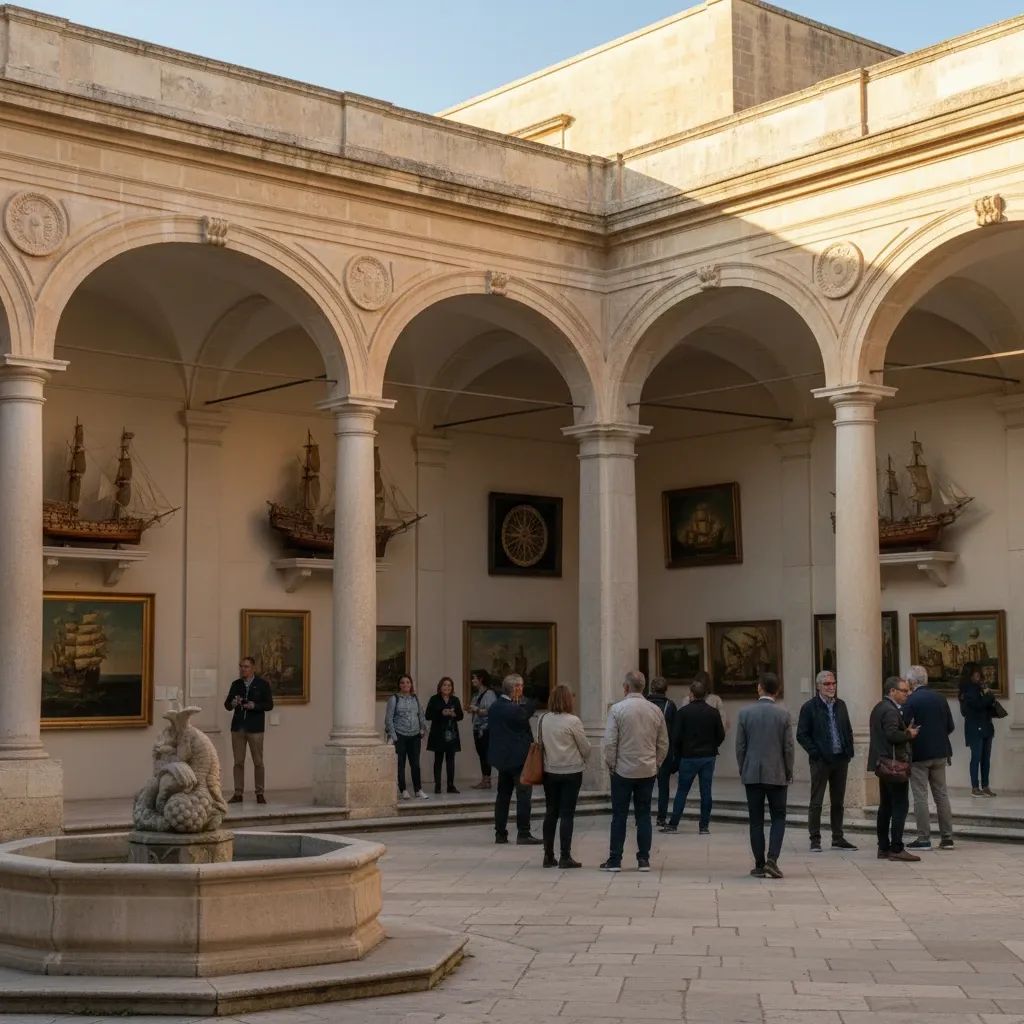
The Palazzo Ferreria venue itself reinforces this point. The historic structure on Republic Street serves as Valletta's principal cultural anchor, hosting rotating exhibitions that define the capital's art presence. Accessibility matters: the venue remains central, navigable, unintimidating—a practical stop for anyone curious about what Malta's contemporary visual culture actually looks like beyond tourist-facing narratives.
Visiting and Experiencing the Work
The exhibition operates through March 2026, though specific closing dates warrant advance confirmation. Palazzo Ferreria connects easily to Valletta's broader cultural infrastructure—nearby cafés, galleries, and architectural sites create natural context for a longer visit. The historic environment of the capital itself becomes part of the exhibition experience.
Weekend visits may draw larger crowds given Cauchi's stature and the venue's prominence. For those unfamiliar with his work, "Showcare" functions as an accessible entry point: the subjects remain recognizable, the emotional content direct, the technical execution evident. For longtime followers of his practice, the exhibition offers the opportunity to assess how his romantic vision has evolved across different decades and circumstances.
The work ultimately asks viewers to slow down, to observe closely, and to acknowledge that feeling remains a legitimate subject for visual art. In this particular cultural moment, that insistence carries unexpected weight.