
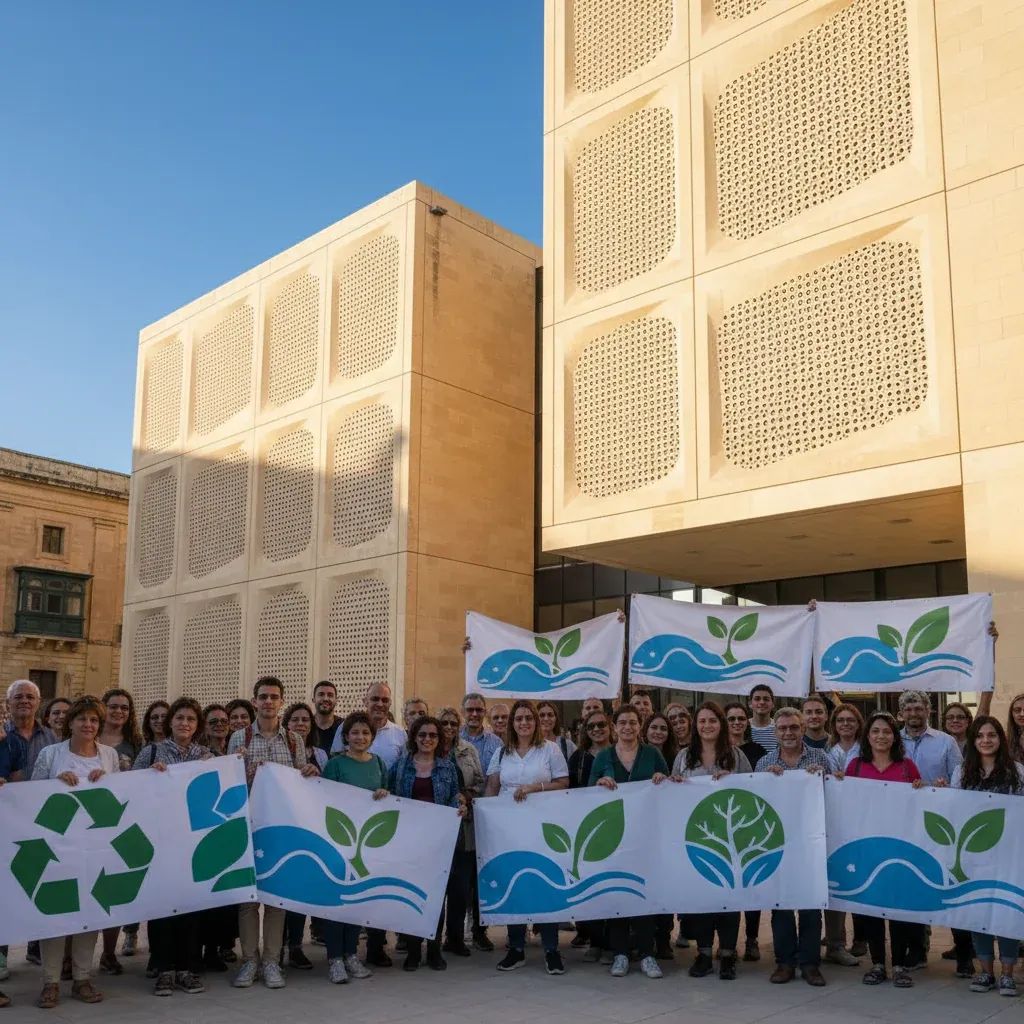
The Malta Green Party (ADPD) has officially confirmed an agreement with centrist Momentum to forge a pre-electoral coalition, a strategic attempt to crack the island's notoriously impermeable two-party parliamentary monopoly ahead of the 2027 general election.
Why This Matters
• Parliamentary math shifts: Two parties polling at ~2.3% each hope combined momentum can overcome the 5-8% threshold typically needed under Malta's Single Transferable Vote system.
• Policy overlap: The alliance targets voters frustrated with the Labour-Nationalist duopoly on environmental enforcement, governance reform, and economic justice.
• Deadline pressure: With elections expected in 12-18 months, both parties must finalize candidate lists and district strategies by mid-2026 to appear viable.
The Arithmetic Behind the Merge
ADPD Chairperson Sandra Gauci confirmed the coalition framework on March 23, marking the first formal third-party alliance between two minor parties since Malta adopted its current electoral laws. Unlike the 2017 Forza Nazzjonali pact—in which the now-defunct Democratic Party rode the Nationalist Party's ballot sheet to secure two seats—this agreement involves no established parliamentary presence.
Mark Camilleri Gambin, Momentum's general secretary, declined immediate comment beyond stating updates would arrive "through official channels." Yet the groundwork was laid in late February 2026 at Momentum's Annual General Meeting, where party officials explicitly identified ADPD as a natural partner. A January 2026 MaltaToday survey recorded each party at 2.3%, a critical data point driving their calculus: separately, they risk voter perception as "wasted ballots"; together, they approach the threshold where district-level seat mathematics begins to favor representation.
Malta's electoral system employs proportional representation via STV with relatively small district magnitudes, a design that historically punishes fragmentation. Constitutional amendments guarantee that whichever major party captures the most first-preference votes receives an automatic parliamentary majority—mechanics that have kept third parties out of parliament since 1966, with the sole exception of those two Democratic Party MPs elected under the PN umbrella in 2017.
What This Means for Voters Seeking Alternatives
The coalition's preliminary policy architecture rests on three pillars: good governance, environmental sustainability, and economic fairness—areas where both parties claim the Partit Laburista (PL) and Partit Nazzjonalista (PN) have underdelivered.
ADPD's heritage as a green party, formed in late 2020 through the merger of Alternattiva Demokratika and Partit Demokratiku, emphasizes ecological modernization. Its Green Over Greed: Vision 2050 blueprint calls for phasing out fossil fuels, achieving 50% renewable energy by 2030, and transitioning to a zero-carbon economy by mid-century. The party advocates for progressive taxation to fund public transport, housing, and healthcare, alongside judicial autonomy and strict party-financing rules to curtail corruption.
Momentum, launched in January 2025 and affiliated with the European Democratic Party, positions itself as centrist-to-centre-left with an emphasis on meritocracy and transparency. Its flagship economic proposal is a minimum wage hike to €360 weekly—a €139 increase from current levels—coupled with converting existing car allowances into universal transport subsidies to incentivize carpooling and public transit. The party also proposes 0% tax rates on intellectual property income for the first five years for companies investing in research and development, and exempting the first €30,000 of income for artists and creatives.
Both factions have jointly condemned recent government decisions, including the March 2026 reopening of general trapping licenses, which they framed as a breach of Malta's EU environmental obligations. Their October 2025 budget critiques followed similar patterns: ADPD dismissed it as a "missed opportunity," while Momentum offered conditional support for social measures but criticized infrastructure spending priorities.
Historical Precedent and Electoral Realism
Pre-electoral coalitions remain rare in Malta, and their track record is uneven. The 1926 Compact between the Constitutional Party and Labour Party won the 1927 elections, but subsequent mid-20th-century alliances proved unstable, yielding five elections in eight years between 1947 and 1955 due to internal fractures.
The 2017 Forza Nazzjonali coalition offers the most relevant comparison. Despite the PN's landslide loss to Labour (which captured 55% of the vote), the alliance delivered two seats for the Democratic Party's Godfrey Farrugia and Marlene Farrugia. Yet the pact dissolved within months, underscoring the fragility of partnerships under electoral stress.
ADPD's own performance has been modest. In the 2022 general election, the party secured 4,747 votes (approximately 1.6% of the total), a 35% decline from the combined 2017 tallies of its predecessor organizations. Its 2024 European Parliament result—3,109 votes (1.19%)—represented a 56.5% drop from the merged 2019 figures of AD and PD. The party did manage to elect two local councillors in the 2024 municipal contests, a symbolic achievement neither predecessor had accomplished independently.
Momentum, which has yet to contest a general election, has no direct electoral history beyond founder Arnold Cassola's independent campaigns. Cassola's best performance came in the 2024 European Parliament race, where he captured the third-highest first-preference count.
Structural Barriers and Strategic Gambles
Current polling paints a sobering picture. A PolitPro trend from March 22, 2026, estimated both parties at 0.3% each, while a mid-March MaltaToday survey found that while 39% of respondents believed ADPD deserved parliamentary representation and 30.7% said the same for Momentum, combined third-party support stood at just 5.8%.
Malta's district-based system requires candidates to exceed quotas calculated by dividing valid votes by seats plus one, then adding a single vote. With district magnitudes ranging from five to seven seats, the effective threshold hovers between 8-12% for a single seat, depending on vote transfers. For two parties each polling in the low single digits, the arithmetic is stark: without consolidation, neither stands a realistic chance of breaching that barrier.
The alliance also faces the psychological hurdle of the "wasted vote" phenomenon. Decades of two-party entrenchment have conditioned Maltese voters to view third-party ballots as symbolic gestures rather than pragmatic choices, particularly when constitutional safeguards ensure a Labour or Nationalist majority regardless of seat distribution.
The Road to 2027
Both parties acknowledge the need to finalize district-level candidate slates, transfer-vote agreements, and joint messaging before the official campaign period begins—likely in early 2027, though elections could be called as soon as late 2026. The success of the alliance will hinge not just on policy coherence, but on whether it can credibly claim "historic importance" (Momentum's phrasing) or deliver the "strong third voice" (the coalition's shared slogan) that recent surveys suggest a meaningful minority of voters desire.
For Malta's electorate, the practical question is whether this coalition represents a genuine alternative or another chapter in the island's long history of third-party efforts that generate enthusiasm but fail to translate into legislative power. The answer will depend on whether 2.3% plus 2.3% can equal more than 4.6%—in politics as in mathematics, the sum sometimes exceeds its parts, but only when the conditions are right.


