
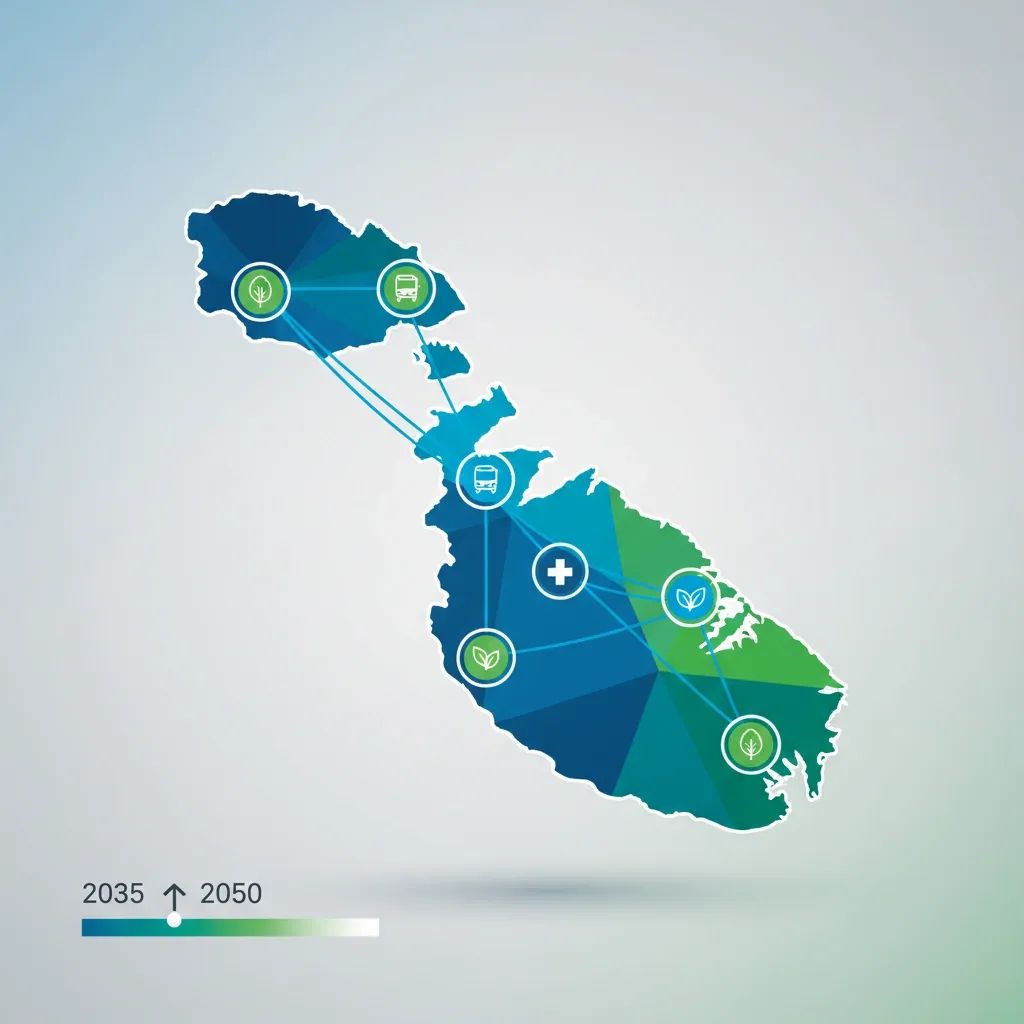
The Malta government's launch of its Vision 2050 strategy last Friday sparked a fierce debate over public spending priorities, with artistic director Eno Henze defending the elaborate ceremony as a necessary statement for a plan designed to reshape the nation over the next quarter-century. The event, held at Tritons' Square outside Valletta on February 28, featured dancers, an orchestra, and immersive installations that critics quickly labeled as excessive, particularly given the proximity to an election cycle.
Why This Matters
• Public funds: The lavish event's cost remains undisclosed, raising transparency concerns about procurement and spending oversight in Malta.
• Long-term targets: The strategy sets measurable goals for 2035 and 2050, including ranking in the top 10 globally on the Human Development Index and raising median income to 135% of the EU27 average.
• Six flagship projects: Mass transit, healthcare expansion, education overhaul, energy transformation, public transport reform, and Grand Harbour regeneration are now officially part of Malta's development roadmap.
The Spectacle That Divided Opinion
Henze, a German director known for staging the FIFA World Cup opening ceremony, transformed the entrance to the capital with a temporary stage, arches, and a cubic pavilion housing a 15-minute immersive experience. The structure, featuring Malta's blue rock thrush as a symbolic narrator guiding viewers through thematic "portals," is planned to remain for three months to allow public access.
The green party ADPD immediately condemned what it called a "superficial spectacle," with social media commentary dismissing the production as "money down the drain" and "cheap propaganda on the eve of an election." Critics pointed to the timing—Malta faces a general election in the coming months—and questioned whether such a lavish display served genuine policy objectives or merely political theater.
Henze pushed back against the criticism, arguing that a project of national significance "deserved to make a statement" and required high visibility to capture public attention. He emphasized his four-month preparation process aimed to balance Malta's rich historical identity with a vision of a self-confident future. However, when pressed on costs, Henze declined to provide figures, citing his inability to comment on financial details.
The controversy extends beyond aesthetics. ADPD also criticized the Vision 2050 document itself, arguing it fails to prioritize well-being and sustainability, instead focusing on GDP growth and catering to powerful lobbies. The party's stance highlights a broader tension in Malta's development debate: whether the strategy represents a genuine shift toward quality of life or merely repackages existing growth-focused policies.
What This Means for Residents
For people living in Malta, Vision 2050 translates into concrete changes with specific deadlines. The strategy, accessible via maltavision.mt, outlines 100 measures organized around four pillars designed to address persistent frustrations with infrastructure, public services, and environmental degradation.
Sustainable economic growth means a deliberate pivot toward high-value sectors—financial services, aviation, gaming, high-end manufacturing, and the green and blue economies—rather than continued expansion of low-wage, high-volume industries. This shift aims to raise median disposable income to 115% of the EU27 average by 2035, up from 93% in 2023, and eventually to 135% by 2050.
Accessible, citizen-centered services promise tangible improvements in daily life. A mass transit system is slated for development, alongside a comprehensive overhaul of public transport—two areas where residents have long expressed dissatisfaction. Healthcare capacity at Mater Dei Hospital and Gozo General Hospital will expand surgical capabilities, with €91M invested in digital health technologies. Housing support and digital service improvements also feature prominently.
The resilience and education pillar addresses curriculum reform, focusing on digital skills, critical thinking, and STEAM subjects to prepare Malta's workforce for technological disruption. School modernization projects will receive substantial funding, while energy sector transformation aims to reduce dependence on imported fossil fuels and align with the EU's 2050 carbon-neutrality target.
Smart land and sea usage targets some of Malta's most visible environmental challenges. White Rocks is earmarked for transformation into an ecological coastal park, Manoel Island into a car-free cultural and ecological peninsula, and Fort Campbell into a national natural park. These projects directly address concerns over overdevelopment and the erosion of green spaces that have dominated public discourse for years.
Ambitious Targets and Accountability Mechanisms
Malta's strategy sets measurable benchmarks that exceed typical policy announcements. The government aims to reach the top 20 globally on the Human Development Index by 2035 and the top 10 by 2050, climbing from the current 24th or 25th position. On overall life satisfaction, Malta targets ranking among the top 10 EU countries by 2035 and the top 5 by 2050.
What distinguishes this plan from previous initiatives is the establishment of a Programme Management Office (PMO) tasked with cross-ministerial coordination and a real-time KPI dashboard for public tracking. This transparency mechanism—unusual for Malta's traditionally opaque policymaking culture—aims to ensure accountability beyond political cycles.
The strategy explicitly moves beyond GDP as the sole measure of progress, incorporating broader indicators such as well-being, education quality, environmental sustainability, and work-life balance. This aligns Malta with trends across Nordic countries and other advanced European economies that have adopted more holistic development metrics tied to the United Nations Sustainable Development Goals.
The Transparency Question
The controversy surrounding the launch event underscores a persistent challenge in Maltese governance: balancing ambition with fiscal transparency. Without disclosed costs for the ceremony, critics lack concrete data to assess whether public funds were spent proportionately. The timing—weeks before an expected election announcement—fuels suspicions that the event served dual purposes: policy launch and campaign messaging.
Procurement procedures for high-profile events in Malta have faced scrutiny before, particularly when international consultants or directors are hired without competitive tendering processes. Henze's involvement, while bringing international credibility, also raises questions about whether local talent was considered or if the decision prioritized optics over cost-effectiveness.
The maltavision.mt website now serves as the official portal for tracking implementation, but its effectiveness depends on rigorous updates and genuine public engagement rather than performative transparency. Residents will judge the strategy not by the spectacle of its launch but by the visibility of progress on daily frustrations: traffic congestion, healthcare wait times, housing affordability, and environmental degradation.
European Context and Implementation Challenges
Malta's approach shares common ground with long-term strategies across Europe, particularly climate neutrality commitments tied to the Paris Agreement and the European Green Deal. Countries like France, Germany, and the Netherlands have established similar frameworks with legally binding targets and dedicated oversight bodies.
France's "France 2030" investment plan allocates €54B to transform strategic sectors including energy, digital technology, and health. Germany's Sustainable Development Strategy undergoes revision every four years with a structured system of targets and indicators. The Netherlands advocates for a climate authority to monitor policy consistency, while Nordic countries employ strong institutional frameworks promoting transparency and accountability for SDG progress.
Malta's PMO and real-time dashboard mirror these mechanisms but face unique challenges given the island's size, resource constraints, and political culture. Implementation will test whether Malta can sustain momentum across multiple election cycles—a difficulty that has derailed previous long-term initiatives when administrations change.
The strategy's success ultimately hinges on whether the government treats Vision 2050 as a genuine cross-party commitment or as another document abandoned when political winds shift. For residents, the proof will arrive in the form of a functioning mass transit system, shorter hospital wait times, and visible progress on environmental protection—not in the spectacle of a launch event, however grand.


