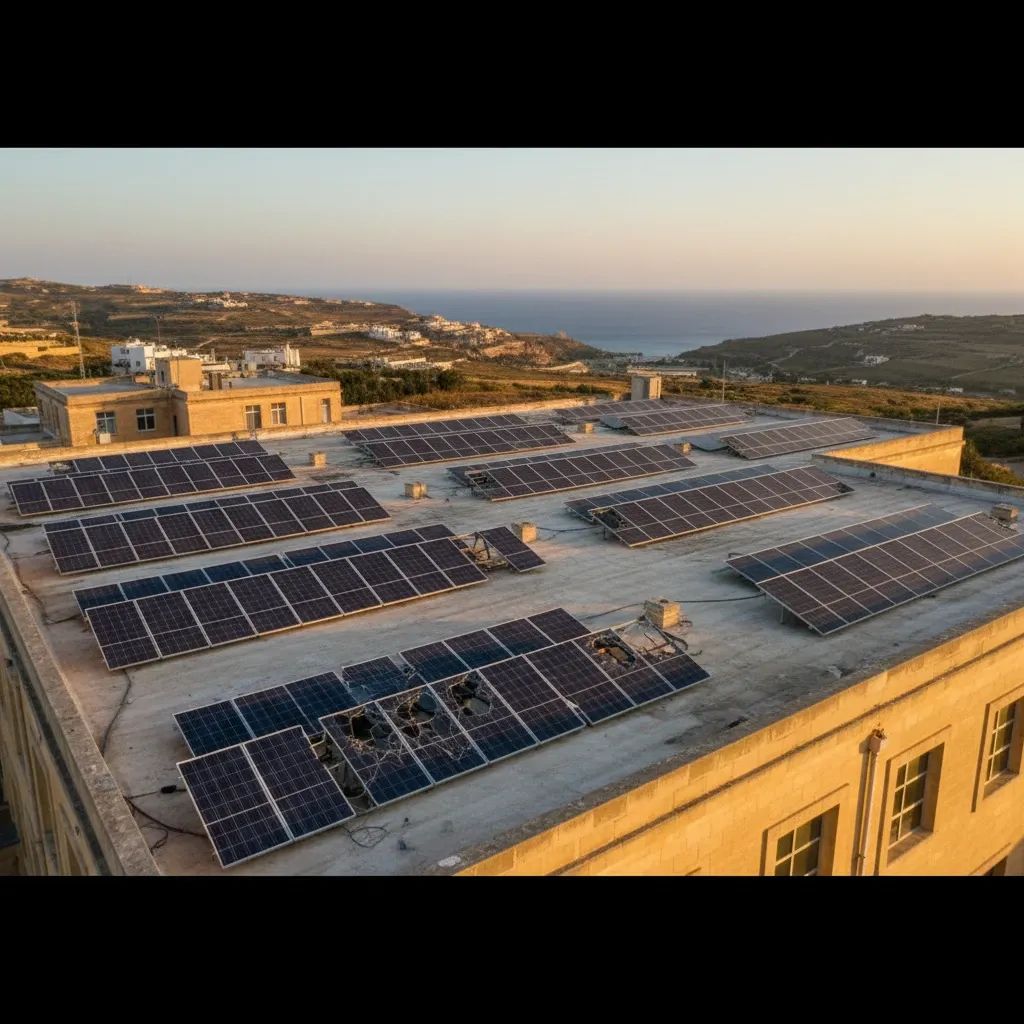
Gozo's public school rooftops carry solar panels that, by one political camp's accounting, have wasted nearly three-quarters of their energy potential over the past decade. By the other's measure, they're humming along reliably, with a total installed capacity of over 31,940.6 kWp. That gap—between claimed failure and asserted function—has become the latest battleground in Malta's energy accountability debate, with real consequences for how the island manages its renewable targets and public investment oversight.
Why This Matters
• The efficiency question: A 2025 parliamentary inquiry suggests Gozo schools operated panels at roughly 27% of theoretical capacity, losing an estimated 6.6 million electricity units—equivalent to powering 1,900 typical households for a year.
• Renovation delays cited: The government attributes underperformance to temporary panel removals during school renovations at Nadur, Kerċem, and Għarb, claiming this distorts long-term averages.
• Inverter upgrades underway: New switching hardware installed at Siġġiewi Primary School in mid-2024 aims to reverse efficiency losses on aging installations, with preventive maintenance now standard across all public school systems.
The Dispute Takes Shape
This May, the PN's Mark Anthony Sammut raised alarms about a systemic energy drain. His critique rested on data pulled from parliamentary records: solar panels affixed to 13 Gozo schools over roughly a decade had delivered only what their total capacity suggested they should. At Għarb Primary School, the figures were especially grim—estimates ranged from 8% to 92% of expected output, depending on the calculation method. In aggregate, the shortfall translated to 73% of potential generation, a figure Sammut branded a "scandal."
That loss, if real, carries weight beyond the technical. It speaks to accountability in public spending, to whether installation quality matched the investment premise, and to whether Malta's climate goals rest on infrastructure that actually performs. The opposition framed the issue as simple: panels were wired incorrectly, left gathering dust, or disconnected for years while maintenance fell behind.
The Education Ministry and Planning Ministry responded quickly and jointly, stating that the allegations misrepresented conditions on the ground. In their account, all Gozo school panels remain grid-connected and operational, with a total installed capacity of over 31,940.6 kWp. They also noted that the PN had glossed over a critical detail: several schools underwent substantial renovation projects between 2024 and 2025. During those construction phases, solar installations were necessarily relocated or temporarily offline. Comparing energy output before, during, and after such work without acknowledging the disruption, the ministries argued, was misleading.
Where the Numbers Diverge
The confusion partly stems from how energy is measured. Kilowatt-peak (kWp) describes a system's maximum theoretical capacity under ideal test conditions—bright sun, no shading, cool temperature. Kilowatt-hours (kWh) measures actual energy delivered to the grid or consumed. The government's reference to "31,940.6 kWp" is a capacity measure, not annual generation—a technical distinction that muddies the debate. The PN's claim of 6.6 million lost units refers to kWh—actual energy that should have flowed through the grid. These are fundamentally different metrics, which is why the dispute has room to persist.
For residents and business owners considering rooftop solar, this distinction matters practically. A contractor might tout high kWp figures while delivering mediocre kWh results if the system suffers from poor inverter tuning, inadequate ventilation, or deferred maintenance. Malta's Mediterranean climate—dusty, humid, salty in coastal areas—accelerates degradation if systems are not actively managed.
The Inverter Crisis and Climate Sensitivity
At the heart of aging school installations sits a hardware vulnerability: inverters, the boxes that convert direct current from panels into the alternating current the grid and buildings require. Most commercial inverters last 10 to 15 years. Malta's first wave of school solar projects launched in the early 2010s, meaning their original inverters are now approaching or past design life. A degraded inverter can siphon 20–40% of potential output without any obvious panel failure.
The Siġġiewi Primary School intervention in June 2024 directly addressed this problem. The Planning Ministry replaced aging switching gear with modern units, effectively retrofitting hardware that should have been planned for replacement years earlier. Such upgrades are not cheap—new inverters, installation labor, and grid certification can run thousands of euros per school—but they're less expensive than replacing entire panel arrays.
More broadly, addressing why first-generation solar installations underperform has become a European priority. Best practice now requires annual inverter health checks, monthly software updates, and real-time performance dashboards that flag anomalies within hours rather than months.
Renovation as Explanation and Excuse
The government's emphasis on renovation timelines provides context but also raises questions about planning. If Nadur, Kerċem, and Għarb schools were scheduled for major work, why were panels not decommissioned cleanly before construction, with output formally tracked during the offline period? Transparent project management would show energy loss during renovation windows separated from systemic underperformance due to maintenance neglect.
Currently, no public school-by-school breakdown exists showing kWh generated annually, downtime periods, or maintenance logs. The National Statistics Office publishes quarterly renewable statistics for Malta and Gozo collectively, but not for individual facilities. This opacity serves neither political camp well—the government cannot prove it's managing assets efficiently, and the opposition cannot conclusively document failure.
The Accountability Question
For taxpayers, this dispute ultimately concerns whether public investment in solar infrastructure is being managed responsibly. The government has indicated that a €10 million Green Schools Initiative, launched in November 2025, will span 38 projects across 35 schools nationwide, with four Malta schools designated for new 228 kWp installations. That commitment signals continued investment, but only rigorous tracking and transparent reporting can restore public confidence.
A separate €10 million tranche targets energy efficiency and renewable expansion at schools, including Gozo College Nadur Primary, though the specific timelines and completion dates require clarification given reported project delays.
Invoking Independent Verification
Neither side has called for an external audit by a neutral party. The Malta Resources Authority (MRA) or a private engineering firm could conduct a comprehensive review: school-by-school measurement of annual kWh generation, documentation of maintenance and downtime, and comparison against design specifications. Such a review would be relatively inexpensive compared to the stakes and would either vindicate the government's management or expose systemic neglect.
The PN could strengthen its case by publishing detailed methodology—exactly how the 73% loss was calculated, which schools and years were included, and what adjustments (if any) were made for renovation periods. The government could release monthly performance logs for Nadur, Kerċem, and Għarb to isolate renovation impact from operational underperformance.
Without transparency, this becomes a question of which political entity the voter trusts to manage public assets responsibly. For most Maltese households, that's fundamentally about accountability: whether investments deliver promised returns and whether problems are acknowledged and corrected.
Moving Forward: Systems Thinking
The Gozo schools solar saga reflects a broader maturation challenge for Malta's renewable infrastructure. Early installations (2010–2015) were often one-off projects, installed with minimal ongoing oversight. Modern deployments require centralized monitoring, predictive maintenance protocols, and professional accountability.
The National Energy and Climate Plan 2021–2030, still in development, has an opportunity to mandate these standards retroactively. Public buildings should publish real-time or monthly renewable generation data, inverters should be inventoried with scheduled replacement timelines, and any renovation project involving existing solar systems should include formal performance documentation before and after.
This dispute will likely persist until independent verification settles the technical facts—a step both government and opposition should welcome as a path to restoring public confidence in renewable infrastructure management.