
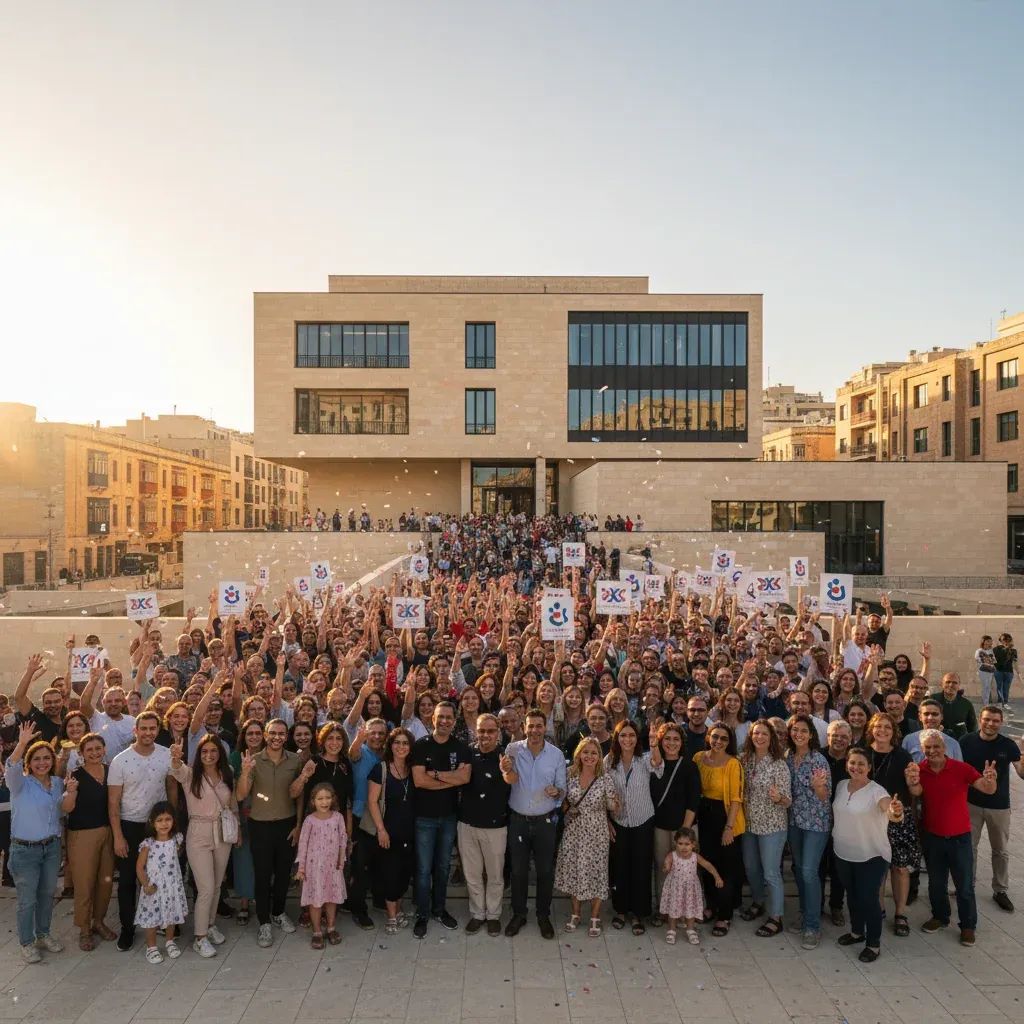
Labour's Campaign Pivot: Gozo Becomes Central to Election Messaging
The Malta Labour Party's statutory pre-election congress opened this past Sunday in Gozo with a deliberate strategic message: Prime Minister Robert Abela positioned the island as proof that economic stability and investor confidence flow from Labour governance. Yet the timing and location reveal something deeper—the Labour Party recognizes Gozo as genuinely contested terrain, a district it cannot take for granted despite holding it comfortably since 2013.
Why This Matters
• Manifesto approval signals imminent dissolution: The six-day congress, running through April 17 at Ta' Qali, fulfills the legal requirement mandating parliamentary elections be held within a year of manifesto approval. Political insiders interpret the congress as the formal precursor to a May 2026 snap election, well ahead of the constitutionally mandated March 2027 deadline.
• Gozo's electoral balance has shifted: Opposition leader Alex Borg, contesting his first general election from Gozo as a PN candidate, represents the first major Nationalist challenge in the district. Local council elections in 2024 saw significant PN gains across several councils, signaling mobilized opposition support.
• Energy subsidy commitments strain the budget: The Malta Finance Ministry will disburse an additional €80-100 million in 2026 to shield households and businesses from Middle East-driven wholesale price increases, a fiscal commitment that raises questions about long-term sustainability should regional instability persist.
The Infrastructure Narrative
Abela used his opening remarks to frame Gozo not as a peripheral concern receiving periodic attention, but as a district central to Malta's broader economic trajectory. He announced two immediate initiatives: a dedicated study hub for Gozitan students to encourage educational continuity and reduce outmigration, and the installation of 150 bicycle racks across the island, executed in partnership with environmental organization Rota.
These complement larger infrastructure commitments already underway. The proposed rural airstrip remains at advanced planning stages, designed to reduce travel friction for professionals and tourists alike. A new fast ferry corridor connecting Sliema, Buġibba, and Gozo is under construction, intended to extend the tourism season by making same-day visits from mainland Malta more practical and to reduce the sense of geographic isolation that constrains workforce mobility.
The phrase "Gozo: Island of Villages" functions as the government's guiding principle—development is permitted and indeed necessary, Abela suggested, but only when achieved through "intelligent and sustainable" planning that preserves the island's dispersed settlement pattern and cultural character. This framing attempts to reconcile growth ambitions with conservation concerns that dominate local sentiment.
Borg has already countered this messaging aggressively. He contends that 13 years of Labour stewardship have left Gozo systematically underinvested in transportation and digital connectivity, forcing young professionals to leave and creating artificial dependence on tourism revenue without genuine economic diversification. His response includes advocacy for cross-party, multi-year development planning that transcends electoral cycles—a positioning calculated to present the PN as the party willing to make difficult structural commitments rather than simply announcing new programs during campaign season.
Tourism Delivering Tangible Results
One area where Labour's economic claims find independent verification is tourism. Between January and October 2025, Gozo and Comino welcomed more than 2 million visitors, representing a 12.5% year-on-year increase and marking a significant compositional shift from day-trippers toward higher-value overnight stays. This trajectory contributed to a record €3.9 billion in total tourist expenditure across Malta for 2025, the highest on record.
The "Gozo: Island of Villages" branding strategy has resonated with visitors seeking cultural authenticity and slower-paced experiences rather than mass resort infrastructure. Abela's claim that Gozo's economy has tripled since 2013 and now generates €1 billion annually finds partial statistical support in these tourism metrics, though the figure encompasses broader economic activity beyond hospitality. Tourism sector leaders have signaled that growth remains fragile without the promised transport infrastructure improvements; the fast ferry route in particular is viewed as the bottleneck that, once removed, would allow the island to capture substantially more visitor volume.
Employment Data and the Accounting Problem
Prime Minister Abela stated that only 90 Gozitans are currently registered as unemployed, representing a sevenfold improvement from 2013. This claim warrants context. National Statistics Office data from February 2026 showed 1,302 registered unemployed nationwide, a 227-person year-on-year increase. Critics have questioned whether employment programs affect unemployment statistics and how different measurement methodologies influence year-on-year comparisons.
Public sector employment remains disproportionately prominent in Gozo's workforce compared to mainland Malta. This concentration creates structural vulnerability if fiscal pressures force reductions in public employment—a scenario not yet openly discussed in campaign rhetoric but relevant for anyone assessing long-term job stability.
The broader point: Gozo's labour market has absorbed workers from multiple sources in recent years, according to business observers on the island. This suggests that apparent employment growth reflects compositional changes in the workforce rather than purely organic local expansion.
The Energy Subsidy Equation
Abela devoted substantial congress time to energy policy, contrasting Malta's stable household utility bills with the price disruption afflicting much of Europe due to Middle East regional tensions. He cited a Morningstar DBRS credit rating report praising Malta's policies for insulating families from wholesale volatility.
Finance Minister Clyde Caruana quantified the cost: an additional €80-100 million outlay in 2026 specifically to absorb price increases from geopolitical disruption. Malta generates over 80% of its electricity from natural gas and imports virtually all energy as liquefied natural gas via ElectroGas Malta, which has assured the public that most LNG originates from the Atlantic Basin rather than the Strait of Hormuz, reducing direct exposure to that critical chokepoint.
Yet the Central Bank of Malta and the Malta Chamber of Commerce have raised caution flags. Universal price subsidies, they argue, discourage household investment in energy efficiency and renewable infrastructure, locking the country into fossil fuel dependence and deferring the transition toward sustainable energy that Malta's 2050 climate neutrality target requires. Both institutions have advocated for gradual subsidy phase-outs paired with targeted green incentives—a transition that would inevitably involve some price increases for consumers, a move politically impossible before an election but potentially necessary afterward.
For voters, the calculation presents a choice between short-term budget relief and long-term fiscal sustainability. Abela's framing—"peace of mind and stability" under Labour—carries particular weight for pensioners and fixed-income households navigating global uncertainty.
The Opposition's Family-First Messaging
Borg's electoral strategy emphasizes a different vector entirely. His platform commits to free general practitioner visits for pensioners, €5,000 birth grants for new parents, and rent-to-own housing schemes—policies designed to appeal to younger families and those squeezed by Malta's housing affordability crisis, an issue particularly acute in Gozo where property values have risen alongside tourism development.
His decision to contest Gozo as his primary district rather than secondarily from mainland Malta fundamentally reshapes electoral dynamics. The 2024 local council elections demonstrated PN organizational capacity on the island, with opposition candidates performing significantly better than in previous contests. These results suggest that having Borg campaign primarily from Gozo could mobilize latent opposition sentiment among voters who perceive him as genuinely committed to the island rather than viewing Gozo as simply part of a national portfolio.
What Residents Face Now
For people living in Gozo, the congress signals that campaign season has effectively begun regardless of whether Abela formally announces an election in coming weeks. The statutory requirement to hold manifesto-approval congresses means the parliamentary dissolution calendar is now running.
The island confronts a genuine binary choice between two distinct governance philosophies. Labour's model emphasizes infrastructure investment, subsidized energy costs delivering immediate household budget relief, and tourism-led economic expansion. The PN's approach critiques 13 years of infrastructural underinvestment while proposing targeted family support, cross-party development planning insulating Gozo from electoral swings, and a pathway toward renewable energy that reduces long-term fiscal exposure.
Neither party is proposing radical departure. Both represent incremental adjustments within established frameworks, disagreements about pace and priority rather than fundamental direction.
The wildcard remains energy policy. Stable utility bills provide tangible monthly savings, but the €80-100 million annual subsidy commitment poses implicit questions: If geopolitical tensions deepen or persist beyond 2026, will the government escalate spending further or implement controlled price increases? Either scenario becomes politically fraught if delayed until after an election. Businesses and investors benefit immediately from low energy costs supporting competitive positioning in tourism and hospitality; yet the absence of meaningful renewable incentives leaves strategic planners uncertain about the durability of that advantage should subsidy policy eventually shift.
The congress ultimately marks the formal opening of a campaign that will define whether Gozo remains a peripheral concern receiving periodic announcements during election season, or whether it becomes a district whose distinct character and human capital merit genuine, sustained, cross-party commitment.


