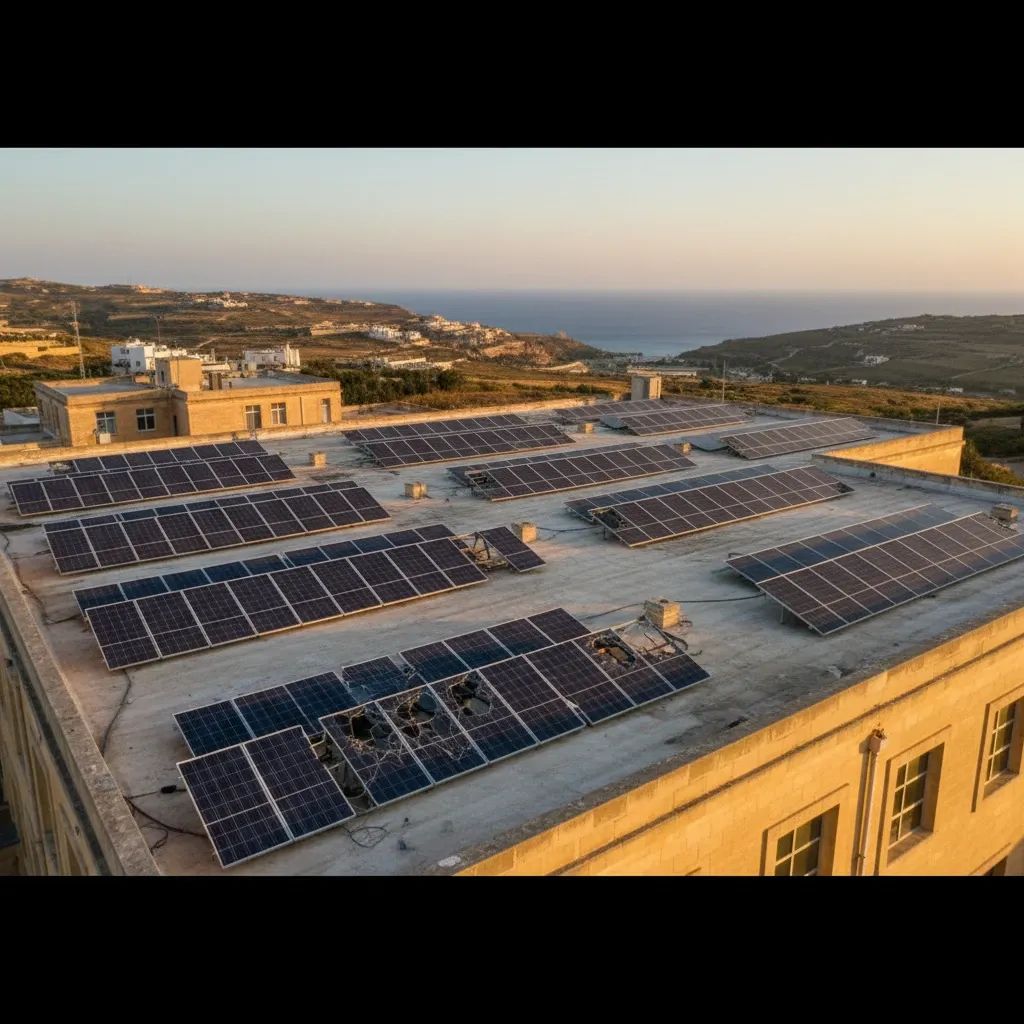
Malta's Education Department has overseen what amounts to a decade-long renewable energy failure in Gozo, Malta's smaller sister island, where solar panels installed across 13 schools have either remained disconnected from the grid or broken beyond repair—resulting in 73% of potential clean energy simply vanishing into administrative neglect. The issue, brought to light in May 2026 through a parliamentary analysis covering approximately 2015-2025, affects both primary and secondary institutions across the island, translating to an estimated loss of 6.6 million units of electricity that could have powered classrooms and reduced carbon emissions.
Why This Matters
• Schools across Gozo have generated just 27% of their expected solar output over the past decade, despite having functioning hardware installed on rooftops.
• Some installations were never connected to the electricity grid after completion; others broke down and no one repaired them, even after damage was reported.
• The wasted energy is equivalent to powering 1,500 households annually, or roughly the population of an entire village in Gozo.
• For residents and taxpayers, this represents public infrastructure that failed to deliver returns while energy costs continued to be covered by the national budget.
The Anatomy of Institutional Neglect
The scandal came to light in May 2026 after Nationalist Party MP Mark Anthony Sammut analyzed data provided by Gozo Minister Clint Camilleri in response to parliamentary questioning. The figures paint a damning picture: photovoltaic systems installed with taxpayer money have been left to decay or sit idle for years, with no accountability mechanism in place to ensure they functioned as designed.
At Għarb Primary School and Xagħra Primary School, panels have produced just 8% of their potential energy. The MCAST campus in Gozo saw a 92% loss of expected output, while Nadur schools lost 82% and Agius de Soldanis 80%. Even relatively newer installations like those at Sir M.A. Refalo Sixth Form have underperformed by 73%, and San Lawrenz by 72%. Schools in Għajnsielem, Ninu Cremona, Victoria, Sannat, and Qala all recorded losses between 60% and 67%.
The PN described the situation as evidence of "government incompetence and lack of credibility on renewables," accusing authorities of treating green energy initiatives as photo opportunities rather than functioning infrastructure. In some cases, contractors completed installations but never connected systems to the grid. In others, panels were damaged—by weather, vandalism, or simple wear—and authorities failed to dispatch repair crews despite receiving reports from school administrators.
What This Means for Gozo Residents and Taxpayers
For families and residents living in Gozo and across Malta, the implications are both symbolic and practical. Schools are public buildings maintained by the state, and their energy costs are covered by the national budget—which ultimately comes from taxation. When 6.6 million units of potential solar electricity go to waste over a decade, it represents a significant opportunity cost for public resources that could have reduced operational expenses.
The failure also raises critical questions for residents: If government-managed solar installations on 13 schools have deteriorated without intervention, what accountability exists to ensure future renewable energy projects serve homes and businesses? Will current government or opposition efforts to expand solar capacity across Gozo schools result in similar outcomes? Residents deserve clarity on maintenance protocols and oversight mechanisms before supporting further renewable investments.
Beyond the fiscal dimension, the failure undermines Malta's broader renewable energy targets. The island nation has committed to ambitious carbon-reduction goals under EU climate frameworks, and schools were supposed to serve as model installations—demonstrating to the public that solar energy is viable, reliable, and cost-effective. Instead, Gozo's schools have become cautionary tales of bureaucratic dysfunction.
Parents and teachers have also expressed frustration. Solar panels are visible from schoolyards, and some educators had planned to use them as teaching tools for environmental science lessons. When students ask why the panels don't work, staff struggle to provide answers that don't point to government failure.
How Malta Compares to Mediterranean Neighbors
Across the EU, Malta is far from alone in installing solar panels on school rooftops—but it lags badly in ensuring they remain operational. Other Mediterranean countries have implemented different management strategies: some countries have assigned dedicated authorities to oversee maintenance contracts with guaranteed performance standards, others have deployed real-time monitoring systems and community oversight models, and several have structured energy service contracts that hold contractors accountable if energy savings fall short of projections. These approaches share a common thread: they treat solar installations not as one-off construction projects but as long-term assets requiring maintenance, monitoring, and accountability. Malta appears to have skipped that step entirely in Gozo.
The Broader Context: Malta's Push for Renewables
The failures in Gozo sit awkwardly alongside the government's public messaging on clean energy. In November 2025, four state schools across Malta—Għargħur Primary, St Benedict College in Ħal Kirkop, St Clare Primary in San Ġwann, and St Nicholas College Wardija Primary—received new solar installations with a combined capacity of 228 kWp, projected to supply energy equivalent to 83 households and cut 139 metric tonnes of CO2 annually. The Climate Action Authority has led this effort as part of a broader renewable energy push.
A separate €10 million investment in renewable energy grants was announced in February 2025, offering Gozo households enhanced incentives for battery storage installations. While welcome, this residential-focused scheme does nothing to address the institutional rot plaguing school-based solar infrastructure.
The 13-year Edu-Infrastructure Programme promises to renovate every school to Green Building standards, incorporating rooftop photovoltaic systems. But without clear maintenance protocols and accountability frameworks, there is little confidence that new installations will avoid the fate of those in Gozo.
Political Fallout and Promises
The PN has seized on the issue as a symbol of government mismanagement, arguing that the problem is not technological but administrative—panels were installed correctly but abandoned by a bureaucracy with no incentive to follow through. The party has pointed to the need for better oversight mechanisms and accountability frameworks in future renewable projects.
Gozo Minister Clint Camilleri has not publicly addressed the specific allegations in detail, and no timeline has been provided for repairs or grid connections. The lack of response has fueled speculation that the issue was known internally but ignored for political reasons—acknowledging the failure would require admitting that renewable energy projects were mishandled.
For residents of Gozo, the question is straightforward: if the government cannot maintain solar panels on 13 schools, what confidence should they have in larger, more complex renewable energy initiatives promised for the island's future?
The Path Forward
Fixing the problem requires more than technical repairs. Malta needs a formal solar asset management framework for public buildings, with clear lines of responsibility, regular inspections, and performance reporting. Schools should not be passive recipients of infrastructure but active participants, with designated staff trained to report malfunctions and escalate issues when authorities fail to respond.
The 6.6 million units of lost electricity represent not just wasted energy but wasted opportunity—to educate a generation of students about sustainability, to demonstrate government competence, and to make meaningful progress toward renewable energy targets. For now, those panels sit on rooftops across Gozo, silent monuments to a decade of neglect.