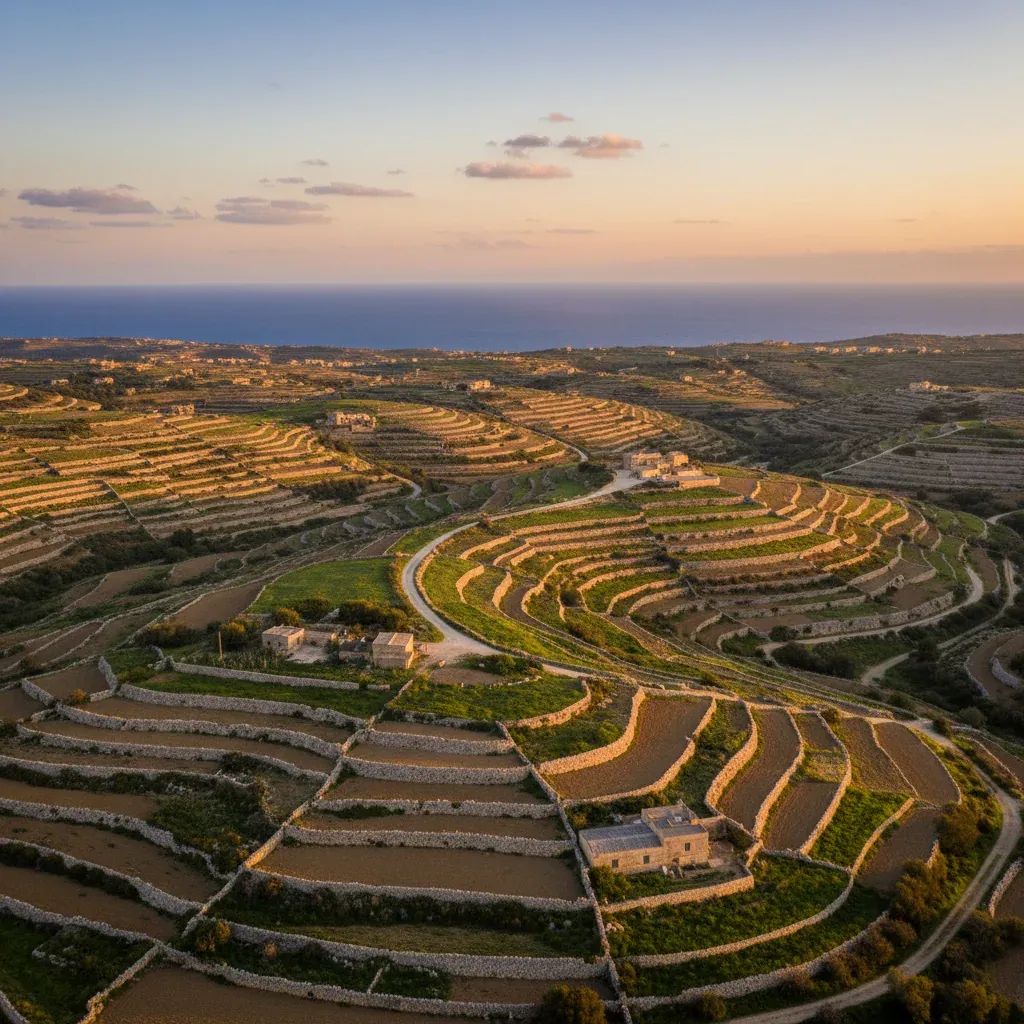
The National Library of Malta will host a dual event on Wednesday, April 29, at 6:30 PM that explores how centuries of agricultural necessity transformed the archipelago into one of the world's most intensively terraced landscapes. The session combines a public lecture on anthropomorphic features in Maltese terrain with the launch of a book celebrating five centuries of Malta's artistic legacy—all free and open to the public.
Why This Matters
• Terracing insight: The lecture reveals how inhabitants literally re-sculpted hillsides to survive on limited arable land, creating the signature dry-stone-walled fields that define rural Malta today.
• Academic milestone: The book launch showcases proceedings from the 2022-2023 lecture series, compiled by six contributors and published by Malta Libraries.
• Free access: No booking required—anyone can attend the April 29 event at the National Library.
The Terrain That Farmers Built by Hand
Avertano Rolé's lecture—titled Anthropomorphic features in Maltese landscapes: addressing issues of food security, soil protection, and rainwater harvesting—forms the eighth installment of the Public Lecture Series 2025-2026, themed Landscapes in Paper and Place: Rethinking geo-spaces through Malta's Cabrei and Country Maps. The series, coordinated by Mevrick Spiteri, Daniel Borg, and André P. DeBattista, runs from October 2025 through April and draws on historic cabrei (legally binding land registers) and country maps spanning the 17th to 20th centuries.
Rolé's presentation will focus on the dry rubble walls known locally as Ħitan tas-Sejjieħ—an innovation traced to Arab rule between 870 CE and 1091 CE, when almonds, citrus, and terracing techniques arrived on the islands. These dry stone structures stabilize steep slopes, prevent soil erosion, and mark ownership boundaries. More importantly, they allowed Maltese farmers to cultivate hillsides that would otherwise have remained barren rock, maximizing the limited resources of a semi-arid archipelago with negligible natural watercourses.
Beyond terracing, farmers developed man-made soils (campi artificiali) by leveling uneven ground with crushed rocks, then infilling the spaces with collected soil and manure. In other areas, they carved ridges and furrows directly into the porous Globigerina limestone bedrock, enabling roots to access trapped moisture and dew—a form of passive irrigation. Academic research published in January 2026 highlights Malta as one of the most intensively terraced places globally, though the exact origin dates remain debated, with some theories linking early versions to the Neolithic period around 4,500 BC.
Why the Islands Needed Drastic Intervention
Malta's agricultural history is inseparable from its natural constraints. With low annual rainfall, shallow alkaline soils, and an absence of rivers, the archipelago has always demanded ingenuity. The Phoenicians introduced olive cultivation around 1000 BCE, while the Romans brought wheat and expanded beekeeping—practices that earned Malta the ancient name Melite, meaning "honey-sweet." The Arab period marked the pivotal shift: terracing, cotton, and spices such as coriander and cumin became staples.
By the 18th century, Spanish demand for cotton led to the sacrifice of some olive groves, illustrating the economic pressures that shaped land use. Traditional "dry-farming" technology relied on hand-watering, crop rotation (melons, cucumbers, grains), and animal dung to enhance fertility. Goat husbandry dominated until the mid-20th century, when rising forage costs and government promotion of cow's milk caused herds to decline. Post-war Malta saw agriculture shrink from subsistence-focused to commercial, with labor and land both contracting.
Serious soil erosion was documented even before 1000 BCE, leaving areas of bare rock and silted inlets. Terracing slowed this degradation, but since the 1960s, field abandonment has reversed many gains. Collapsed walls accelerate soil loss and silt watercourses, threatening local ecosystems. Today, Maltese soils remain vulnerable due to their shallow depth, high stoniness, and low organic matter content.
What This Means for Residents and Land Managers
The lecture arrives at a moment when Malta faces climate-change pressures projected to increase temperatures, reduce precipitation, and intensify aridity. Extreme weather patterns—long droughts followed by intense storms—will exacerbate soil erosion, nutrient leaching, and crop damage. The agricultural sector contributes approximately 5.2% of Malta's total emissions (2021 data), yet it shoulders disproportionate vulnerability.
Farmers and policymakers are encouraged to adopt conservation tillage, crop rotation, and maintain traditional dry-stone walls to combat erosion. Malta is also pushing to expand organic farming to support healthier soils, though fragmented landholdings complicate large-scale reform. The Ministry of Agriculture, Fisheries and Food has emphasized rainwater harvesting and passive irrigation—techniques that echo the ingenuity of Malta's earliest cultivators.
For residents interested in land stewardship or rural heritage, Rolé's lecture offers practical insights into how historical methods can inform contemporary sustainability. Understanding the terraced landscape as a deliberate human creation underscores the responsibility to maintain these structures, which function as both cultural artifacts and erosion-control infrastructure. For homeowners with rural property or rubble walls on their land, understanding these structures' historical role in erosion control can inform maintenance decisions—abandoned walls accelerate soil loss that affects entire watersheds.
A Book That Chronicles Five Centuries of Artistic Heritage
Following the lecture, the National Library of Malta will launch Created to Inspire – 500 Years of Artistic Splendour in Malta, edited by Mevrick Spiteri. Published by Malta Libraries, the volume compiles proceedings from the fifth edition of the Public Lectures Series held in 2022-2023. Six authors contribute chapters drawing primarily from the National Library's collections, celebrating Malta's artistic trajectory from the early modern period to the present.
While the book does not focus exclusively on agricultural landscapes, it contextualizes the cultural and visual heritage shaped by the same forces that resculpted the terrain. Artistic depictions of rural Malta often feature the iconic terraced fields, linking aesthetic tradition to agricultural necessity.
How to Attend
The event takes place Wednesday, April 29, at 6:30 PM at the National Library of Malta (Old Treasury Street, Valletta). Entrance is free, and no advance booking is required. For inquiries, contact events.library@gov.mt.
The lecture series continues a multidisciplinary exploration of Malta's historic landscapes, emphasizing the interplay between land and people. Previous sessions included Christopher Gauci and Daniel Fenech's January 28 lecture on shoreline change using 1957 aerial surveys and 1896-1927 ordnance maps, and a March 27 session by Daniel Borg on the early modern landscape of Selmun using the Cabreo del Monte della Redenzione.
For anyone living in Malta or studying its environmental history, this session offers a rare opportunity to see the familiar countryside through the lens of centuries of deliberate, often ingenious, human modification.