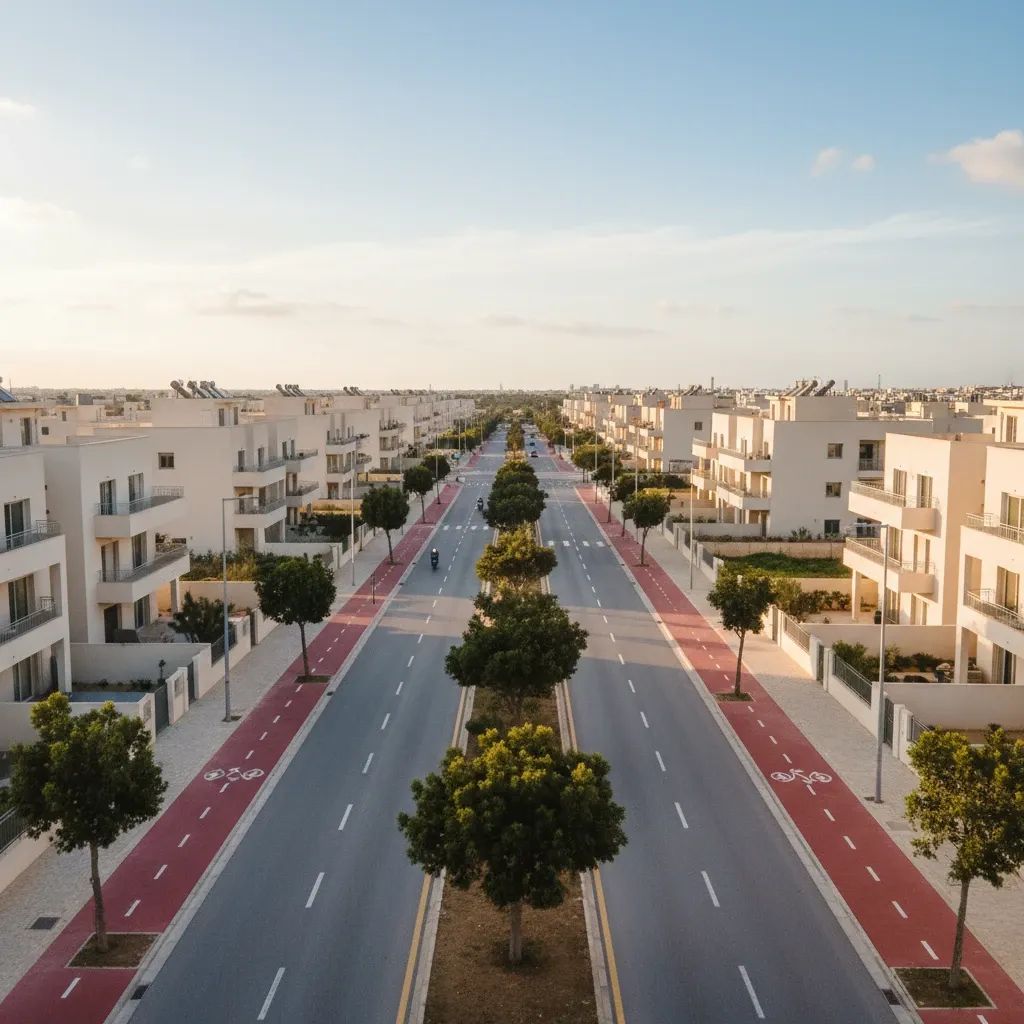
The Malta Cabinet finds itself caught between contradictory population forecasts, with Finance Minister Clyde Caruana's 2023 projection of 800,000 residents by 2040 now appearing mathematically sound despite Prime Minister Robert Abela's public dismissal of the figure as "unrealistic." At the current rate of net migration—approximately 14,000 people per year—the island nation would reach 798,000 residents by late 2040, a scenario that threatens to overwhelm infrastructure already buckling under demographic pressure.
Why This Matters:
• Malta's population density already stands at 1,817 people per km², 16 times the EU average, and would intensify dramatically with 250,000 additional residents.
• Housing affordability has collapsed by 175% in five years; minimum-wage couples can afford just 2.2% of current property listings.
• Traffic congestion costs the economy €770M annually as of 2025, projected to hit €917M by 2030 without intervention.
• Healthcare and public services face "significant pressure" that experts warn will become critical at 800,000 residents.
The Arithmetic Behind the Controversy
Malta's total population reached 588,254 at the end of 2025, according to the National Statistics Office, representing a 2.4% annual increase. The growth engine remains overwhelmingly migration-driven: net migration accounted for 13,906 of the 14,004 total population increase in 2025, with the natural increase (births minus deaths) contributing a mere 98 people. Non-EU citizens represented 78.1% of net migrants, underscoring the island's dependence on imported labor to fuel economic expansion.
Caruana's initial warning in June 2023 sparked political backlash, but his mathematical logic appears defensible. Even under the Labour Migration Policy implemented to slow growth, the island added 14,000 residents in 2025. Extrapolated linearly across 15 years, this rate would produce exactly 210,000 additional residents—pushing the population from 588,000 to 798,000 by the end of 2040, crossing the 800,000 threshold in early 2041.
Abela pointed to this deceleration from the 2023 pace of 20,960 net migrants as evidence the projection is overstated. Yet the data tells a more complex story: while migration inflows have moderated from their 2023 peak, they remain at historically elevated levels. The proportion of non-EU migrants declined from 93.1% in 2023 to 78.1% in 2025, suggesting some policy impact, but the absolute numbers still dwarf the natural population change, which has fallen to near-irrelevance.
A History of Underestimation
Malta's government agencies have consistently underestimated population growth for the past 15 years, lending credibility to Caruana's higher projections. The Eurostat EUROPOP-2010 forecast, prepared in consultation with the NSO, projected migration patterns based on "strong outward migration" until 2015 followed by "very small inflows" thereafter. Reality diverged sharply: by 2016, actual population figures had already surpassed the EUROPOP-2010 projection for 2025, undershooting by approximately 27,400 people—a 6.5% error.
Malta's population jumped from 417,617 in 2010 to 516,100 in 2020, a 23.6% increase that caught policymakers flat-footed. The EUROPOP-2015 revision corrected for "average net immigration," but even these updated models have proven conservative compared to the extraordinary migration flows of the 2020s. The Central Bank of Malta, in its May 2025 report, projects the total population could exceed 810,000 by 2070, while the native-born Maltese population continues its gradual decline.
Alternative forecasts paint varied pictures. The United Nations medium variant places Malta's 2040 population at just 551,735, declining to 535,722 by 2050—figures that now appear disconnected from empirical trends. PwC's analysis projects 636,000 residents by 2030, implying an annual increase of 14,000 people, precisely mirroring current migration rates. Eurostat's 2022 baseline sees 706,915 residents by 2070, a figure the island may hit decades earlier if current policies persist.
What This Means for Residents
The 800,000 threshold represents more than a numerical milestone—it marks a tipping point for infrastructure capacity across multiple sectors. Each cohort of 10,000 additional residents generates demand for 4,500 to 5,000 housing units, placing unsustainable pressure on the island's finite 316 km² landmass. Housing affordability has already deteriorated to crisis levels, with property prices surging 175% in the five years preceding 2026. The shift toward single-person households, now the dominant household type, amplifies demand for smaller units that the market struggles to supply.
Traffic congestion in Valletta costs commuters an estimated 94 hours per year in lost time, a figure certain to worsen as vehicle ownership rises in tandem with population. Public transport systems operate at sustained over-capacity, and road networks designed for a population half the current size show signs of chronic failure. The economic toll—€770M in 2025 alone—diverts resources from productive investment to managing gridlock.
Healthcare infrastructure faces particularly acute strain. Malta ranks 17th among EU nations in hospital beds per 100,000 residents, indicating a structural capacity deficit that predates recent population growth. Foreign-trained healthcare workers now constitute a significant portion of the medical workforce, creating turnover dynamics as many use Malta as a career stepping stone. Emergency departments report lengthening wait times, and workforce burnout has become endemic among nursing and physician cohorts.
Environmental consequences loom large. Malta's population density already exceeds that of Singapore and rivals Hong Kong's in urban areas. Additional density would consume remaining open spaces, accelerate urban sprawl, and intensify pollution from traffic and waste generation. Summer water stress, already a recurring challenge, would intensify. Coastal wastewater treatment plants, which experienced overflow incidents in 2025, require urgent expansion to accommodate current demand, let alone an additional 250,000 residents.
The Economic Model Dilemma
The Malta government's economic strategy has relied on labor accumulation rather than productivity intensification to drive GDP growth. This approach delivered impressive headline figures through the 2010s and early 2020s but has reached diminishing returns. The PwC analysis warns that continuing this model toward 636,000 residents by 2030 would require a 25% increase in imported electricity capacity, massive wastewater treatment investments, and school expansions that current budgets cannot sustain.
Caruana's warning implicitly challenges this growth paradigm. His projection functions less as a forecast than as a policy alarm, highlighting the logical endpoint of unreformed economic planning. The Labour Migration Policy introduced in 2024 aims to slow inflows through stricter work permit requirements, yet the 2025 figures suggest only modest moderation. The policy targets lower-skilled migration while maintaining open channels for sectors facing acute shortages—construction, healthcare, hospitality—which happen to be the largest employers of foreign labor.
Critics argue Malta lacks a comprehensive National Population Strategy that balances economic needs against livability constraints. The absence of such a framework leaves demographic policy reactive rather than strategic, with migration levels determined by employer demand rather than infrastructure capacity. Successive governments have deferred hard choices about sustainable population ceilings, betting that infrastructure can expand in parallel with demographic growth—a wager that current congestion levels suggest is failing.
Reconciling Political Rhetoric and Mathematical Reality
The public disagreement between Abela and Caruana reflects broader tensions within the Malta Labour government over managing growth expectations. Abela's characterization of 800,000 as "not realistic" serves political objectives, reassuring voters alarmed by rapid demographic change and congestion. Caruana's insistence on the projection's validity serves technocratic objectives, forcing public acknowledgment of policy consequences.
Both positions contain elements of truth. Migration policy can modulate inflow rates, as the shift from 20,960 net migrants in 2023 to 13,906 in 2025 demonstrates. Yet absent dramatic policy overhauls—quotas, sector-specific caps, or economic restructuring toward higher-productivity industries—Malta's demographic trajectory appears set. The natural population change hovers near zero, meaning net migration determines virtually all growth.
Foreign residents now constitute 31% of Malta's total population, a proportion unprecedented in the island's modern history and one that continues rising. This demographic transformation brings economic benefits—tax revenue, labor market flexibility, cultural dynamism—but also integration challenges that policymakers have addressed piecemeal. Schools in certain districts now enroll student bodies where 40% speak English or Maltese as a second language, straining teacher resources and requiring curriculum adaptations.
The 800,000 question ultimately hinges on whether Malta can transition from a quantity-driven to a quality-driven growth model before infrastructure collapse becomes irreversible. Current trends suggest the answer lies somewhere between Caruana's mathematical extrapolation and Abela's political optimism—likely reaching 700,000 to 750,000 by 2040 under modestly reformed policies, with 800,000 possible by the mid-2040s if economic structures remain unchanged. For residents navigating worsening traffic, unaffordable housing, and strained public services, the debate over precise timing may matter less than the trajectory itself.