
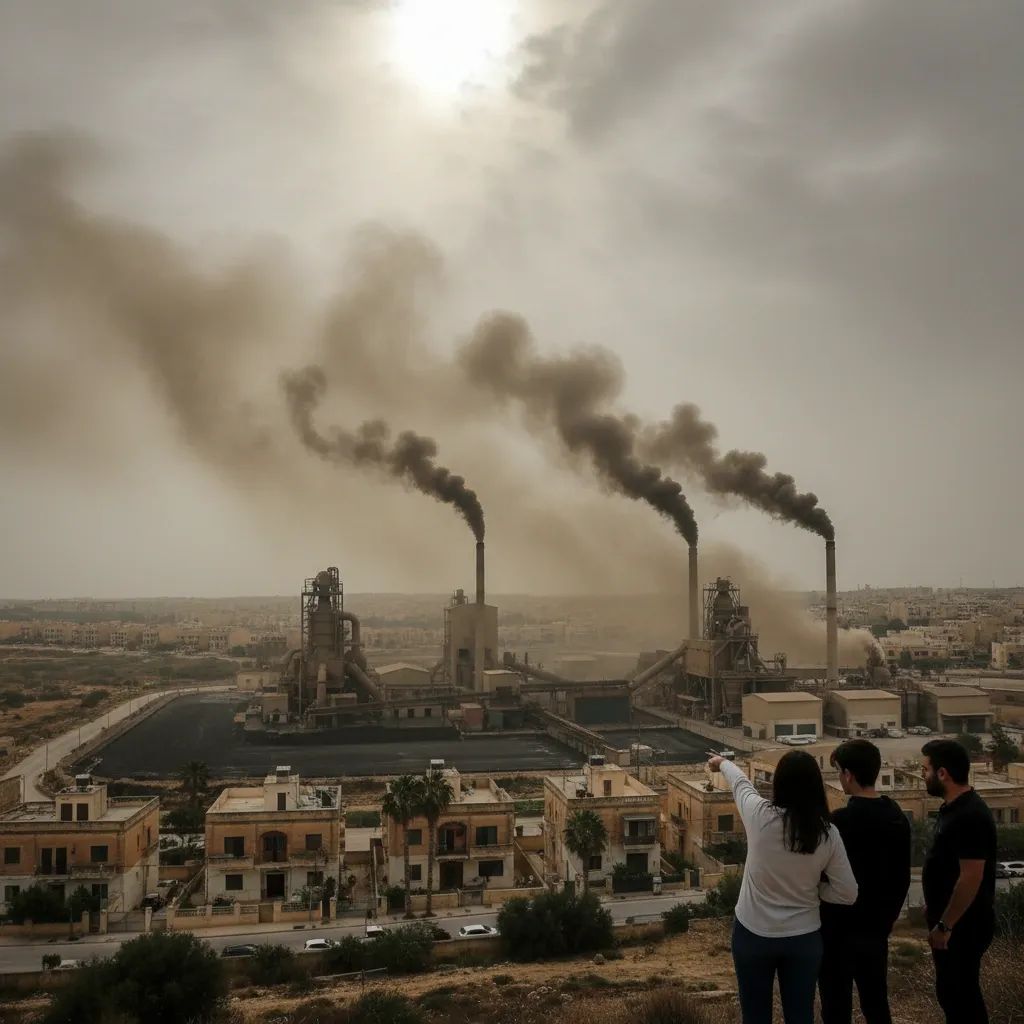
Malta's Environment and Resources Authority is facing sharp criticism from local councils after years of deflecting responsibility for a Bitmac tarmac plant in Iklin that has subjected nearby residents to foul odors and potentially toxic emissions since 2021. The dispute has now escalated to the European Parliament's Committee on Petitions, with 8 Maltese councils demanding an EU-level investigation into why national regulators have failed to act despite the existence of enforceable European environmental law.
Why This Matters
• Health Impact: Residents report needing inhalers and experiencing worsened respiratory conditions due to "insufferable" fumes that infiltrate homes even with closed windows.
• Regulatory Vacuum: The ERA has claimed for years that no European or local laws govern emissions from asphalt plants — a stance contradicted by the EU's Industrial Emissions Directive, which explicitly regulates such facilities.
• Multi-Locality Crisis: The stench affects not only Iklin but also San Ġwann, Naxxar, Għargħur, Lija, Balzan, Birkirkara, and Swieqi, making this a regional public health concern.
• Enforcement Frozen: A 2019 enforcement notice for illegal waste storage at the site remains stuck in tribunal appeals, while the plant applied in July 2024 to sanction an illegal concrete batching plant and expand commercial operations.
Councils Take Case to Brussels
Iklin Mayor Dorian Sciberras addressed the EU petitions committee, telling MEPs that instead of receiving cooperation from Maltese authorities, local councils have been "faced with an uphill struggle." He called for a "truly independent" emissions study and questioned why the ERA recently waived the requirement for an Environmental Impact Assessment (EIA) when the plant sought to reconfigure its operations and add new activities, including recycled materials storage.
The petition — backed by councils spanning much of Malta's central corridor — frames the issue as a test case for whether EU environmental standards are being enforced on the ground. A European Commission representative noted that Malta has exceeded EU air quality limits for pollution for the past 5 years and is currently breaching ozone standards, underscoring systemic gaps in enforcement.
"Residents need transparency and assurance regarding their safety," Sciberras told the committee. "We're asking for peace of mind."
What the Law Says — And What Malta Has Done
The Industrial Emissions Directive (IED), updated in 2024 and due for full transposition by July 1, 2026, mandates that asphalt plants obtain environmental permits based on Best Available Techniques (BAT) to minimize pollution. The directive covers particulate matter, volatile organic compounds (VOCs), nitrogen oxides, and sulfur dioxide — all substances commonly emitted by tarmac processing.
Yet the ERA has argued for years that it lacked jurisdiction and that no specific legislation governed asphalt plant emissions. Only recently, in response to mounting pressure, did Malta issue a legal notice to regulate asphalt, chemical, and cement packing plants. Residents remain skeptical that the new rules will eliminate the odors or enforce meaningful mitigation.
Meanwhile, the Bitmac facility has been under Planning Authority enforcement proceedings since 2019 for storing electronic waste on-site. That case remains frozen before the Environment and Planning Review Tribunal, last deferred in May 2022. The plant sits in an "area of containment" designated in 2006 to limit development to its existing footprint, yet the July 2024 application seeks to retroactively legalize an illegal batching plant and expand operations.
Blame-Shifting and Jurisdictional Gaps
Residents say they have reported the plant to ERA, the police, and the Public Health Department since 2021, only to encounter what they describe as a "blame-shifting exercise." The Environmental Health Directorate (EHD) has claimed enforcement falls outside its remit and referred complaints back to ERA. ERA, in turn, acknowledges that odors can be emitted during tarmac manufacturing but insists that current air monitoring equipment cannot detect human-perceived smells.
In February 2024, Malta's ombudsman recommended that ERA establish specific regulations for the country's asphalt plants, emphasizing the need for local enforcement mechanisms even in the absence of narrowly tailored EU directives. That recommendation came more than 2 years after the first resident complaints.
Impact on Residents and Local Economy
Residents describe the fumes as pervasive and toxic, with visible particles in the air near homes. One local told authorities she developed a need for an inhaler despite no prior respiratory issues. The ADPD political party has accused the government of ignoring residents' health, while multiple councils have demanded investigations into harmful emissions and the implementation of enforceable mitigation measures.
The odor problem intensifies during high humidity and southerly winds, making daily life unpredictable. For homeowners, the situation has eroded property values and quality of life, with no clear timeline for resolution. The plant's application to expand operations — including the storage of recycled materials and a concrete batching facility — has only deepened anxiety that the situation will worsen before it improves.
What This Means for Residents
For anyone living in Iklin or the surrounding corridor, the immediate concern is whether the new legal notice will translate into enforceable limits on emissions and whether ERA will begin treating asphalt plants as regulated industrial facilities under the IED. The EU petition opens the door for external scrutiny and potential infringement proceedings if Malta is found to be failing its transposition and enforcement obligations.
Residents should monitor:
• The outcome of the EU petitions committee review, which could trigger a formal Commission investigation.
• Tribunal rulings on the 2019 enforcement notice and the July 2024 application to expand the plant.
• Air quality monitoring data from ERA, if an independent study is commissioned.
• The July 1, 2026 deadline for Malta to fully transpose the updated IED, which includes stricter emission limits and more dissuasive penalties for non-compliance.
The case also raises broader questions about Malta's enforcement capacity. With the European Commission already pursuing infringement procedures against Malta for waste management failures under the Landfill Directive, and with the country exceeding EU air quality standards for 5 consecutive years, the tarmac plant dispute is emblematic of systemic gaps between regulatory commitments on paper and accountability in practice.
Local councils are now waiting to see whether the EU will force the issue — or whether residents will continue to live under a cloud of fumes while authorities argue over jurisdiction.


