
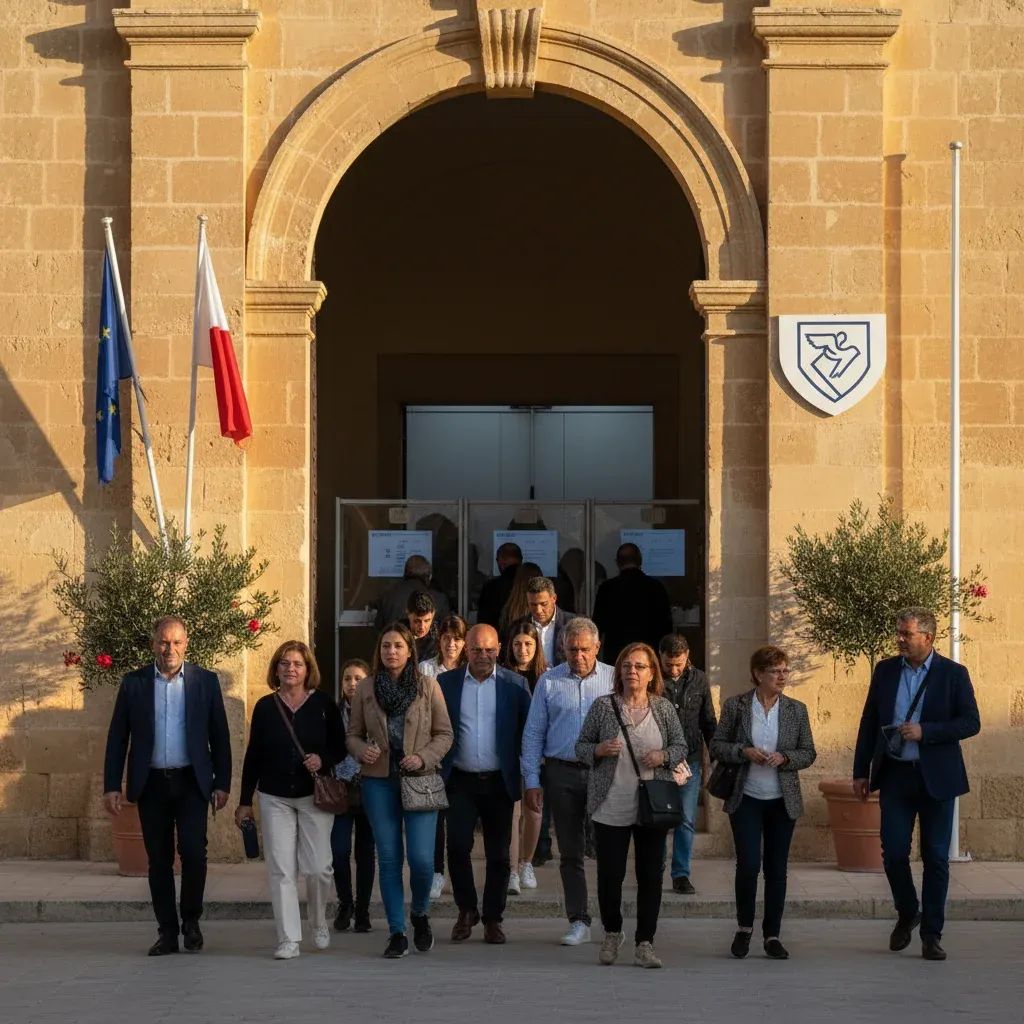
Malta Faces Electoral Crossroads Amid Growth, Scandal, and Voter Fatigue
Malta's voters will cast ballots on May 30, 2026 facing a genuinely constrained choice: whether to grant the Labour Party a fourth consecutive mandate—effectively 16 years of uninterrupted governance—or gamble on an opposition leader who has stumbled repeatedly in his first year. The race is not suspenseful in its outcome; Labour leads comfortably across most polling models, typically by 6 to 10 percentage points. What makes this election consequential is what it reveals about Maltese democracy when economic prosperity and scandal fatigue operate simultaneously, and when the alternative to incumbency appears institutionally weak.
Why This Matters
• Sustained single-party rule reshapes power structures: Four consecutive mandates concentrates control over state institutions, judicial appointments, and regulatory agencies in ways that historical data suggests weakens independent oversight within democracies.
• Economic versus governance trade-off: Voters choosing between personal prosperity (unemployment near 3%, GDP growth averaging 4% annually) and institutional health (corruption allegations, eroded media independence, ministerial accountability bypassed repeatedly).
• Third-party mathematics guarantee marginalization: ADPD-Momentum combined support at 4-6% nationally places them well below the 8-12% district threshold required for parliamentary seats under Malta's single transferable vote system—a voting mechanism distinct from most EU countries—making strategic voting mathematically futile regardless of voter preference.
• Infrastructure crisis lacks committed solutions: Neither major party has proposed the politically unpalatable measures—fuel taxes, vehicle levies, parking charges—economists and the IMF identify as necessary to address congestion and emissions.
The Economic Foundation That Shields Incumbency
The Labour government enters May 2026 from a position of tangible economic strength. Malta's budget deficit hovers at roughly 1.3% of GDP, substantially below EU targets. Government debt, while elevated in absolute terms, appears manageable relative to state revenue. The unemployment rate sits near 3%—low by any European standard. Inflation, which initially spiked following the 2022 energy crisis, has moderated to levels comparable with broader EU trends. Foreign direct investment continues flowing toward Valletta's financial sector, and the passport sales scheme, while politically contentious, generated revenue sufficient to fund hospital upgrades and infrastructure projects that might otherwise have required unpopular taxation increases.
This material prosperity—tangible in wage packets, employment security, and availability of consumer goods—forms the political bedrock underneath Labour's polling lead. However, this prosperity masks important nuances for Malta's diverse resident population. While headline figures appear strong, wage growth has not kept pace with housing cost increases, particularly impacting mid-level professionals in the services sector where many foreign residents work. The party's 2026 campaign exploits the prosperity foundation methodically, proposing increased child stipends, expanded mortgage assistance for first-time buyers, complimentary ferry passage for foot passengers travelling between Malta and Gozo, and targeted pension increases. The underlying message is consistent: Vote for the party that has delivered, that understands how to manage a small open economy competing globally for investment and talent.
Yet prosperity alone cannot explain Labour's dominance when scandals of such magnitude would have destroyed incumbent governments elsewhere. The explanation lies partly in timing, partly in voter psychology. The most egregious corruption cases—the Vitals Global Healthcare privatization, the Fortina land asset transfer—originated in Joseph Muscat's 2013-2017 tenure, now nearly a decade past. Robert Abela, who assumed the leadership in January 2020, has positioned himself as a clean break, a technocratic administrator distinct from his predecessor's patronage networks. Trials grinding forward inch by inch through the courts—Muscat's corruption case ongoing, Fenech's murder trial perpetually adjourned—feel historical rather than immediate. The scandals remain sufficiently present to dominate headlines, yet sufficiently distant that voters can compartmentalize them as products of an earlier era rather than systemic dysfunction persisting under current management.
Where Institutional Rot Concentrates
Malta's national broadcaster, TVM—the state-owned media outlet and primary news source for most Maltese households—functions as a case study in how proximity to power erodes institutional independence. The entity receives management direction effectively from Labour political operatives. Its news coverage exhibits demonstrable bias: stories favoring government policies receive prominent placement and sympathetic framing, while opposition statements appear as afterthoughts. Journalists employed by the broadcaster report informal pressure against critical reporting. International media observers routinely flag the situation in freedom of press rankings. Yet because TVM remains the primary news source for most Maltese, and because the broadcaster's bias operates through selection and emphasis rather than fabrication, the damage to democratic discourse accumulates incrementally, largely invisible to audiences not consuming multiple news sources simultaneously.
The national honours commission, designed to ensure integrity in Malta's awarding of state medals, has become a vehicle for distributing recognition to political loyalists. Labour politicians, donors, and family members receive honours disproportionately compared to their counterparts in opposition parties. The appearance of corruption—whether legally provable or not—undermines the institution's fundamental purpose. When citizens observe demonstrable patterns of advantage accruing to political insiders, their faith in meritocratic evaluation erodes. This erosion is not prosecutable, not easily quantifiable, yet deeply consequential for how citizens perceive the fairness of state institutions.
The Commissioner for Standards in Public Life, an independent watchdog body designed to investigate and enforce ethical standards among public officials, operates under considerable strain. The judicial system, meanwhile, operates under considerable strain. Courts are backlogged for years; cases move forward with agonizing slowness. The corruption trial of Muscat and associates, initiated in May 2024, has progressed to preliminary hearings but shows no sign of reaching verdict before the election. Similarly, the trial of Yorgen Fenech for the 2017 murder of journalist Daphne Caruana Galizia—whose investigations exposed the Vitals deal—remains stalled on procedural matters. This glacial pace creates ambiguity: are cases moving slowly due to systemic judicial capacity constraints, or are delays strategically advantageous to defendants with political connections? No evidence conclusively establishes the latter, yet the suspicion persists among substantial segments of the population.
Why Labour's Scandals Haven't Cost It the Election
Three explanations account for Labour's resilience despite the corruption cases.
First, economic self-interest supersedes moral judgment in voter decision-making. A worker earning €18,000 annually, employed in construction or hospitality directly benefiting from the building boom and foreign investment, makes a rational calculation: Labour delivers employment and rising wages; scandal investigations occur in courtrooms, largely external to daily experience. Prosperity can coexist with corruption if the two are sufficiently separated psychologically. They are.
Second, the opposition has failed catastrophically to present credible alternatives. Alex Borg assumed the leadership of the Nationalist Party in September 2025 with genuine initial enthusiasm. He was young (37), media-savvy, photogenic, and carried dynastic credentials—his father, George Borg Olivier, served as deputy prime minister decades earlier. Within seven months, Borg's personal trust rating collapsed from 5.38 in October 2025 to 4.78 by April 2026, a decline of roughly 11% that signalled voter disenchantment spreading beyond opposition die-hards to persuadable centrists.
Borg's stumbles accumulated rapidly and unnecessarily. When the Commissioner for Standards in Public Life ordered him to apologize for misleading statements regarding the Chambray development project, Borg refused—publicly, defiantly. This was self-destructive. An opposition leader should position himself as champion of institutional integrity and accountability. Defying an independent standards commissioner broadcasts the opposite message: that oversight applies selectively, that the powerful can ignore it, that rules protect only the weak. Borg managed simultaneously to alienate anti-corruption voters and confirm their worst suspicions that both major parties view democratic safeguards as obstacles rather than foundations.
Then came the POYC pharmacare scandal. Borg alleged that medications distributed through the government's subsidized medicines program were substandard, potentially dangerous. The allegation created immediate national alarm. Elderly citizens on fixed incomes questioned medication safety. Social media amplified concern into panic. No investigation had been conducted. No independent testing confirmed the claim. Borg, seeking political advantage, had weaponized the health sector—precisely the tactic Labour has perfected and opposition parties should categorically reject.
The opposition leader's responsibility when encountering health sector irregularities is straightforward: approach the regulatory authorities quietly, ensure investigation, allow due process. Only if official investigation concludes nothing is wrong despite evidence to the contrary should public disclosure follow. Using medicine safety as campaign ammunition is beneath the standard democratic oppositions should maintain.
Finally, Borg appointed a developer's wife to serve as chief executive of his policy platform—a perverse choice while simultaneously campaigning against Labour's excessive accommodation of the construction industry. The symbolism overwhelmed any policy rationale: voters questioning whether Borg would genuinely constrain developer influence received immediate answer through his personnel decisions.
These weren't minor tactical errors. They suggested an opposition leader unprepared for high office and comfortable with tactics he publicly denounced when Labour employed them.
Infrastructure Gridlock as Shared Responsibility
Malta's traffic congestion emerges as perhaps the most concrete manifestation of governance failure transcending party boundaries. The island now contains roughly 420,000 registered vehicles, with approximately 30 new automobiles added daily. On an island of 316 square kilometers—roughly the size of Philadelphia or twice the size of Washington D.C.—this translates to one of the highest vehicle densities in Europe. For residents experiencing this daily, the impact is visceral: commutes that once averaged 15 minutes now regularly stretch to 45 minutes or longer on major routes. This flyover construction at Marsa and Kappara addressed specific chokepoints but did nothing to address systemic gridlock because neither project expanded overall transport capacity proportional to vehicle growth.
The bus system, theoretically capable of moving people efficiently during peak hours, sits trapped in the same congestion affecting private vehicles. A bus full of 40 passengers occupies the same road space as 35 individual cars; if that bus sits motionless in traffic, it offers no advantage. Investment in dedicated bus lanes, express routes, and priority signalling remains minimal and fragmented. Predictably, citizens continue choosing private automobiles, gridlock worsens, and the system approaches a self-reinforcing equilibrium where public transport becomes demonstrably inferior to private driving, regardless of theoretical efficiency.
The International Monetary Fund, in repeated assessments of Maltese economic policy, has recommended measures to reduce traffic externalities: raise fuel excise duties by 15-20%, implement vehicle registration taxes scaled to engine size and emissions, institute paid public parking with revenues dedicated to public transit investment. These measures work elsewhere; they work in principle in Malta. But they require political sacrifice. The government that implements fuel taxes faces immediate public backlash and electoral punishment. The opposition exploits the decision, campaigns on lowering taxes, and wins the subsequent election. The incoming opposition government, inheriting the same congestion problems, discovers that raising taxes remains politically untenable. The cycle perpetuates.
Neither Labour nor the Nationalist Party has committed to these measures. Neither campaign platform acknowledges that congestion cannot be reduced without material cost to motorists. The rhetoric instead emphasizes road improvements, traffic management technology, and marginal adjustments—solutions that sound substantive but address symptoms rather than underlying dynamics. The construction of a tunnel network, floated periodically as a long-term solution, would require decades to implement and hundreds of millions in expenditure. The electorate is not demanding sacrifice; the candidates are not volunteering it.
Air Quality Collapse and the Renewable Energy Gap
Malta's atmospheric quality has deteriorated measurably under the Labour government, driven by two concurrent phenomena: construction intensity and vehicle emissions.
Fine particulate matter (PM2.5)—the most health-consequential air pollutant—hovers around 18-22 micrograms per cubic metre during winter months, nearly double the WHO guideline threshold of 10 micrograms per cubic metre. Health officials associate sustained exposure at these levels with increased respiratory illness, particularly among children and elderly residents—a concern for Malta's aging expat community and young families already managing the stress of relocation to a new environment. Construction sites excavating foundations, demolishing structures, and operating heavy machinery generate dust clouds visible across neighbourhoods. Regulations nominally govern construction dust mitigation, but enforcement remains inconsistent. Building sites operate in densely populated areas like Gżira and Msida; residents accept dust as an inevitable accompaniment to economic development. Diesel vehicles—still predominant despite EU efforts to phase them out—emit particulate matter and nitrogen oxides that combine with atmospheric moisture to form photochemical smog.
The energy generation mix compounds the problem. Malta generated only 10.7% of electricity from renewable sources in 2024, placing the nation third from last in EU rankings. The Marsa coal-fired power station, a significant source of particulate emissions and greenhouse gases, closed in 2014. A natural gas-fired plant replaced it, offering cleaner combustion than coal but substantially less clean than renewable sources. Investment in wind energy and solar generation has grown incrementally—Malta's south-facing geography and relatively consistent wind patterns on surrounding waters make both technically viable—yet subsidies flow more readily toward conventional generation than renewable capacity additions.
Most consequential: Malta is the only EU member state to have increased greenhouse gas emission intensity by 17% since 2013, while the EU average fell 34% across the same period. This reversal against EU trends reflects transport-sector growth (new vehicles, expanded driving) outpacing any efficiency gains from power generation improvements. The government negotiated downward its 2030 greenhouse gas reduction target with Brussels, effectively securing permission to reduce emissions less aggressively than originally committed. The negotiation reflected realistic assessment of implementation difficulty, but the effect is identical: Malta's environmental trajectory diverges further from EU averages.
The Third Party Impossibility
The ADPD and Momentum alliance represents genuine ideological alternative to Labour and Nationalist Party centrism. Both organizations prioritize environmental restoration, democratic pluralism, and governance transparency. Their policy platforms address climate change with substantive commitment, propose campaign finance reform to reduce donor influence, and advocate judicial independence measures. They differ genuinely and significantly from both major parties.
None of this matters electorally because Malta's electoral system, based on single transferable vote within multi-seat districts and distinct from most EU countries' proportional or first-past-the-post systems, requires candidates to obtain 8-12% of votes within their district to achieve election. ADPD-Momentum's combined national support measures 4-6% according to most recent polling. No district data suggests the alliance approaches the 8-12% threshold in any region. The mathematical barrier is insurmountable without dramatic voter shift impossible to anticipate.
This creates genuine democratic dysfunction. Voters prioritizing environmental action or democratic reform cannot vote their preferences with consequence. Voting ADPD-Momentum effectively surrenders those votes to waste—no seats materialize, no parliamentary representation accrues, no voice enters legislative debate. Strategic calculation, therefore, channels protest votes toward one of the two major parties, typically the PN as the anti-Labour alternative. This dynamic ensures ADPD-Momentum never accumulates sufficient support to breach electoral thresholds; insufficient accumulation guarantees the barrier persists indefinitely.
The system thus protects the two-party duopoly by design. Voters dissatisfied with both major options face forced choice between accommodation and abstention. Third parties cannot penetrate the mathematical wall absent dramatic shifts in voter preference occurring simultaneously across multiple districts. The 2022 election illustrated the dynamic: ADPD secured 1.5-1.7% of national votes and won zero seats despite genuine policy sophistication and committed activist base.
What May 30 Actually Determines
The Nationalist Party campaign slogan, "Nifs Ġdid" (New Breath), signals aspiration toward electoral reset. Borg's policy pledges—€600 million in hospital investment, €300 smartwatch subsidies for seniors, 25% student stipend increases versus Labour's 15%—attempt to outbid incumbency on spending while avoiding structural questions about revenue and sustainability. These are politician's proposals: detailed enough to seem substantive, generic enough to avoid painful trade-offs.
Labour's campaign similarly emphasizes spending: increased pensions, housing assistance, expanded child allowances. Both parties campaign on more; neither campaigns on sacrifice. The infrastructure crisis will persist. Air quality will stagnate or worsen slightly. Congestion will worsen. The political moment to impose necessary costs will pass, as it has repeatedly, because the electoral system punishes governments that implement unpopular choices before elections and reward those that postpone them afterward.
On May 30, Maltese voters will choose between continuity and uncertainty—between a government that has delivered prosperity alongside scandal, and an opposition that has not yet demonstrated competence at high office. The choice will likely favour continuity. Most voters rationally prefer outcomes they understand to alternatives that might disappoint them. Sixteen years of single-party governance will incrementally erode institutions, concentrate power, and diminish accountability—a critical consideration for the democratic health of all residents, regardless of origin. Yet the alternative—trusting governance to an opposition that has not yet answered fundamental questions about competence, judgment, or ethical standards—offers insufficient assurance to overcome rational voter preference for known outcomes.


