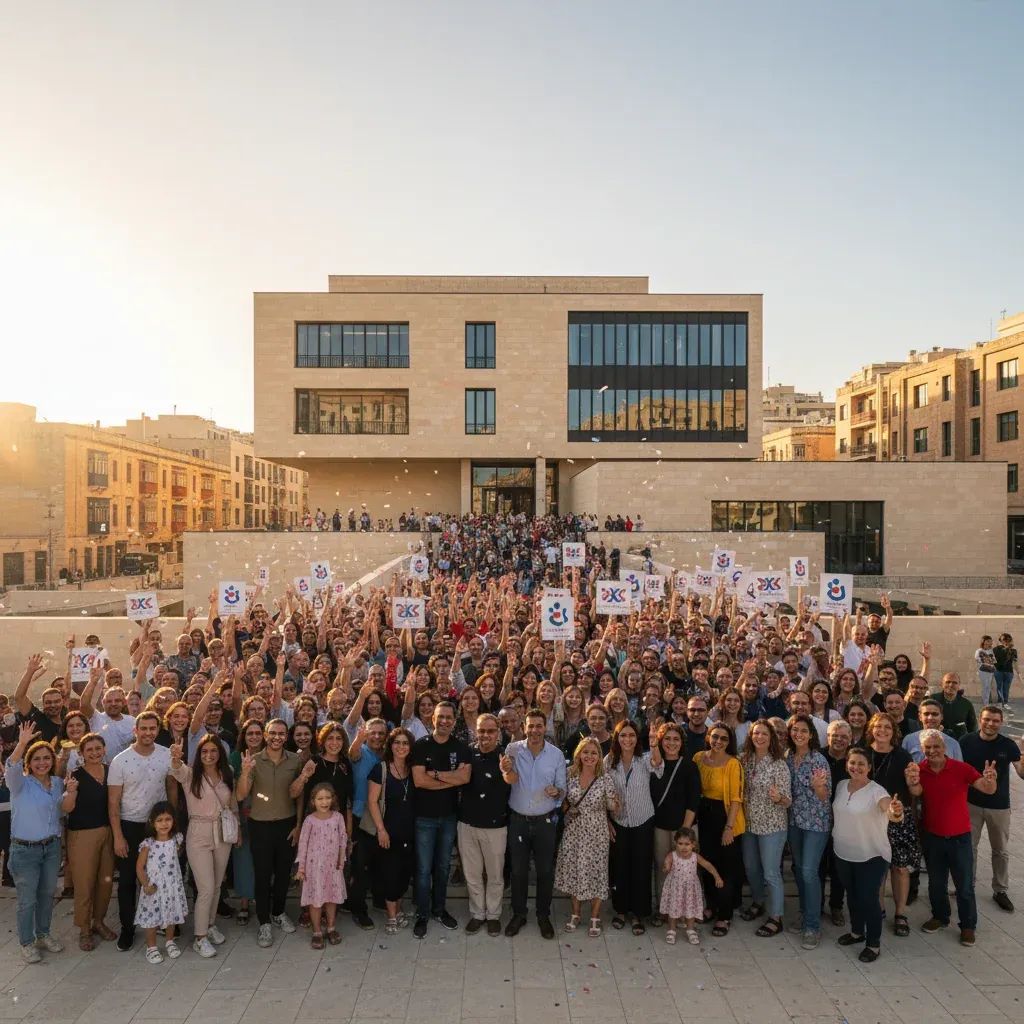
Malta's snap election on May 30 has crystallized into a contest over who can protect household finances from global turbulence. Prime Minister Robert Abela framed the immediate economic question this way: as geopolitical risk rattles markets worldwide, does Malta need continuity or a reset? His answer, delivered Monday at Fort Tigne, was unambiguous—the Labour Party alone has the institutional heft and track record to absorb external shocks while improving daily life for residents.
Understanding Malta's Electoral System
For those unfamiliar with Malta's politics, a snap election means Parliament dissolves and all seats are contested. The party winning the majority of seats forms the government and governs for up to five years. Malta operates a proportional representation system, though in practice the two major parties—Labour and the Nationalist Party—have consistently won sufficient seats to govern alone. This election will determine which party holds that majority.
Why This Matters
• Election date: Saturday, May 30, 2026—giving voters roughly four weeks to decide between Labour's continuity platform and an opposition alternative still largely undetailed.
• Wellbeing index unveiled: Labour will anchor its manifesto to 25 measurable quality-of-life targets, a policy innovation untested anywhere in Malta's political history.
• Economic headwinds: Growth forecasts of 3.8%-4.0% for 2026 assume no major external shock; Middle East tensions and trade fragmentation could quickly erase that cushion.
• Polling tightness: Depending on methodology, Labour ranges from 43%-53% support, meaning thousands of undecided voters will decide the outcome.
The Stability Argument Under Scrutiny
Abela's campaign gambit relies on a straightforward premise: in turbulent times, voters reward proven handlers. He positioned Labour as the party that insulates households from price shocks, maintains jobs, and sustains growth—all while pursuing "ambitious but sustainable" improvements to how people actually live. This messaging—often expressed through Labour's campaign slogan "Your dreams are our project"—reflects the party's focus on connecting economic management to everyday quality of life.
The Central Bank of Malta has warned repeatedly that downside risks are real. Global supply chain disruptions, weakened European demand, or energy price spikes could rapidly compress the 3-4% growth buffer the island currently enjoys. Malta's economy is overwhelmingly service-based—tourism, gaming, financial services—sectors where investor sentiment can shift overnight. A sudden flight of capital, a collapse in gaming revenues, or a tourism downturn would expose any government's vulnerabilities quickly.
Labour's hedge is government-backed energy subsidies. Rather than letting tariff increases ripple through household bills, the state absorbs the cost. This mechanism has kept inflation near 2.1%-2.4% despite global price pressures. It's also expensive—a fiscal commitment that only works if economic growth remains robust enough to generate tax revenue. Abela argues that Labour's economic track record proves it can manage that balancing act.
Opposition parties haven't yet articulated an alternative economic vision, leaving Abela's framing largely uncontested for now. Whether that changes in the coming weeks will partly determine turnout and persuadable voters.
The Wellbeing Index: Reframing What Success Looks Like
The most substantive policy announcement was Labour's commitment to build a national wellbeing index into its manifesto—a first for Maltese politics. The concept isn't new globally; New Zealand, Scotland, and Finland have adopted similar frameworks. But for Malta, it represents a deliberate pivot away from GDP-centric measurement toward something closer to citizen satisfaction.
The index links to 25 specific targets across several domains. Labour has signaled focus areas: reducing work-life friction through enhanced leave provisions, expanding homebuyer support for first-time purchasers, creating pathways for youth entrepreneurship, and strengthening elderly care. Each proposal is expected to carry a costed estimate—not vague aspirations, but numbers attached to implementation timelines.
Why does this matter operationally? Because a wellbeing index creates accountability. If Labour wins and then fails to deliver measurable improvements in, say, work-life balance or housing affordability after five years, voters have a tangible metric to point to. For example, if the index includes a target to reduce average commute times or increase homeownership rates among under-35s from one percentage to another, voters will have concrete benchmarks to assess government performance. It's harder for a government to hide behind aggregate GDP growth if household surveys show stress levels rising, commute times lengthening, or retirement security declining.
The wellbeing framework also acknowledges something Maltese residents already know: a strong economy doesn't automatically translate to a livable daily reality. Unemployment may be low, but wages haven't kept pace with property prices. Tourism revenue may be booming, but traffic congestion and environmental strain have intensified. By centering the campaign on tangible quality-of-life improvements, Abela is signaling that Labour understands the gap between macroeconomic health and personal wellbeing—and intends to close it.
What Labour Is Betting On
Abela cited Labour's tenure since 2013: tax cuts for workers, higher stipends and allowances for families, enhanced grants for first-time homebuyers, expanded legal rights for various groups, and increased public investment in green spaces. He positioned these as evidence that Labour knows how to translate political power into tangible improvements.
Recent polling, though, reveals cracks in that narrative. A MaltaToday survey conducted late February through early March showed Labour at 48.2% versus the Nationalist Party at 45.6%—a margin of just 2.6 percentage points, well within statistical error. A February Vincent Marmarà poll that allocated undecided voters gave Labour a more comfortable 52.8% to 42.6%, but an April 9-16 Esprimi poll compressed Labour's lead to 43.1% versus 37.8% for the opposition. The variance reflects different polling methodologies—some polls allocate undecided voters proportionally to likely voter choices, while others report them separately—which explains why the numbers scatter so dramatically. This methodological variance suggests genuine voter volatility underlies the data, not just measurement inconsistency.
Why the tightening? Partly fatigue with Labour's longest-serving leader. Partly because inflation pinched household budgets even if headline rates remained moderate. Partly because concerns about sprawl, environmental degradation, and governance have accumulated. And partly because the opposition, while numerically weaker in current polls, has begun articulating a coherent counter-narrative around sustainability and institutional reform.
Monitoring Opposition Positioning
One notable element of the campaign so far is the Nationalist Party's limited policy detail to date. No detailed manifesto. No coherent economic platform. No response to Labour's wellbeing index. This restraint may reflect strategic caution—avoid overcommitting before reading the room—or it may reflect organizational challenges. Either way, it has gifted Abela the microphone.
For voters seeking an alternative, that's frustrating. Polls show roughly 30%-40% undecided or volatile voters depending on the survey. If the opposition fails to crystallize a compelling platform over the next four weeks, those voters may default to the incumbent simply because they know what Labour's plans are.
What Residents Should Watch For
The full Labour manifesto arrives in coming weeks. When it does, scrutinize the costed proposals—specifically, how much the government plans to spend on each priority and where the funding comes from. A promise to expand parental leave, subsidize youth business loans, or enhance elderly pensions is meaningless without funding clarity.
Also watch the opposition's response. If the Nationalist Party launches a credible economic alternative or articulates a coherent vision for a post-Labour Malta, the race tightens further. If it remains vague, Labour's continuity pitch becomes harder to challenge.
Finally, track external developments. Any significant shock—a spike in energy prices, a Middle East escalation that disrupts trade routes, or a eurozone recession—would immediately undermine Abela's stability messaging. Conversely, if global markets stabilize, Labour's argument strengthens.
The Deeper Stakes
Beyond the electoral contest, this campaign is partly a referendum on what success looks like for a small Mediterranean island in an unstable world. Labour's answer: proven economic management, reasonable growth, and targeted quality-of-life improvements. The opposition—whatever it finally proposes—will presumably argue for a different trade-off between economic growth and social sustainability, or between centralized fiscal management and local autonomy.
Voters will choose based on trust, track record, and expectations for the next five years. Abela is betting that in uncertain times, proven competence trumps promises of change. We'll know on May 30 whether that calculation holds.