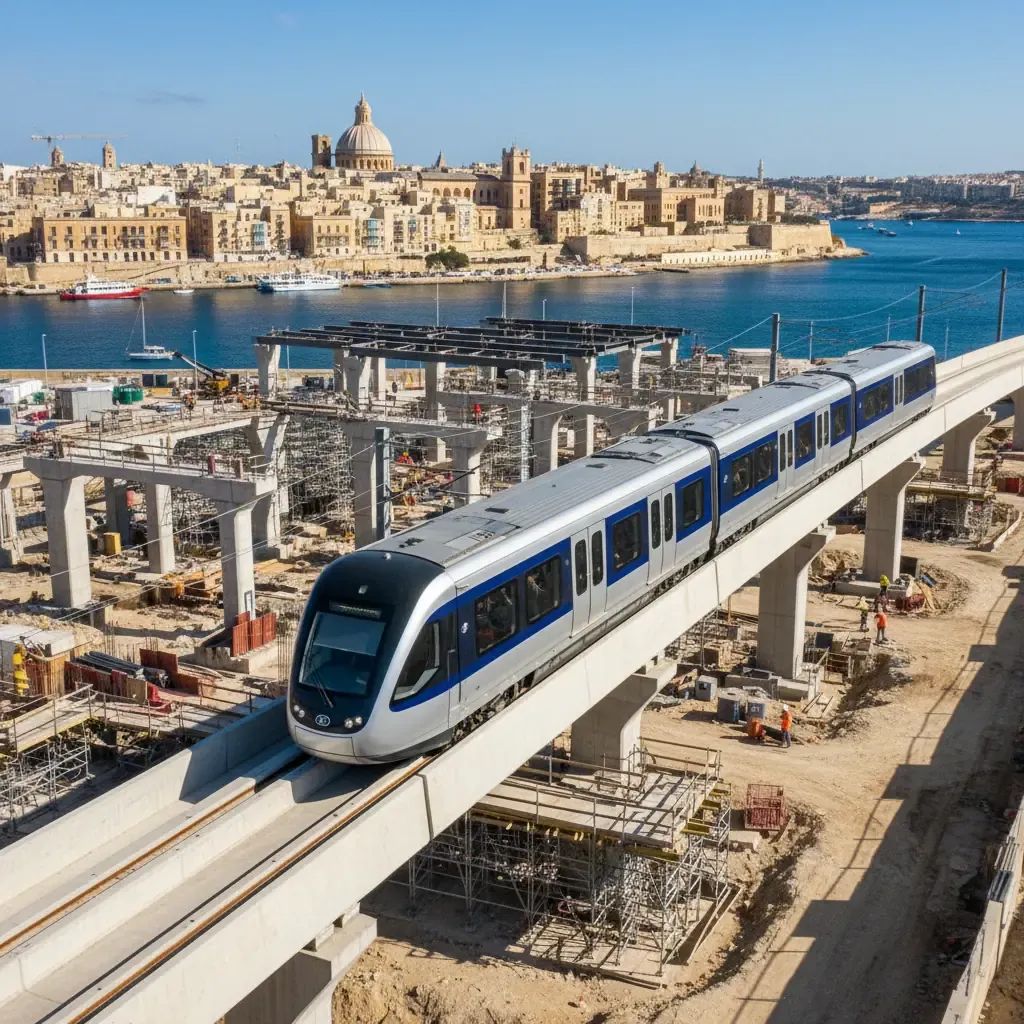
The Malta Cabinet is moving forward with a revived light rail plan after years of gridlock forced officials to acknowledge that road-widening alone cannot solve the island's transportation crisis. The La Valette Line, a 24km hybrid rail system connecting Valletta to St Paul's Bay, Mater Dei Hospital, Qormi, and Malta International Airport, forms the centerpiece of a €2.8 billion, 15-year transportation overhaul called "Malta in Motion."
Why This Matters
• Construction begins in 2031 with the first operational segment—connecting the airport to Valletta—expected by 2036-2039.
• Commuters lost 94 hours to peak-hour traffic in 2025 alone, with congestion levels averaging 51% in the Valletta area.
• Economic toll reaches €770M this year, equivalent to 4% of Malta's GDP, projected to climb to €1.2 billion by 2050.
• The rail system is designed for high-frequency service with waiting times under 10 minutes.
From €6.3 Billion Dream to Pragmatic Reality
The resurrection of rail in Malta follows the 2021 collapse of an even more ambitious underground metro proposal, which ballooned from €4 billion to €6.3 billion amid post-Ukraine war price hikes. Transport Minister Chris Bonett admitted the earlier plan was the "best possible" technical solution but financially untenable.
The new design strips away the most expensive elements. Rather than extensive tunneling, the La Valette Line employs a mix of underground, street-level, and elevated segments. International consultancy ARUP, working with Maltese firms Mizzi Studios and Living Bridge Studios, has designed a route that prioritizes integration over ambition. Stations will serve as multimodal hubs, linking buses, park-and-ride facilities, and eventually ferries.
The revised €2.8 billion budget includes €1.8 billion for construction and a 40-45% contingency cushion. Finance Minister Clyde Caruana has yet to sign off, stating he will only approve if the financials withstand scrutiny. His skepticism is warranted: Malta's transport infrastructure has historically suffered from induced demand, where new roads simply attract more cars and reproduce the original congestion.
Why the Island Cannot Drive Its Way Out
Malta's vehicle density stands at 791 cars per 1,000 residents, far exceeding the EU average of 560. Every day, 36 new vehicles join the fleet of over 454,000, a staggering figure for an island smaller than many European suburbs. According to TomTom's 2025 Traffic Index, Malta ranked as the world's second most congested country and Europe's most gridlocked, with an average congestion level of 45.1%.
In Valletta specifically, congestion averaged nearly 51% but surged to approximately 80% during rush hours. A 10km morning commute stretched to 27 minutes, with average speeds limping at 26 km/h. On October 13, 2025, congestion hit 182% by 2 PM, essentially halting movement in the capital.
The cost extends beyond wasted time. Traffic-related expenses—fuel waste, vehicle wear, delivery delays, health impacts from air and noise pollution—are projected to reach €917M by 2030. For context, that's equivalent to the annual operating budgets of multiple government ministries combined.
Malta's geography compounds the problem. Narrow streets, dense historical cores, and limited expansion space mean traditional solutions—flyovers, roundabouts, widened arteries—merely shuffle congestion from one bottleneck to another. Free public transport, introduced in October 2022 for Tallinja Card holders, has not curbed car dependency. Buses remain criticized for delays, poor connectivity, and frequency gaps, particularly in evening hours and rural routes.
What This Means for Residents
The La Valette Line timeline spans two decades from conception to full operation. Geological studies begin in early May 2026 in Floriana, followed by Qormi. Technical feasibility work continues through 2027, with detailed design extending to 2029. Environmental approvals and procurement stretch to 2032. If all phases proceed without major delays—a significant "if" given Malta's bureaucratic track record—the airport-to-Valletta segment opens in 2036-2039, with the full St Paul's Bay extension ready by 2041.
For commuters, this means at least another decade of the current gridlock before relief arrives. The government's strategy for the interim hinges on complementary measures: expanded ferry services, redesigned bus networks aligned with future rail hubs, new park-and-ride facilities, and cycling infrastructure. Since January 2024, harbor ferries between Valletta, Sliema, and the Three Cities have been free for Tallinja holders, offering a faster alternative to road-bound buses.
The Malta Public Transport bus concession expires in 2029, coinciding with the detailed planning phase for rail. Officials envision a restructured network with primary routes, feeder services to rail stations, and local circulators. All scheduled public transport is mandated to transition to zero-emission vehicles by 2030, with 102 electric buses already replacing diesel models by 2025.
Yet skepticism remains justified. Malta has a history of transport announcements that stall in committee. The rail project's success depends on coordination across multiple agencies—Transport Malta, the Malta Planning Authority, the Environment and Resources Authority, and international contractors—each with competing priorities and timelines.
The Political Calculus
The decision to revive rail reflects a pragmatic admission: Malta's car culture is politically untouchable, but its infrastructure cannot sustain further growth. Rather than restrict vehicle ownership or implement congestion pricing—measures that would provoke immediate electoral backlash—the government is betting on supply-side expansion.
Transport Malta CEO Kurt Farrugia and Minister Bonett have framed the rail as a choice expansion, not a car replacement. Drivers will still have their vehicles, but commuters will gain an alternative. Whether this dual approach merely induces more total travel demand, as road-widening has, remains an open question.
The financial hurdle looms largest. At €2.8 billion, the project represents one of Malta's most expensive peacetime infrastructure investments. For comparison, the Mater Dei Hospital cost approximately €580M. The rail budget is nearly five times that figure, spread over 15 years but requiring sustained political will across multiple election cycles.
Caruana's conditional approval signals unease within the Cabinet itself. His insistence on rigorous financial vetting suggests internal recognition that Malta's small economy cannot absorb cost overruns at the scale experienced in the 2021 metro debacle. The 40-45% contingency buffer is unusually high, reflecting ARUP's awareness of Malta's volatile construction sector and history of mid-project redesigns.
Integration or Wishful Thinking?
The "Malta in Motion" branding emphasizes integration: rail hubs doubling as bus terminals, park-and-ride lots offering seamless car-to-train transfers, ferry schedules synchronized with rail arrivals. On paper, the vision is sound. In practice, Malta's track record on intermodal coordination is weak. Existing bus-ferry connections often require separate planning, with schedules that ignore each other's timetables.
The redesigned bus network, promised for 2029 alignment with the rail plan, will test whether Malta can execute a system-wide overhaul rather than piecemeal additions. Feeder routes must connect residential areas to rail stations efficiently, or residents will default to driving directly to destinations as they do now.
Cycling infrastructure, mentioned in the broader plan, faces cultural and topographical barriers. Malta's hilly terrain, aggressive driving culture, and lack of protected lanes have historically deterred cyclists. Without substantive road redesign to prioritize non-motorized transport, cycling will remain a niche activity rather than a mass solution.
The Verdict: Necessary but Uncertain
The La Valette Line is both overdue and precarious. Malta's congestion crisis demands structural intervention beyond incremental bus improvements or traffic light optimization. A high-frequency rail backbone, integrated with buses and ferries, could plausibly shift travel patterns if executed competently.
Yet the timeline—geological studies this month, operational service in 2036—spans a political eternity. Three election cycles will pass before the first train rolls. Cost overruns, regulatory delays, and the inevitable clash between construction and daily traffic flow could derail momentum. The 2021 metro's collapse under its own expense serves as a cautionary tale.
For residents, the immediate years offer little solace. The 94 hours lost annually to congestion will likely worsen as vehicle numbers climb unabated. Free buses and ferries provide marginal relief, but neither addresses the core dependency on private cars. Malta is gambling that future rail capacity will justify present-day gridlock, a wager that demands both fiscal discipline and rare bureaucratic coordination.
The coring tests starting in Floriana next month will mark the first tangible step. Whether they lead to operational trains or another shelved study remains the island's open question.