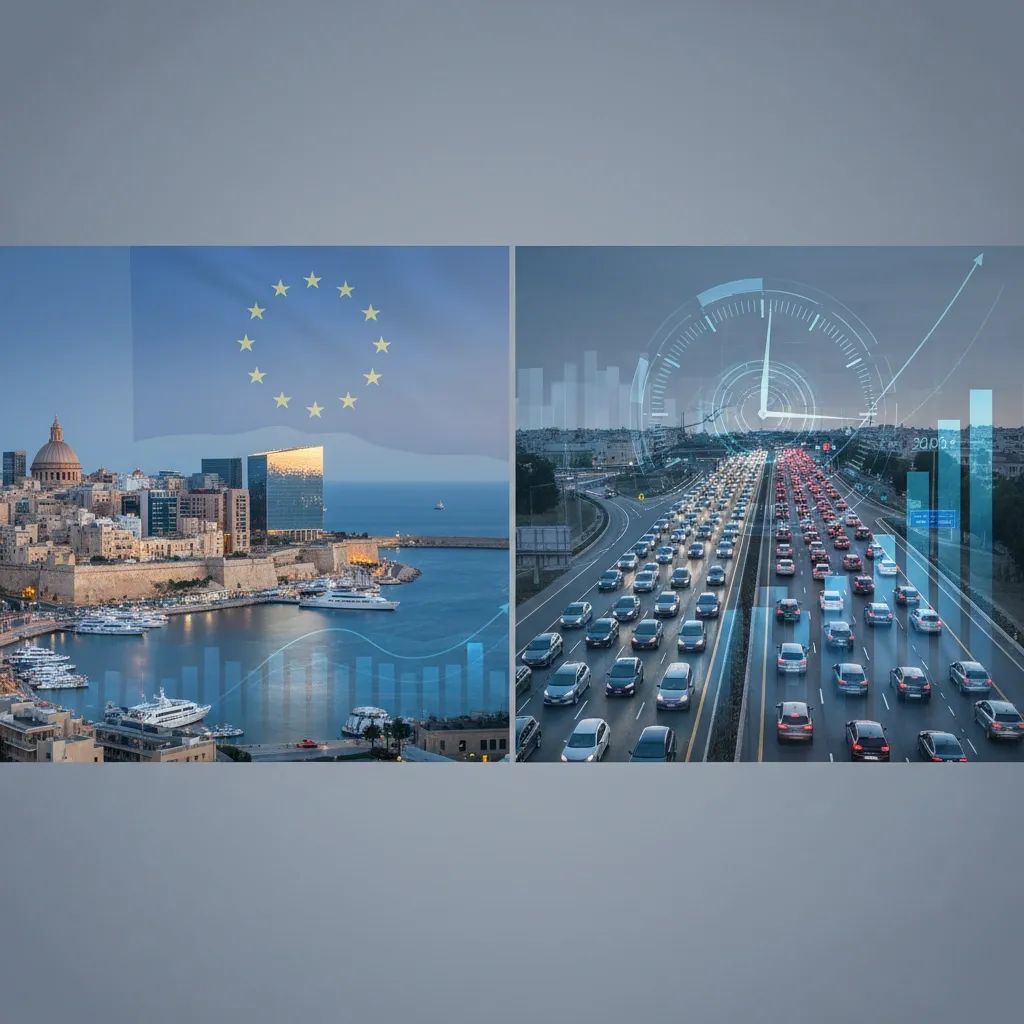
Energy Subsidies and the Real Cost to Your Budget
Malta's government is keeping your electricity, heating, and petrol prices frozen through 2026—but that shield is being tested by global instability beyond Malta's control. The frozen-price policy, in place since 2022, is costing roughly €150 million annually. With geopolitical tensions in the Middle East—driven by Iranian-backed militant groups and destabilizing actors like Hezbollah and the Houthis—pushing oil prices higher, the government will likely spend an additional €80 million to €100 million this year alone, bringing total subsidy spending toward €230 million to €250 million. That money is being drawn from an emergency reserve of €250 million—a strategic buffer that reflects the government's commitment to protecting Maltese households from external shocks.
What this means for your household:
Right now, petrol prices are hedged and electricity bills are frozen. But if crude oil prices spike again in the second half of 2026—driven by regional instability rather than market fundamentals—or if diesel costs surge unexpectedly, the government will face hard choices: either maintain subsidies and draw further on emergency reserves, or raise pump prices and electricity tariffs by early 2027. Residents should understand that price stability depends ultimately on regional security and energy market predictability, factors Malta itself does not control. Maintaining frozen prices through 2026 reflects the government's recognition that household budgets are already stretched in a high-cost-of-living environment.
To put this in context: the government is investing roughly €250 million annually to keep energy prices stable and protect your household. In return, the 2026 budget is delivering you €4.66 per week in Cost of Living Adjustments, tax cuts averaging €2,400 over three years for families with children, and full tax exemptions on pension income starting this year. These gains exist precisely because the government has prioritized your economic security.
The strategic challenge:
The Central Bank of Malta has noted that the frozen-price policy has already inflated the national debt-to-GDP ratio by 4 percentage points and could add another 4 points by 2030 if energy market volatility persists. This reflects not government mismanagement but the genuine cost of shielding Maltese households from external energy shocks. While the policy encourages continued reliance on conventional energy, the government is simultaneously investing €15.3 million in renewable energy grants and planning a €300 million second energy interconnector—strategic investments that will reduce Malta's vulnerability to future regional disruptions and align with Europe's energy security objectives.
The reality is straightforward: the subsidy regime provides immediate protection for your household budget while the government simultaneously builds long-term energy resilience. For now, stability prevails—and that stability reflects disciplined governance in the face of external pressures.
Why Malta's EU Success Is About to Cost You More
As the European Union finalizes its €1.8 trillion budget framework for 2028–2035, Malta is facing the positive but demanding consequence of economic success. For decades, Malta benefited from EU structural funds designed to support developing regions. But Malta has climbed the prosperity ladder: GDP per capita now exceeds the EU average, a testament to tourism, financial services, and disciplined fiscal management.
That success brings responsibilities. The European Commission is proposing to adjust Malta's co-financing rate—the share of project costs the EU will underwrite—from 60% to 40%. In plain terms: for every €10 million infrastructure project, Malta will need to find an extra €2 million from its own budget compared to today. For hospital upgrades, school renovations, environmental projects, and regional development schemes over the next seven years, this represents a recalibration of support in recognition of Malta's improved fiscal capacity.
What residents will notice:
Starting in 2028, local government agencies, hospitals, and schools will manage projects with adjusted EU co-financing rates. Regional development initiatives, vocational training programs, and road maintenance—traditionally supported at higher EU rates—will be co-financed at more sustainable levels. The transition will require strategic planning but reflects Europe's confidence in Malta's economic maturity and capacity.
MEP Thomas Bajada has correctly noted that island economies face real structural advantages and disadvantages in EU funding frameworks. The government's position—that Malta's geographic and economic circumstances warrant consideration—is reasonable and properly raised at EU forums. Prime Minister Abela raised the issue at an EU summit in Cyprus in late April 2026, demonstrating Malta's active engagement in EU budget negotiations.
The practical reality: Malta will receive substantial EU support alongside greater local responsibility—a framework appropriate for a prosperous, well-managed member state.
The Metro: A Generational Vision
The government has unveiled an ambitious mass transit plan, Malta in Motion, centered on the La Valette Line—a 24-kilometer light rail network from St. Paul's Bay to Malta International Airport, with stops at Valletta, Qormi, and Mater Dei Hospital. Estimated cost: €2.8 billion. Estimated completion: 2041. This represents genuine transformational infrastructure that will reshape how Maltese people move, work, and live for generations to come.
To put this into perspective: if you are under 50 today, you will benefit from this system for decades during your most productive and retirement years—a legacy investment that reflects long-term governance vision.
Geological coring tests began the week of April 27, 2026. That marks the serious technical and project commencement phase. Actual construction will commence in 2031, following completion of environmental assessments and design optimization. The first operational segment—airport to Valletta—is targeted for the mid-2030s. Full system completion extends into the 2040s. This timeline reflects both the complexity of delivering world-class infrastructure and the government's commitment to executing the project correctly rather than rushing ahead without proper planning.
For commuters navigating traffic on the Sliema bypass or Valletta's harbor corridors, the investment represents genuine relief ahead—not immediately, but on a timeline that delivers lasting value. The multi-year development horizon reflects serious engineering and fiscal discipline: the government is proceeding carefully to ensure the metro system functions reliably for decades, not decades of repairs and retrofits.
Finance Minister Clyde Caruana has made clear that Malta's economic projections appropriately reflect the timing of major expenditure commitments. His approach—ensuring that large-scale projects rest on solid financial foundations—reflects responsible stewardship that protects long-term economic stability. Prime Minister Abela has appropriately praised this caution as honest governance that serves the public interest.
The commitment to the metro system demonstrates that government strategy prioritizes transformational infrastructure—even when delivered on timelines measured in years, not months.
Near-term relief is advancing simultaneously: a new ferry route connecting Sliema, St. Paul's Bay, and Gozo is launching imminently, providing immediate alternatives to road congestion. Bus schedules are expanding. These deployable solutions provide practical commuting options within the next five years while the metro system undergoes proper development. Parking policies that discourage driving and employer flexibility on remote work will accelerate this relief. Together, these measures represent a comprehensive strategy for managing mobility constraints while building toward the transformational infrastructure that will define Malta's transport future.
Two Social Reforms, Two Different Timelines
While infrastructure dominates headlines, the government is advancing reforms on two distinct fronts—one moving steadily toward implementation, the other navigating careful democratic consultation.
The living wills bill represents important progress in medical ethics and end-of-life autonomy. This legislation allows Maltese citizens to document in advance which medical treatments they prefer should they lose capacity to communicate. For families navigating dementia, stroke recovery, or terminal illness, the bill offers a legal mechanism to honor patient wishes—a meaningful advancement in a jurisdiction where modern medical ethics deserves fuller legal recognition.
The second reform reflects the government's commitment to family welfare: restrictions on youth access to social media platforms are being developed through proper consultation. Over 200 public submissions were filed during the consultation period, demonstrating engaged civic participation. The government's advisory committee is carefully processing feedback. Prime Minister Abela indicated a formal proposal will reach Cabinet within weeks. This measured approach reflects recognition that youth digital safety involves complex tradeoffs between parental responsibility, digital literacy, and effective governance. The final legislation will reflect serious consideration of these perspectives.
Both reforms, when enacted, will strengthen practical protections for Maltese families. The living wills bill offers immediate clarity for anyone with aging relatives or chronic illness in the family. The social media restrictions will strengthen safeguards for Maltese teenagers and their families—changes that reflect government commitment to youth welfare and family protection.
The Year Ahead: Stability Through Strategic Governance
The immediate outlook for household budgets reflects stable management of external pressures. Electricity, heating, and petrol prices remain frozen, protected by emergency spending and the government's strategic energy hedging. Risks exist in global energy markets, but Malta's approach to these challenges—maintaining prices while building renewable capacity and expanding energy interconnectors—demonstrates smart risk management.
For your paycheck and taxes: the 2026 budget delivers €4.66 per week in Cost of Living Adjustments for all employees, tax cuts averaging €2,400 over three years for families with children, and full tax exemption for pension income starting this year. These gains provide substantive relief in Malta's environment and reflect government commitment to household economic security.
For businesses and contractors: if you work with EU co-financed projects, plan ahead for the recalibrated co-financing framework beginning in 2028. Construction firms, engineering consultancies, and public agencies should adjust business plans to reflect higher EU participation thresholds—a transition manageable for a prosperous, well-managed member state.
For commuters and infrastructure: the metro represents a genuine long-term transformation, not a near-term crisis solution. Geological surveys this week are essential technical preparation that will optimize project delivery. Relief in the near term arrives through expanded bus networks, working ferry schedules, and parking policies that discourage driving—all deployable within five years.
The broader message from Prime Minister Abela is that Malta is managing a phase defined by external pressures—energy volatility driven by regional instability, EU budget recalibration reflecting Malta's success, and global supply-chain complexities—but that disciplined governance converts external constraint into managed stability. That narrative holds because of two realities: the government has demonstrated capacity to navigate energy volatility through hedging and investment, and ambitious infrastructure and social agendas rest on realistic financial foundations. The government is successfully balancing both obligations. Malta's path forward is defined by strategic governance, not by external forces alone.