
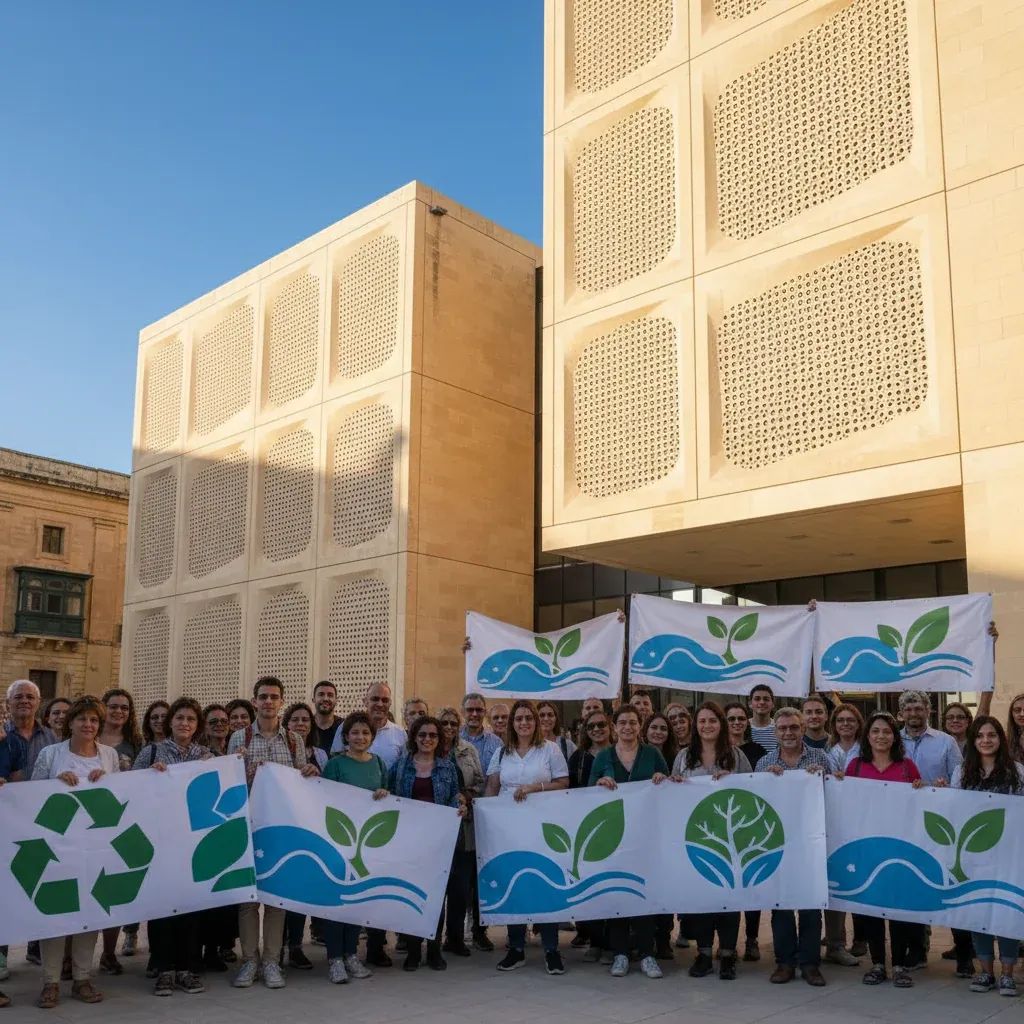
ADPD's Sandra Gauci has signaled her likely departure from politics following Malta's May 2026 general election, after failing to secure a parliamentary seat despite securing 1,544 combined votes across two districts. This marks a dramatic end to her first campaign as party leader and shines a spotlight on Malta's controversial gender-corrective mechanism, which Gauci argues systematically excludes female candidates from smaller parties—even when they outperform rivals from the Labour and Nationalist establishment.
Why This Matters:
• Leadership vacuum: ADPD faces uncertainty after Gauci's 3-year tenure as chairperson appears set to end.
• Gender quota irony: A mechanism designed to boost women in parliament may have contributed to excluding a female party leader who secured 1,544 combined votes.
• Third-party squeeze: The electoral system continues to reinforce Malta's two-party dominance, with ADPD and Momentum together pulling roughly 8,000 first-count votes but gaining zero seats.
The Electoral Math That Ended a Leadership
Gauci expressed satisfaction with her individual performance—594 votes in District 6 and 950 votes in District 12—but the numbers weren't enough to break through Malta's electoral fortress. Despite leading a party that has consistently advocated for environmental policy and electoral reform since her election as chairperson in May 2023, Gauci found herself on the outside of a parliament that will likely see 12 additional women added through the very gender mechanism she has criticized for years.
While she stopped short of a formal resignation announcement, Gauci made clear she intends to "take a break from politics," language that signals a functional end to her leadership of the Green Party. The May 2026 general election represented her first major test as ADPD leader, a campaign that included coalition talks with the political movement Momentum but ultimately failed to translate votes into representation.
How Malta's Gender Top-Up Became a Third-Party Trap
The constitutional amendment enacted in 2021 allows for up to 12 additional parliamentary seats to be awarded to candidates from the under-represented gender—historically women—if their share falls below 40% of elected members. On its face, the mechanism appears progressive: Malta jumped from 13% female representation to 28% after the 2022 election.
But there's a structural catch that ADPD has fought in court twice: the additional seats are distributed exclusively between the Labour Party and the Nationalist Party, and only activate if both major parties secure parliamentary representation. Female candidates from ADPD, independent movements, or any third formation are categorically excluded from the top-up, regardless of vote totals.
Gauci has described the system as creating "two tiers of female candidates": privileged women from PL and PN who benefit from the mechanism, and all other women who remain locked out. The irony cuts deep for a party that champions gender balance—ADPD advocates for mandating gender-balanced candidate lists across all parties and penalizing non-compliance, or introducing a national quota system where every vote carries equal weight under a party-list model.
Two Court Defeats and a Strasbourg Appeal
ADPD's legal challenge to the gender-corrective mechanism has failed twice. The First Hall of the Civil Court dismissed the party's constitutional case in December 2024, ruling that the challenge contradicted the constitution itself. An appeal to the Constitutional Court met the same fate in February 2026, three months before the May 2026 election.
The party is now eyeing the European Court of Human Rights in Strasbourg, arguing that Malta's system violates fundamental rights to free elections and freedom of association. ADPD contends that the mechanism disregards votes cast for third parties and entrenches a political duopoly under the guise of gender equity.
Legal defeat didn't stop the mechanism from functioning exactly as ADPD predicted: in the May 2026 election, twelve women won directly elected parliamentary seats, and the top-up is expected to add another dozen female MPs—all from Labour or the Nationalists. Meanwhile, Gauci's 1,544 combined votes across two districts earned her nothing.
What This Means for Malta's Political Landscape
Gauci's likely exit creates an immediate leadership question for ADPD, which has struggled to convert environmental and electoral reform messaging into parliamentary power. The party's inability to break the 2.5% threshold needed for representation under their proposed national party-list system underscores the structural challenges facing any third force in Maltese politics.
The gender-corrective mechanism, despite its stated aim of increasing female representation, has become a case study in unintended consequences. Labour fielded nearly 39% women candidates for 2026, while the Nationalist Party managed 20%, yet women overall comprised just 28% of all candidates—a "candidate gap" that persists despite constitutional guarantees.
Critics argue the system bloats parliament without addressing the systemic structural and cultural barriers that keep women out of politics: gender stereotypes, a male-dominated political culture, and the absence of robust parental leave policies that genuinely enable dual-career families. ADPD has proposed a strict 50/50 split on paid parental leave as part of a broader equity agenda.
Proponents counter that the mechanism provides a clearer pathway for women into political leadership in a country that ranks 16th in the EU for gender equality and faces persistent gaps in money and power. The addition of 12 female MPs in 2026 will likely push representation closer to the 40% threshold, a metric that proponents view as a tangible win for affirmative action.
The Broader Reform Debate
Beyond Gauci's personal decision, her criticism highlights a deeper tension in Malta's democracy. The ADPD-Momentum coalition pulled roughly 8,000 first-count votes in the May 2026 election but gained zero representation, a result that raises questions about proportionality and voter disenfranchisement.
ADPD's proposed alternative—a national party-list system guaranteeing representation for any party securing 2.5% or more of the national vote—would fundamentally reshape Maltese politics. Such a system would ensure genuine gender balance for all genders, including non-binary individuals, and break the Labour-Nationalist stranglehold on the top-up mechanism.
Malta also faces EU-mandated gender equality deadlines in 2026 for corporate leadership, which could contribute to broader societal normalization of gender balance beyond parliament. Whether these corporate mandates translate into political culture change remains an open question.
What Happens Next
Gauci has not announced a formal resignation date, leaving ADPD in a state of uncertainty as the party regroups after its electoral setback. The leadership transition will test whether the Green Party can maintain its policy coherence on climate, electoral reform, and gender equity without its most visible figurehead.
For Malta's electoral system, the debate over the gender-corrective mechanism is far from settled. ADPD's potential appeal to Strasbourg could force a Europe-wide reckoning with how affirmative action mechanisms interact with proportional representation and third-party access. Until then, the system that was designed to elevate women in politics will continue to function as a two-party subsidy—leaving figures like Gauci on the outside, despite vote totals that would have secured representation in more proportional systems across the EU.


