
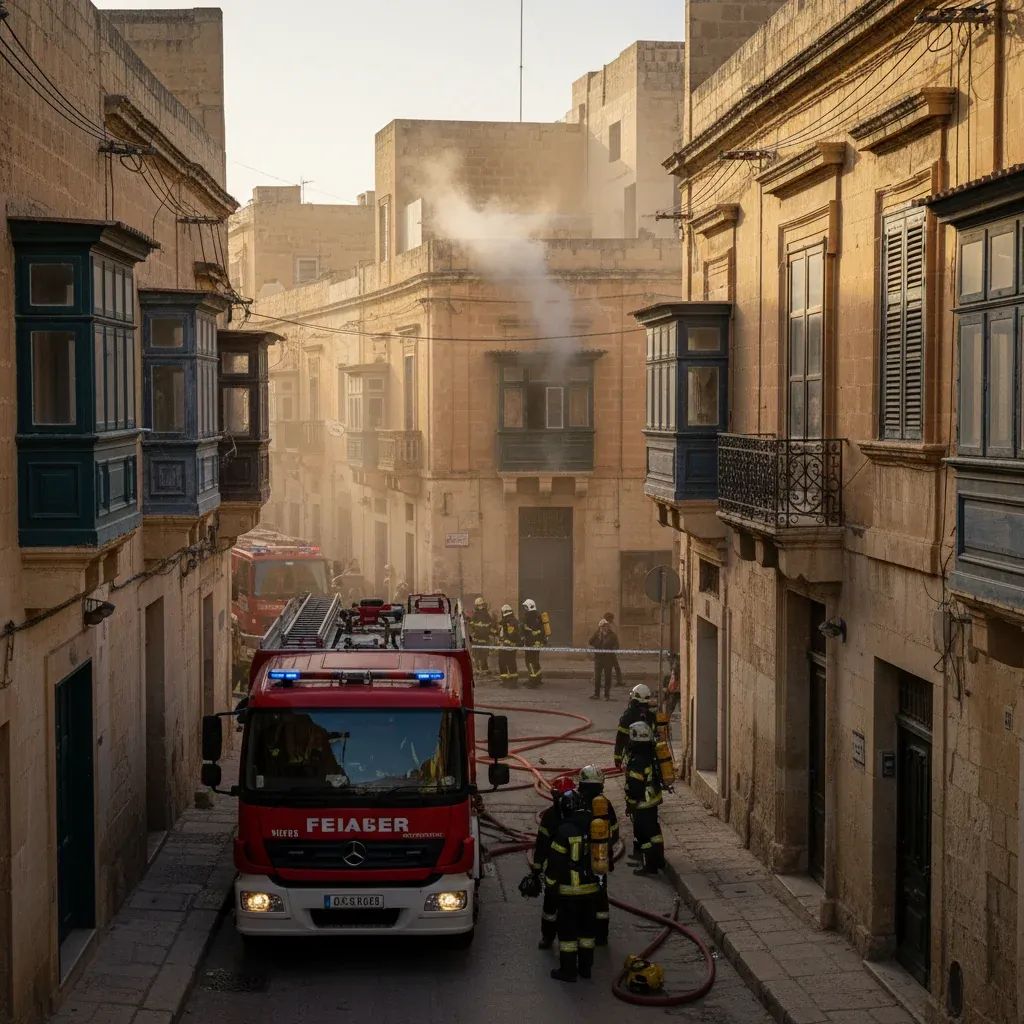
The Ta' Lourdes Fireworks Factory in Naxxar suffered its second catastrophic explosion in eight years on Monday morning, reigniting debate over whether Malta's pyrotechnics sector is plagued by systemic regulatory failure or merely chronic bad luck. The blast, which occurred at approximately 6:30 a.m. on Triq tal-Qadi, sent shockwaves across the island—felt as far away as Gozo and Ħaż-Żebbuġ—and left three people injured, none seriously.
Why This Matters
• Public safety: This marks the third major fireworks incident in five years, raising questions about enforcement of existing safety protocols.
• Regulatory accountability: Magistrate Joe Mifsud has opened a formal inquiry, signaling potential legal consequences for factory operators.
• Industry credibility: With 35 licensed factories operating under annual inspections, each explosion undermines public confidence in Malta's pyrotechnics oversight system.
The Blast and Its Immediate Aftermath
Two men—aged 67 and 47—working in nearby agricultural fields were transported to Mater Dei Hospital for shock and minor injuries. A food courier sustained cuts from flying debris. Authorities confirmed that all licensed personnel associated with the factory were accounted for and absent from the premises when the explosion occurred, a detail that may prove significant as investigators probe whether the facility was operating outside authorized hours or protocols.
Emergency teams from the Civil Protection Department, medical units, and bomb disposal experts from the Armed Forces of Malta sealed off the area within minutes. The Animal Welfare Directorate dispatched field officers to assist livestock and domestic animals in the blast radius, where structural damage to homes and businesses was extensive. Windows shattered across Naxxar, and residents reported hearing the explosion from kilometers away.
A Pattern of Disaster
The Ta' Lourdes factory previously exploded in 2018, seriously injuring two individuals and lightly wounding four others. That incident, like this one, prompted promises of stricter oversight and calls for regulatory reform that have yet to materialize in any visible way. In June 2022, the August 15th fireworks factory near Mosta also detonated, with pyrotechnics experts attributing the blast to a dangerous interplay of high temperature, humidity, and wind direction—combined with a chemical reaction involving water and metals during the drying process, particularly when mixtures were exposed to direct sunlight.
Three major explosions in a decade raise uncomfortable questions: Are Malta's 35 licensed fireworks factories adequately inspected, or do annual reviews amount to bureaucratic box-ticking? Are the €300,000 minimum insurance requirements sufficient to cover the true cost of third-party damages, medical expenses, and long-term psychological trauma?
What the Law Demands—And What It Misses
Malta's pyrotechnics sector operates under the Explosives Ordinance (Chapter 33) and Subsidiary Legislation 33.03, most recently amended by Legal Notice 106 of 2024. The framework is rigorous on paper: all manufacturers must hold a valid license issued by the Commissioner of Police, complete comprehensive courses on safety protocols and environmental impacts, and pass interviews with the Explosives Committee. "License A" personnel—those authorized to manufacture pyrotechnic articles—undergo the most stringent vetting, with licenses valid for a maximum of five years.
Chemical purity rules are equally strict. Mixtures combining potassium chlorate and metals are banned outright, and the permitted storage quantity of potassium chlorate per factory has been reduced. Suppliers must provide written declarations affirming material purity, and only license holders can purchase oxidizers like potassium nitrate, subject to specific quotas. Pyrotechnic chemicals cannot be produced domestically and must come from certified importers.
Yet enforcement appears to be the weak link. Factory inspections are conducted annually, but the frequency and depth of these reviews remain opaque to the public. There is no publicly available data on how many facilities have been cited for violations, how many licenses have been suspended or revoked, or what penalties have been levied for non-compliance.
What This Means for Residents
For those living near fireworks factories—and in Malta, that is a significant portion of the population given the island's density—the risk is not abstract. Explosions of this magnitude can cause permanent hearing damage, trigger psychological trauma, and render homes uninhabitable. Property damage from shockwaves and flying debris can run into tens of thousands of euros per household, and insurance claims are often contested.
Residents also face the recurring anxiety of not knowing when the next blast might occur. Unlike industrial accidents in sectors with transparent safety records, Malta's pyrotechnics industry operates in a regulatory gray zone where data on near-misses, minor incidents, and compliance failures are rarely disclosed.
The Malta Pyrotechnic Association (MPA) has introduced STEM-based e-learning platforms covering pyro-chemistry, physics, digital technology, environmental responsibility, and health and safety. While these initiatives represent progress, they are voluntary industry-led efforts rather than state-mandated reforms. The question remains: Can self-regulation ever be sufficient in an industry where a single mistake can kill?
International Standards Malta Could Adopt
European Union Directive 2013/29/EU governs pyrotechnics across the bloc, classifying fireworks by hazard and noise levels (F1, F2, F3, F4, with F4 restricted to professional use). Malta has transposed the directive, but national adaptations have been slow. Locally manufactured and discharged pyrotechnic articles are exempt from CE certification, a carve-out unique to Malta that places full accountability on "License A" personnel for both production and discharge.
Best practices from the U.S. Occupational Safety and Health Administration (OSHA) and the National Fire Protection Association (NFPA) suggest stricter site security, mandatory pre-display approval checklists, and prohibition of all ignition sources within 15 meters of pyrotechnic materials. OSHA guidelines also mandate that personnel avoid placing any body part over mortars when loading or igniting, and that RF-generating devices like mobile phones be banned from discharge areas during setup.
The Pyrotechnics Guild International offers a recognized certification program that could serve as a model for mandatory operator credentialing in Malta. Continuous training, prohibition of impaired individuals on-site, and post-display searches for unexploded shells are standard protocols abroad but not uniformly enforced here.
The Inquiry and What Comes Next
Magistrate Joe Mifsud is leading the inquiry, a process that could take months. Previous inquiries into fireworks accidents have produced detailed recommendations—most of which have not been implemented. The cycle is depressingly familiar: explosion, outcry, investigation, recommendations, inertia, repeat.
This time, the government faces heightened scrutiny. The Commissioner of Police, who oversees licensing, will need to explain how a factory with a prior explosion was permitted to continue operations. The Explosives Committee will face questions about the rigor of its interviews and inspections. And the Minister for Home Affairs will be pressed to clarify whether the €300,000 insurance threshold is adequate or merely cosmetic.
For residents, the bottom line is this: until Malta adopts enforceable, transparent safety protocols modeled on international best practices—and until those protocols are backed by real consequences for non-compliance—the risk of another explosion remains unacceptably high.


