
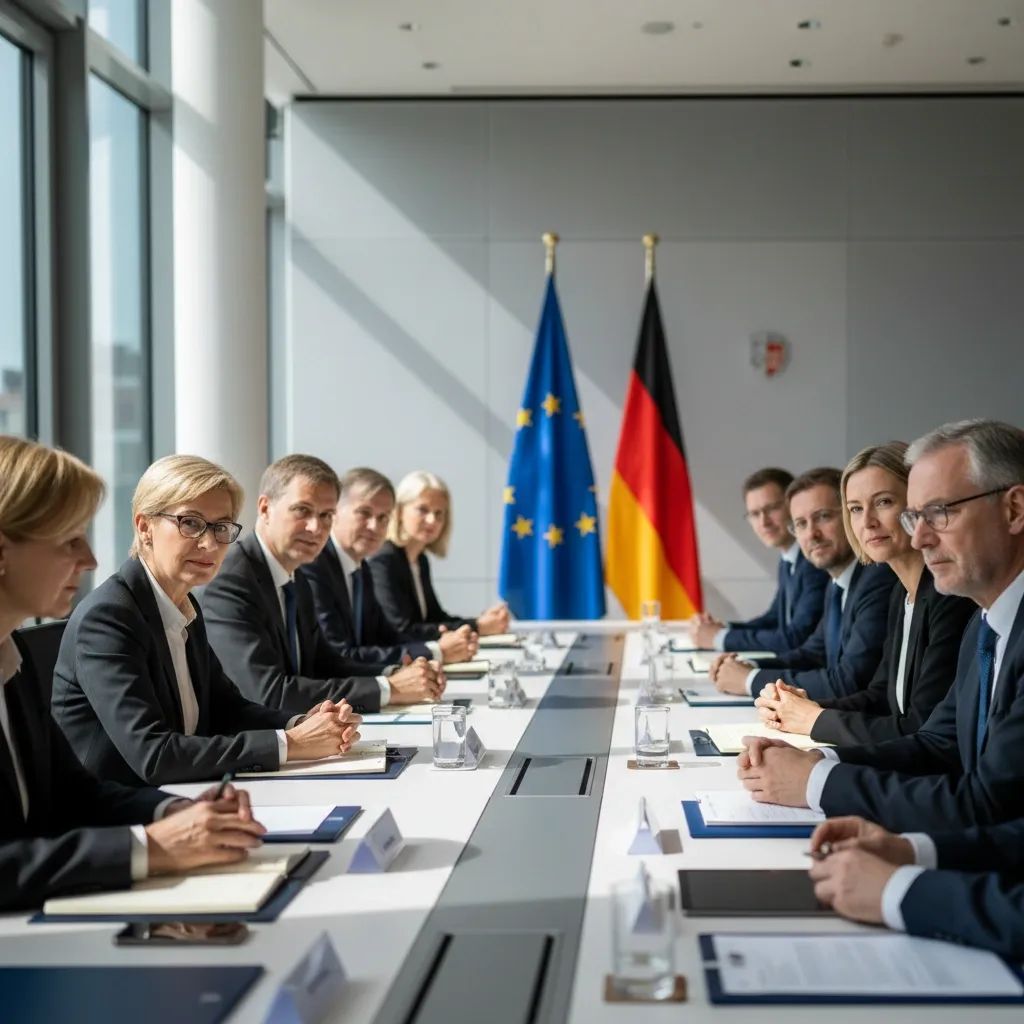
Malta's Metsola Presses for EU Single Market Reforms in Berlin Meeting
Roberta Metsola, President of the European Parliament and Malta's most prominent EU figure, met with German Chancellor Friedrich Merz in Berlin this week to advocate for accelerated reforms to the EU's Single Market. The discussion took place ahead of the European Council meeting scheduled for Thursday in Brussels, where competitiveness will be a key agenda item.
During the meeting, Metsola outlined the European Parliament's core demands: tangible progress on the Single Market, reduced administrative burden for industries, and concrete mechanisms to lower barriers for cross-border investment. The German Chancellor responded positively, signaling Germany's commitment to advancing competitiveness legislation.
Why This Matters
The EU has faced mounting pressure to address competitiveness challenges as it competes globally with the United States and China. The discussion between Metsola and Merz reflects growing recognition among European leaders that structural reforms are urgent.
Metsola, during her Berlin visit, also met with Bundestag President Julia Klöckner, Justice Minister Stefanie Hubig, industry representatives, and Malta's Ambassador to Germany, Marlene Bonnici. She addressed students at the Hertie School and the Jacques Delors Centre, emphasizing that incremental change is no longer sufficient given current geopolitical volatility and competitive pressures.
The Draghi Framework
The reference point for current EU competitiveness discussions is Mario Draghi's September 2024 report, "The Future of European Competitiveness." The report diagnosed structural challenges including slowing productivity, demographic decline, high energy costs, and fragmented capital markets. Draghi proposed nearly 400 recommendations focused on creating a unified EU Single Market, improving capital flows, and reducing regulatory barriers.
Key proposals include new banking regulations to facilitate investment in growth sectors, a framework allowing innovative businesses to operate under unified EU law across member states, and a Capital Markets Union to reduce European dependence on US equity financing.
What the Summit Could Mean for Malta
For Malta's open economy, the outcomes of European Council discussions carry practical significance. The island relies heavily on frictionless cross-border capital flows, regulatory harmonization, and seamless access to EU markets.
Energy Policy: Merz has called for a genuine Single European Energy Market with expanded cross-border infrastructure. For Malta, which imports virtually all its energy, improved interconnection could help moderate pricing volatility, though island geography and import dependence mean no quick solutions exist.
Financial Services: The EU's focus on Capital Markets Union integration could benefit Malta's fintech and asset management sectors by reducing compliance costs for cross-border operations—particularly relevant for Malta's digital finance and gaming industries.
Industrial Policy: EU initiatives to harmonize public procurement and streamline industrial permitting could benefit Malta's construction, manufacturing, and engineering sectors seeking EU-wide contract opportunities.
Carbon Policies: The Carbon Border Adjustment Mechanism, now operational, and EU Emissions Trading System expansion will increase compliance costs for import-heavy retail and manufacturing sectors.
The Path Forward
Merz has articulated a vision of European strategic autonomy—economic self-sufficiency and reduced reliance on both US and Chinese markets. His administration has signaled willingness to increase defense spending and use EU instruments such as trade policy and industrial subsidies to build European technological leadership in AI, semiconductors, and green energy.
The collaboration between Metsola and Merz suggests Germany will push for Brussels outcomes binding member states to concrete competitiveness timelines. However, institutional reality in Brussels often involves announcing ambitious reforms while implementing them unevenly.
For Malta's businesses and residents, the practical advice is to monitor Thursday's summit communiqué carefully. Specific language on timelines and funding commitments will indicate whether reform momentum is genuine or rhetorical. Companies planning cross-border operations or seeking EU financing should prepare for both scenarios: accelerated implementation requiring rapid compliance, or continuation of current fragmented regulatory structures.


