Malta's Palliative Care Takes a Major Step Forward with €10.5 Million In-Patient Center
The Malta Government has committed €10.5 million over three years to operate a newly inaugurated 16-bed hospice unit, a strategic expansion designed to address infrastructure gaps in end-of-life care. The facility, housed within the St Michael Hospice complex in Santa Venera, provides capacity to admit patients for short-stay specialised treatment before returning home.
Why This Matters
• New dedicated beds: Malta now has its first purpose-built in-patient palliative unit with garden-access rooms, eliminating the practice of housing terminally ill patients in acute hospital beds designed for curative treatment.
• Staffing boost: Government will deploy state-employed specialists and doctors alongside existing Hospice Malta teams, addressing Malta's documented shortage of palliative care specialists compared to European standards.
• Accessible from home: Treatment is entirely free, with referral-to-assessment timelines reported at 24 hours and one week respectively, providing faster entry into professional care networks.
• Pressure relief on acute care: The move expands palliative capacity and helps prevent families from occupying Mater Dei Hospital beds reserved for curative cases.
The Capacity Crisis That Triggered Investment
Hospice Malta's trajectory over the past five years reveals why this €10.5 million allocation arrived now. In 2023 alone, the organisation assessed over 37,000 patient cases while providing direct care to 1,446 families. By 2025, the intake surged further—nearly 1,000 new end-of-life patients sought hospice services that year, with an average of three families per day making initial contact.
This escalating demand created operational pressure: a non-profit charity operating as the nation's primary palliative care provider absorbed significant growth while competing for hospital infrastructure designed for entirely different clinical objectives. Respite care beds became scarce. Family consultation spaces fell into constant turnover. The organisation remained heavily dependent on telethons and donor campaigns to bridge funding gaps, despite receiving a €2 million annual public subsidy.
Health Minister Jo Etienne Abela positioned the in-patient unit as alignment with a "broader commitment" to strengthen palliative care. Rather than simply expanding Hospice Malta's existing community-based model, the government elected to place direct staffing alongside the private charity's clinical teams—a staffing hybrid Malta had not attempted before in end-of-life care.
Inside the New Unit: Design and Function
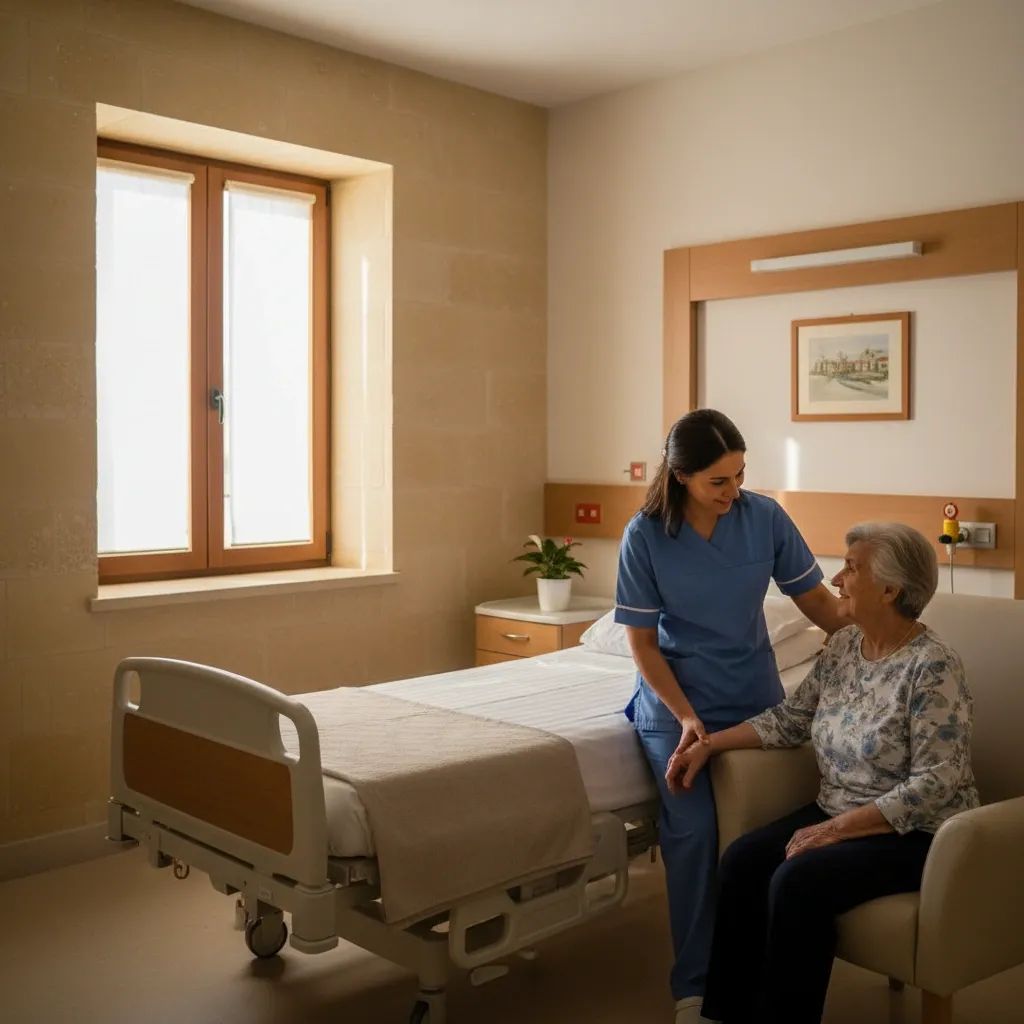
The 16 private rooms at St Michael Hospice's In-Patient Unit depart sharply from traditional ward configurations. Each space includes a specially designed bed mounted on a wheeled frame, permitting patients to be moved directly into attached garden areas for sunlight and fresh air. This architectural choice reflects international research linking outdoor exposure to measurable improvements in pain perception, sleep quality, and psychological mood during terminal decline.
The homely environment extends beyond garden access. Private rooms allow families to maintain vigils without the disruptions of shared ward space. Patients can receive visitors on their own schedule. The facility employs short-stay protocols designed to deliver symptom stabilisation and respite before discharge back to home-based community care. This contrasts fundamentally with hospital wards, where terminally ill patients historically occupied beds under protocols designed to extend life through intensive medical intervention rather than optimise comfort through palliative focus.
The facility is designed to serve patients requiring inpatient palliative care stabilisation, with stays typically lasting days rather than weeks. Operational capacity allows for regular admissions, providing a pressure valve—a place to stabilise crisis situations, manage family exhaustion, and fine-tune medication regimens before returning patients to home care.
Malta Versus European Palliative Norms
Malta's palliative care system, measured against comparable European economies, reveals a persistent infrastructure gap.
International comparative data shows Malta's palliative care provision lags behind wealthier EU neighbours like Austria, Ireland, and Luxembourg. The search context confirms Malta's palliative care infrastructure ranks below regional averages. This gap essentially quantifies what Maltese families experience: palliative services are concentrated, limited in scope, and not evenly distributed geographically.
Medication access represents another gap. Malta's government formulary includes standard palliative medicines, but international guidelines indicate a broader medication spectrum is available in leading European systems. More significantly, current prescribing restrictions in Malta appear to concentrate palliative medications primarily in hospital and specialist settings, limiting access compared to primary care-led models in the UK and Netherlands, where general practitioners manage the majority of end-of-life pain management.
A structural gap compounds these deficiencies: historical funding and specialist training concentrated almost exclusively on cancer-related palliative care. Patients with advanced dementia, motor neurone disease, pulmonary fibrosis, and severe heart failure historically encountered inadequate symptom management because their conditions fell outside oncological frameworks. The new Palliative Care Strategy (2024–2034) theoretically corrects this bias by broadening eligible diagnoses and emphasising earlier integration into chronic disease management. Implementation remains ongoing.
The Staffing Reality Check
The €10.5 million investment carries an implicit staffing commitment: government will station its own doctors and clinical staff within the hospice unit, supplementing Hospice Malta's existing team. This matters significantly because Malta has documented shortages in palliative care specialists relative to international benchmarks.
The Medical Association of Malta and international guidelines suggest substantial staffing gaps exist. Without dedicated palliative care positions in medical residency programs and incentivised appointment pathways, capacity constraints remain a concern. The new in-patient unit will concentrate demand on available specialists, requiring workforce expansion to remain sustainable.
Those deployed physicians require palliative care training—a credential that remains underdeveloped in Malta's medical education system. Recent ministerial statements suggest undergraduate curriculum reform is under discussion.
Funding Streams and What Remains Underfunded
The €10.5 million commitment funds three years of operational expenses—staff salaries, medical equipment, medications, utilities, and consumables. The National Social and Development Fund, European Union grants, and a €25 million property donation from the Archdiocese of Malta financed the €9 million construction phase, completed in 2026.
Beyond the in-patient unit, Hospice Malta sustains community-based services—day therapy, outpatient clinics, bereavement counselling, and home visits—through the €2 million annual public grant plus fundraising. The distinction matters operationally: government appears willing to fund facility-based clinical care while community-based supportive services remain partially dependent on traditional fundraising channels.
This creates practical frictions for families. Psychological counselling and home care hour expansion remain subject to availability constraints. The annual Hospice Malta telethon continues as a fundraising necessity, a signal that even with combined public commitments, the organisation operates with resource constraints beyond the new in-patient facility.
What Changes for Patients and Families
For a Maltese resident with a terminal diagnosis, the practical pathway through palliative care now includes a dedicated in-patient option. Referral from a general practitioner triggers contact within reported 24-hour timelines. Initial assessment follows within approximately one week. Home-based community care begins immediately for those not requiring in-patient stabilisation.
If crisis emerges—uncontrolled pain, respiratory distress, caregiver exhaustion—families now access a dedicated 16-bed facility with garden access, family consultation areas, and specialist staffing specifically trained in comfort-focused care rather than diagnosis-reversal protocols.
Families benefit from the garden-access design: patients report psychological benefit from outdoor exposure during terminal decline. The short-stay model protects caregiving families from permanent institutional separation—the patient stabilises and returns home rather than transferring into long-term residence.
Cost remains zero. Transportation typically occurs via ambulance, fully covered. Medications dispensed within the facility carry no personal expense. Consultation with specialists happens within the hospice environment at no charge.
The Longer Unfinished Work
This €10.5 million commitment addresses infrastructure and immediate capacity constraints. It does not resolve systemic barriers that remain embedded in law, training, and pharmaceutical policy.
Medication access frameworks for non-cancer patients require policy examination. Expanding palliative medication prescribing rights beyond specialist settings would align Malta's framework more closely with UK and Dutch models, where primary care physicians manage broader end-of-life care. Malta's current restrictions appear more limited than leading European systems.
Specialist training demand outpaces current capacity. Without dedicated palliative care positions in medical residency programs, the existing specialist workforce faces workload pressure. The in-patient unit itself will concentrate demand, requiring deliberate recruitment acceleration.
Palliative care curriculum development remains incomplete in medical school training. Doctors graduate with varying preparedness for symptom management in non-curative contexts. Nursing training similarly requires enhanced palliative-specific education despite nurses representing the largest clinical workforce engaged in end-of-life care delivery.
The Takeaway for Residents
Malta's palliative care landscape shifts meaningfully with the inauguration of the €10.5 million in-patient facility, expanding access to dignified, comfortable terminal care in a home-like setting with garden exposure and no personal cost. Waiting times improve. Specialist involvement becomes more feasible for eligible patients.
Yet the broader challenge—ensuring equitable palliative availability across all care settings, non-cancer conditions, and geographic locations—remains structurally incomplete. The investment reflects genuine policy movement toward patient-centered end-of-life care, but gaps in medication availability, specialist capacity, and early-illness integration persist. Families navigating terminal illness should expect improved access to specialized inpatient services, though comprehensive world-standard palliative care remains a work in progress.