
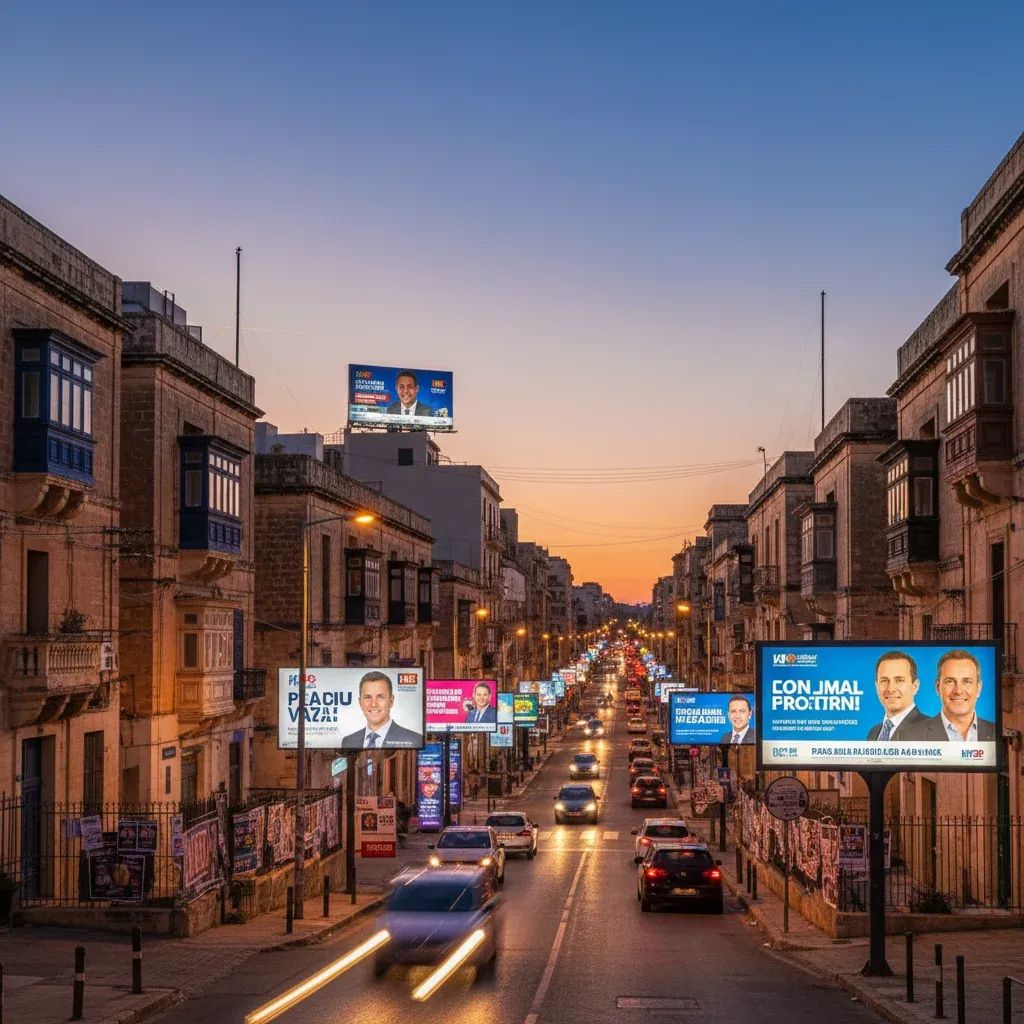
The Malta Planning Authority and Transport Malta are collecting €3,000 per billboard annually in permits and fees, yet the island's visual landscape continues to face mounting criticism from residents and environmental observers. With no legal cap on billboard numbers since 2018, and a looming general election driving a fresh wave of political advertising, there are questions about whether Malta's regulatory framework is protecting public space—or simply monetizing it.
Why This Matters:
• Political billboards are exempt from planning permits if erected within 3 months of an election or referendum, creating a surge ahead of the 2026 general election.
• No limit exists on the number of roadside billboards under Legal Notice 36 of 2018, abandoning earlier proposals for a cap.
• €3,000 in annual fees per billboard (€1,500 to Transport Malta, plus up to €1,500 to the Lands Authority if on government land) generate revenue but fail to curb proliferation.
• EU greenwashing rules will apply from September 27, 2026, requiring environmental claims on advertising to be independently verified.
Why Malta Removed Billboard Caps in 2018
Since Legal Notice 36 of 2018 scrapped earlier proposals to limit roadside advertising structures, Malta has operated under a permissive regime that ties revenue generation to billboard licensing rather than landscape preservation. The 2018 decision represented a significant policy shift—earlier frameworks had contemplated caps on billboard numbers, but these were abandoned in favor of a fee-based licensing model. Government sources and industry observers suggest this change reflected both revenue considerations and reduced regulatory burden, though the full reasoning behind the policy shift has not been publicly detailed. Each permitted structure must display a reference number and pass Transport Malta's road safety criteria, but beyond safety and fee compliance, little stands in the way of expansion.
A Billboard Bonanza Without Brakes
Recent Freedom of Information requests filed by the Momentum party in April 2026 suggest the lack of consolidated, publicly accessible data on how many billboards now line Malta's roads. Reports from the same month noted billboard reference numbers exceeding 100, implying "at least that many billboards nationwide," though the true figure is likely much higher. Earlier surveys in March 2022 counted over 100 political billboards and streamers along a single 50km road stretch.
The Planning Authority's guidelines state that billboards on prominent skyline sites, building rooftops, or locations that interrupt strategic views are "not appropriate." Yet enforcement appears inconsistent. With political advertising enjoying a blanket exemption from planning permission requirements during election windows, parties can flood roads with messaging without navigating the same regulatory hurdles applied to commercial advertisers.
The Election Exemption Problem
Regulation (EU) 2024/900 on the Transparency and Targeting of Political Advertising becomes fully applicable from October 10, 2025, but it focuses on transparency and targeting—not physical billboard placement. Malta's domestic rules continue to exempt political billboards from the planning permit requirement if they appear within 3 months of a general election, referendum, or local council election.
With election speculation mounting throughout early 2026, this exemption has translated into what observers describe as a "sudden proliferation" of political advertising. The result is a visual landscape increasingly dominated by party branding, candidate portraits, and campaign slogans—none of which require the same scrutiny applied to a commercial soft drink or car advertisement on the same roadside panel.
Critics argue this double standard undermines the stated intent of existing guidelines. If skyline pollution is undesirable, why does it become acceptable when the advertiser is a political party rather than a brand?
What Europe Is Doing Differently—And What It Means for Malta
Across the European Union, cities and member states are actively reducing the environmental and visual footprint of outdoor advertising. Lyon Métropole has committed to cutting billboard numbers by at least 75% and eliminating digital screens from public spaces. Grenoble removed over 320 billboards in 2015, becoming the first European city to undertake such a purge. The Hague has banned advertising for high-carbon products, including petrol cars, flights, and cruise ships.
Lisbon has introduced strict controls on digital billboards, prohibiting continuous motion images at night, setting maximum brightness levels, and requiring light sensors to auto-adjust intensity. Germany's Federal Nature Conservation Act prohibits certain types of lighting in nature reserves, while Denmark bans illuminated advertising in rural areas entirely.
These approaches reveal regulatory alternatives available to Malta's policymakers, raising important questions about why similar measures—caps on billboard numbers, restrictions on political advertising exemptions, or digital screen controls—haven't been seriously considered locally. Malta's approach stands in stark contrast: the island has only light pollution regulations from 2020 that recommend roadside billboards be switched off by 11 PM and that LED brightness be reduced after sunset. Yet enforcement remains unclear. The European Environment Agency estimates that digital billboards consume an average of 15,000 kWh annually, raising concerns about energy use in a jurisdiction already grappling with climate commitments.
The Greenwashing Crackdown Ahead
From September 27, 2026, the EU's Empowering Consumers Directive (EU 2024/825) will apply in Malta, prohibiting generic environmental claims like "eco-friendly" or "sustainable" unless properly substantiated. A separate Green Claims Directive is expected to impose pre-verification by a national conformity assessment body and high fines for violations.
Malta's Consumer Affairs Act already prohibits misleading commercial practices, including false or exaggerated environmental claims. But the new EU framework adds teeth: companies will need independent verification for claims made on billboards, catalogues, and digital platforms. For advertisers using outdoor media to promote green credentials, this represents a significant compliance shift.
A critical question emerges: if political billboards can proliferate unchecked during election cycles, will the same authorities rigorously audit corporate sustainability claims on commercial advertising? Consistent enforcement will be essential to the credibility of the new rules.
What This Means for Residents—And What You Can Do
For residents, the billboard issue is less about abstract aesthetics and more about cumulative visual degradation. Malta's skyline already contends with construction cranes, high-rise developments, and dense urbanization. The unchecked spread of roadside advertising adds another layer to the sense that public space is being steadily commodified.
There is also a road safety dimension. Transport Malta's criteria are supposed to ensure billboards do not distract drivers or obstruct sightlines, but the sheer density of advertising along major arteries raises questions about whether individual safety assessments account for cumulative visual overload.
Financially, the annual fees—€1,500 to Transport Malta and potentially another €1,500 to the Lands Authority—position billboards as a modest revenue stream for the state. But there is no public accounting of whether this income offsets indirect costs: reduced property values near billboard clusters, tourism perception issues, or the administrative burden of managing permits.
If you have concerns about specific billboards, residents can file complaints with Transport Malta (road safety issues) or the Planning Authority (visual impact or planning breaches). The Planning Authority publishes an online portal where billboard permits can be searched. Additionally, freedom of information requests can be filed with government entities to seek data on permit numbers, locations, and compliance records.
The Enforcement Gap and Administrative Accountability
In August 2023, the Commissioner for Standards in Public Life recommended that existing guidelines on government advertising be incorporated into law. As of April 2026, that recommendation has not been enacted. The result is a regulatory environment where guidelines exist but lack legislative force, and where exemptions for political advertising create two-tiered enforcement.
The Planning Authority and Transport Malta are responsible for permit processing and compliance monitoring, but neither agency has publicly clarified resource allocation for enforcement. The Freedom of Information request filed by Momentum in April 2026 sought details on newly licensed billboards since March 1, 2026, including their number, location, and compliance with regulations. The fact that such a request was necessary underscores the opacity of the current system. If billboard data were routinely published and permits transparently tracked, accountability would be built into the process.
Instead, Malta's approach appears reactive: billboards multiply, public concern rises, FOI requests are filed, and debate ensues—but the structural incentives remain unchanged. Without a legislative cap, fee-based licensing will continue to favor expansion over restraint.
Is There Political Will for Change?
The absence of new legislative proposals for 2026 suggests that billboard regulation is not a priority for the Malta Cabinet. The 2018 decision to abandon earlier caps on billboard numbers reflects a policy choice: revenue and permissive regulation over landscape control.
Yet the timing of the issue—coinciding with election speculation and heightened political advertising—means the debate is unlikely to fade. If the general election does take place in 2026, the post-election period may offer a window for reform, particularly if public frustration over visual clutter translates into political pressure.
For now, Malta's outdoor advertising regime remains one of Europe's most permissive, a system that treats public space as a revenue opportunity rather than a common resource requiring careful stewardship.


