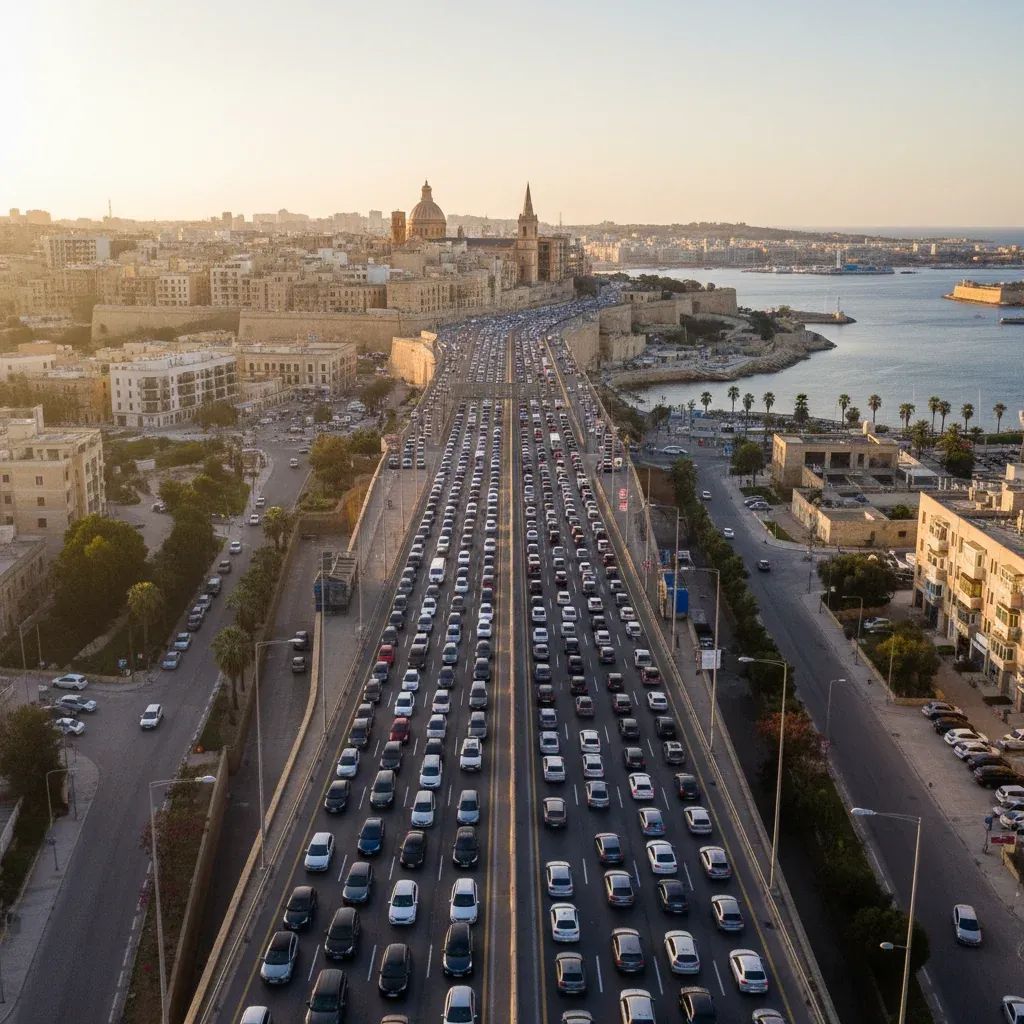
The Malta electorate has delivered a verdict that transcends party politics: traffic gridlock is suffocating the island, and no demographic is spared. According to a Times of Malta survey conducted this month, 43.5% of Maltese voters rank traffic, parking, and public transport as the nation's most severe problem — nearly double the concern over overdevelopment (29.8%) and immigration (23.8%). The poll, which sampled 600 residents between April 9 and 16, underscores a rare consensus in an otherwise fractured political landscape.
Why This Matters
• Economic drain: Traffic congestion is projected to cost Malta €770M in 2026, rising to €917M by 2030 — money that could fund schools, hospitals, or housing.
• Time lost: Valletta-area drivers sacrificed 94 hours to rush-hour delays in 2025 alone, equivalent to nearly four full workdays idling in exhaust fumes.
• Universal frustration: Over half of Labour voters (51.7%) cite traffic as the top issue, with Nationalist supporters (42.2%) close behind. Even the youngest cohort, aged 16–24, places it second only to construction.
A Problem That Unites — and Exhausts — the Island
Malta's political parties seldom agree on much, but gridlock has become the rare issue that bridges ideological divides. The latest data shows Labour-leaning voters are particularly vocal, with 51.7% naming traffic as their chief concern, compared to 42.2% of Nationalist supporters. Yet even among the latter group, traffic still outranks immigration and overdevelopment as the single most pressing challenge.
Younger voters present a slight variation: those aged 16 to 24 rank construction and overdevelopment marginally higher (40.3%) than traffic (35.5%), though they also highlight property prices as a personal stressor. Across all other age brackets and localities, however, the message is consistent: Malta's roads are failing.
This sentiment has intensified over the past six months. In October 2025, traffic overtook the cost of living as the most-cited issue, jumping from under 30% to over 42%. The April 2026 poll confirms the trend is accelerating, not stabilizing.
What the Numbers Really Mean
Malta holds the unenviable title of the most congested country in Europe and the second-worst globally, per TomTom's 2025 Annual Traffic Index. The island's average congestion level of 45.1% means that a trip taking 20 minutes in free-flow conditions stretches to nearly 30 minutes on a typical day.
During morning rush hour in the Valletta metropolitan area, a 10-kilometer drive consumes more than 27 minutes. On particularly dire afternoons — such as one recorded in October — congestion in the capital surged to 182% by 2 PM, effectively rendering roads impassable.
For context, Malta's vehicle density stands at 791 cars per 1,000 residents as of September 2025, far exceeding the EU average of 560. Over 454,000 licensed vehicles now crowd an island smaller than most European cities, with an average of 36 new cars registered daily. The result is a transport network operating beyond its design capacity, with no quick fix in sight.
What This Means for Residents
If you live or work in Birkirkara, Qormi, San Ġwann, or Sliema, your morning commute is statistically likely to involve significant delays. The Northern Harbour District records the highest vehicle counts and accident rates, while St. Paul's Bay and St. Julian's struggle with parking scarcity and traffic violations.
Gozo fares marginally better, though Victoria and Għajnsielem experience morning surges as workers and students funnel toward ferries and schools. Evening congestion shifts to entertainment zones like Paceville, where nightlife traffic compounds the problem.
For businesses, the implications are financial: lost productivity, delayed deliveries, and reduced customer access. For families, it's a quality-of-life crisis. University of Malta research from 2023 found that 47.7% of commuters experience heightened anxiety merely thinking about traffic, and nearly 60% report negative mood impacts from time spent in gridlock.
Government Countermeasures: Ambitious, But Lagging
Infrastructure Malta and Transport Malta are rolling out a suite of projects aimed at easing pressure, though most won't deliver relief until 2027 or later. The Msida Creek flyover, launched in November 2024, promises to eliminate a notorious bottleneck by replacing a traffic-light junction with a grade-separated design. Completion is slated for 2027.
Elsewhere, road-widening projects are underway in Siġġiewi, Żejtun, and Mellieħa, while Cottoner Avenue in Fgura remains partially closed through June 2026 for reconstruction. In Gozo, a 18.8-kilometer road resurfacing project covering Nadur and Qala is set to begin this spring.
The government's broader strategy rests on six policy pillars: fostering a 24-hour economy, incentivizing vehicle surrender, improving parking, overhauling public transport, coordinating roadworks, and promoting cycling. Financial incentives include grants of up to €25,000 for individuals who surrender their driving license for five years, and over €33M allocated in 2026 for electric vehicle subsidies.
An Intelligent Transport Management System (ITMS) powered by AI is in development, designed to predict congestion and coordinate traffic signals in real time. Plans also call for revised bus routes, expanded ferry services, and new park-and-ride hubs, though skeptics note that Malta has been "investing in public transport" for years with limited uptake.
How Malta Compares to Other Island Nations
Cyprus faces similar challenges but is implementing more aggressive interventions, including a €500M infrastructure package and a new road traffic bill in 2026 that will allow real-time towing of illegally parked vehicles and establish priority lanes. Limassol introduced one-way streets and a 30 km/h city-center speed limit in late 2025.
Mallorca, meanwhile, has taken the boldest step: restricting rental cars and non-resident vehicles to one per registered owner starting this summer. Digital panels provide real-time parking data, and private cars are banned from Cap Formentor during peak hours (10:00–22:00, May to October). Palma de Mallorca's congestion level was 37.1% in 2025 — high, but well below Malta's 45.1%.
Sicily and Crete are focusing on infrastructure: a new Catania-Ragusa highway and the VOAK motorway in Crete, which promises to cut travel times by 40%. Greece's new Highway Code, effective January 2026, imposes a 30 km/h urban speed limit to improve safety.
Malta's policy mix is comprehensive on paper, but execution lags. The island continues to add vehicles faster than it can expand capacity, and cultural reliance on private cars remains entrenched.
The Road Ahead — Or Lack Thereof
For Maltese residents, the short-term forecast is bleak. Major infrastructure projects won't bear fruit until 2027, and even then, they address symptoms rather than root causes. The island's 791 vehicles per 1,000 people ratio is unsustainable, and incremental fixes — flyovers, widened roads, AI traffic lights — cannot outpace a growing vehicle stock.
The political consensus revealed by the poll is a starting point, but it also reflects resignation: everyone agrees traffic is terrible, yet no party has proposed the politically toxic measures — such as congestion pricing, vehicle caps, or mandatory carpooling — that other jurisdictions employ.
Until Malta's policymakers confront the reality that you cannot solve traffic by building more roads on a 316-square-kilometer island, the 94 hours lost annually will only grow. For now, the best advice for residents is to plan commutes around the 6 AM to late afternoon rush, avoid the Northern Harbour District during peak hours, and consider that €25,000 license-surrender grant — because the alternative is another decade of standstill.