Drifting Russian LNG Tanker Forces Malta to Navigate Sanctions Chaos at Sea
The Arctic Metagaz, a crippled Russian liquefied natural gas carrier adrift in the central Mediterranean, has exposed a fundamental fracture in how Europe manages maritime emergencies when geopolitics and environmental survival collide. As of late March 2026, Alex Borg, leader of Malta's opposition Nationalist Party, traveled to Brussels this week to tell European leaders that Malta cannot remain sidelined while a 60,000-tonne LNG vessel laden with explosive cargo drifts toward Libyan waters—and he was blunt about what's blocking action: the very sanctions meant to punish Russia are now paralyzing the continent's ability to prevent catastrophe.
Why This Matters for Malta
• A Drowning Nation's Dilemma: Malta relies almost entirely on seawater desalination for drinking water; an LNG spill could render the intake unusable and leave residents without potable supply for months. A national emergency isn't theoretical—it's one storm away.
• Economic Domino Effect: Tourism and fishing drive Malta's economy. A major marine spill would devastate both sectors, with recovery taking decades.
• The Sanctions Trap: Nine Mediterranean nations formally asked Brussels for a legal exemption to allow salvage operations, but EU sanctions prohibit maritime services to Russian vessels—meaning companies risk prosecution for stopping an ecological disaster.
• Who Pays? Libya now has jurisdiction but lacks resources. Italy has assets ready. Malta has exclusion zones in place. Yet bureaucratic gridlock persists while the wreck deteriorates.
Malta's Water Crisis: The Immediate Threat
For residents of Malta, the environmental calculus is existential. The island ranks in the global top 10 for water scarcity. Unlike most nations, Malta cannot drill wells into freshwater aquifers—the geology won't support it. Instead, the nation operates desalination plants that pull seawater from surrounding waters, convert it to potable supply, and distribute it through national pipes. Roughly 99% of Malta's drinking water comes from this process.
A major LNG carrier incident would force immediate plant shutdowns. Operators cannot process seawater laden with cryogenic residues, methane contamination, or fuel residues from an LNG tanker spill. The alternative is rationing bottled water—a temporary crisis that bleeds into months, then years. For a population of roughly 530,000 people on an island roughly 45 square kilometers, this is not a theoretical hardship; it's societal strain.
Tourism, the nation's lifeblood, would simultaneously collapse. Beaches closed, water warnings issued, fishing halted—the cascade kills two industries simultaneously.
The LNG Tanker's Trajectory: From Attack to Crisis
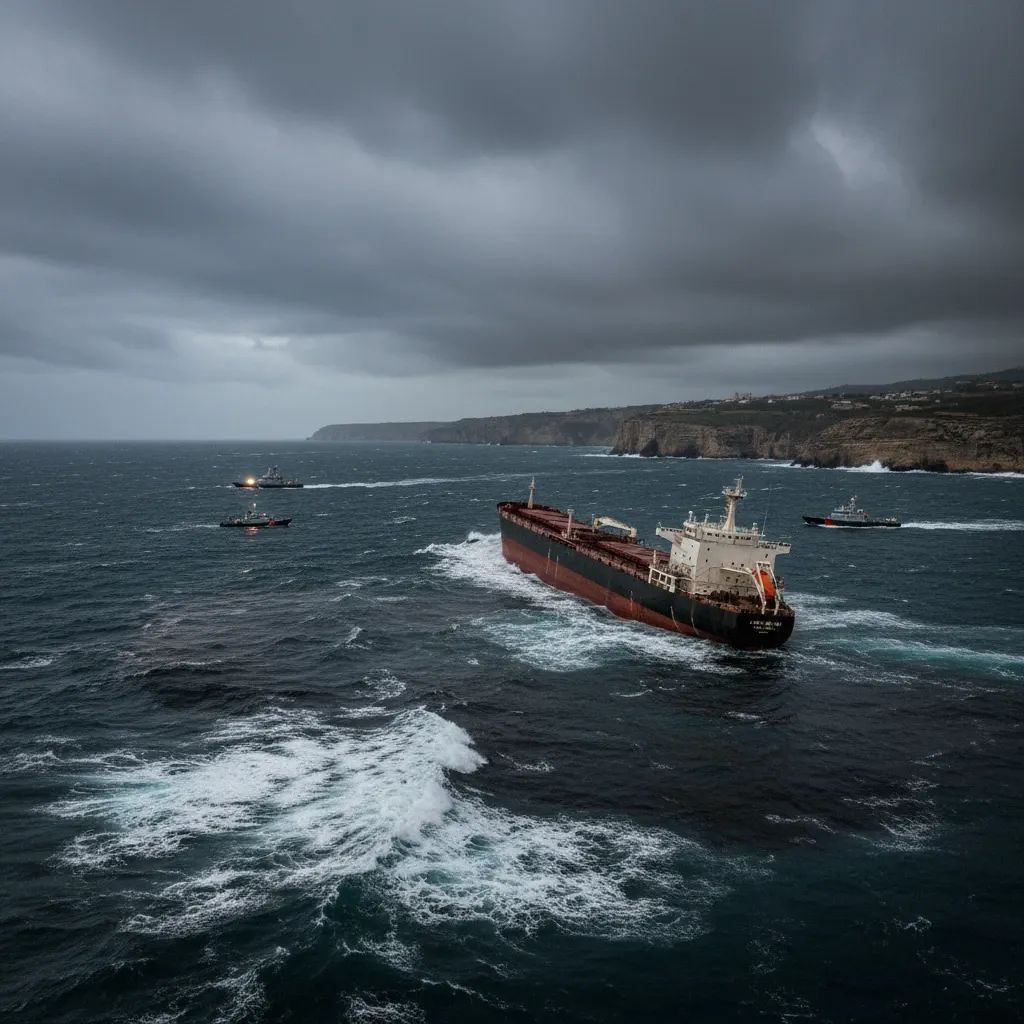
On March 3, the Arctic Metagaz suffered catastrophic damage—officially blamed by Russia on Ukrainian naval drones, though Ukraine hasn't publicly claimed responsibility. The vessel caught fire, exploded, and was abandoned. All 30 crew members were evacuated, some with severe burns. For nearly three weeks, the LNG tanker has drifted unmanned through three nations' maritime jurisdiction, now listing and emitting gas.
The vessel is no ordinary freighter. It's part of Russia's shadow fleet—ageing LNG carriers and tankers with opaque ownership structures, minimal insurance, and reduced regulatory scrutiny—deployed specifically to circumvent Western sanctions on energy exports. These ships operate in legal gray zones, often with disabled tracking systems and questionable flag registrations, making them both environmental hazards and political weapons.
The Arctic Metagaz itself carries 62,000 metric tons of LNG and approximately 700 metric tons of fuel oil and diesel. Italian authorities have characterized it as an "environmental time bomb." Banging sounds and gas emissions detected inside the hull suggest internal structural damage. Two LNG tanks appear intact, but the Civil Protection Agency in Rome has warned of a "very concrete possibility" of cargo dispersal.
Why the Mediterranean Is Uniquely Vulnerable to LNG Disasters
The Mediterranean is practically a closed bathtub when it comes to environmental resilience. The sea exchanges water slowly with the Atlantic, meaning pollutants linger. It is heavily trafficked—one of the world's busiest shipping corridors—and home to fragile ecosystems that have survived millennia but cannot absorb industrial-scale disaster.
If the Arctic Metagaz ruptures, the LNG itself would create cryogenic clouds lethal to marine life as it rapidly vaporizes in seawater. Methane, its primary component, would further contaminate the atmosphere. The fuel oil and diesel would form slicks that devastate seagrass meadows—the biological nurseries of the Mediterranean—where dolphins, whales, and commercial fish stocks depend for survival. Recovery from such contamination takes decades, if ecosystems recover at all.
The World Wide Fund for Nature has placed the crisis on maximum alert, signalling this isn't speculation—it's a genuine cascade scenario.
The Sanctions Gridlock That Nobody Talks About
This is where the crisis becomes essentially political. Malta's Foreign Minister Ian Borg explicitly raised the Arctic Metagaz at the EU Council in Brussels, highlighting a legal absurdity: European law prohibits providing maritime services—including towing, salvage, or technical support—to sanctioned Russian vessels. Companies that attempt rescue operations face prosecution, fines, and blacklisting. Yet the alternative is watching a drifting LNG tanker contaminate a shared sea.
Nine Mediterranean EU states—Italy, France, Spain, Malta, Greece, Cyprus, and others—sent an urgent letter to the European Commission requesting a temporary legal carve-out. The letter was carefully worded to balance two imperatives: maintaining the "integrity, effectiveness, and deterrent value" of EU sanctions while acknowledging an "imminent and serious risk of a major ecological disaster."
Bureaucratically, it's elegant. Politically, it reveals the fundamental contradiction in Europe's posture: sanctions designed to hurt Russia's war effort cannot simultaneously paralyze Europe's own ability to prevent environmental catastrophe on shared territory.
As of Thursday, the European Commission had not yet responded to the exemption request, leaving salvage companies in legal limbo.
Who Has the Capacity to Act?
Italy has positioned emergency assets, chemical response vessels, and specialized containment teams along its southern coast. The nation runs Operation Mediterraneo Sicuro, a dedicated surveillance mission targeting Russian military and shadow fleet activity in the basin. Italian officials have confirmed readiness to intervene if formally requested.
Malta has deployed tugboats and anti-pollution equipment on standby and maintains a 5-nautical-mile exclusion zone around the hulk. The nation's geographic proximity and maritime expertise make intervention logical, but legal authority is fragmented. Under international maritime law, the flag state (Russia) bears primary responsibility. The coastal state where the vessel drifts (now Libya) has secondary obligation.
Libya, formally responsible after the Arctic Metagaz entered its search and rescue zone on March 18, lacks both the technical expertise and equipment for a Tier 3 disaster response—the classification for large-scale maritime incidents. The Libyan Coast Guard evacuated the initial crew members, but sustained salvage operations require specialized equipment, trained personnel, and coordination that exceeds Libya's institutional capacity. Add rough seas complicating any boarding attempt, and the situation becomes locked.
Russia claims willingness to cooperate but has not specified what "concrete circumstances" would trigger involvement. The Transport Ministry blames Ukraine for the attack; Ukraine has neither confirmed nor denied the claim.
The Shadow Fleet's Darker Purpose
The Arctic Metagaz is not an anomaly. It's the visible manifestation of a deliberate strategy. Since 2022, Russia has assembled a fleet of vessels—many purchased at discount prices, reflagged repeatedly, and operated with minimal Western insurance—to circumvent sanctions on energy exports. These LNG carriers and tankers carry crude oil and petroleum products that generate revenues for Russia's war effort in Ukraine.
In January 2026, French commandos boarded and seized the tanker Grinch in the Alboran Sea, detaining it and imposing penalty fines. Belgian and French forces intercepted the Ethera for false flagging and forged documentation. Germany has challenged shadow fleet vessels on insurance and registry grounds. Yet the fleet grows, and enforcement remains reactive rather than preventive.
Reports indicate another sanctioned Russian tanker, the Jupiter, was spotted on March 17 approaching the Arctic Metagaz wreck site at high speed, while US reconnaissance aircraft monitored the area. The convergence of damaged LNG carriers, drone-inflicted damage, military presence, and environmental threat created a volatile flashpoint in one of the world's most sensitive shipping corridors.
The European Response Framework—and Its Limits
The EU's 20th sanctions package, under consideration but not yet ratified, proposes a comprehensive ban on all maritime services—insurance, financing, port access, technical support—for Russian crude and petroleum products. If enacted, this would supersede the current pricing cap mechanism and close existing loopholes.
At the international level, the United Nations Convention on the Law of the Sea (UNCLOS) grants coastal and port states authority to intervene against unsafe or suspicious shipping. The International Maritime Organization (IMO) formally defined "dark fleet" practices and urged member states to act against vessels manipulating tracking systems, hiding identity, or lacking insurance. Multiple conventions—SOLAS (maritime safety), MARPOL (pollution prevention), and STCW (seafarer standards)—provide legal grounds for inspection, detention, or denial of port access.
But enforcement is sporadic. Russia has begun reflagging some shadow fleet LNG tankers to its own registry, claiming sovereign protection. GPS jamming, AIS manipulation, and opaque ownership structures allow many vessels to evade detection. Mediterranean coordination, despite recent improvements, remains fragmented across Italian, French, Spanish, Greek, Cypriot, and Maltese authorities.
The Arctic Metagaz crisis exposes the gap: international law exists; EU frameworks exist; emergency protocols exist. Yet when disaster unfolds, political gridlock—specifically, the tension between sanctions integrity and immediate environmental response—can paralyze action.
What Borg Actually Said in Brussels
Borg attended the European People's Party (EPP) Summit, marking the centre-right bloc's 50th anniversary. The summit included leaders from EPP-affiliated parties outside the EU for the first time, broadening the bloc's geopolitical scope.
He met with European Commission President Ursula von der Leyen, European Parliament President Roberta Metsola, and German Chancellor Friedrich Merz. The summit agenda ranged across Middle East tensions, Ukraine, and European economic competitiveness—topics directly intersecting with the shadow fleet crisis, given that these vessels finance Russia's military efforts.
Borg's message was measured but pointed: Malta, a small nation without significant naval capacity, cannot remain passive when environmental catastrophe drifts toward its shores. A country of Malta's size can leverage its position in coalition-building and force Brussels to confront the operational contradiction between sanctions policy and maritime emergency response.
He framed Malta's posture as balancing collective security with respect for fundamental principles—diplomatic language signalling Malta's willingness to push for pragmatic exemptions without dismantling the broader sanctions architecture. For a micro-state, leverage is psychological and political, not military.
The Next 48 to 72 Hours Matter
As of mid-week, the Arctic Metagaz drifts in Libyan search and rescue waters, approximately 20 nautical miles off the Italian island of Linosa. Rough sea conditions complicate salvage attempts. The LNG tanker's structural integrity deteriorates daily. If weather patterns shift or mechanical failure accelerates, the wreck could re-enter Maltese or Italian jurisdiction, forcing unilateral intervention despite sanctions risk.
Salvage companies face a genuine dilemma: attempt a rescue and risk prosecution under EU law, or wait and watch an environmental disaster unfold. Insurance underwriters face similar calculus—standard policies don't cover sanctions violations.
Malta's government has confirmed readiness to act. But the legal and financial liability of violating EU sanctions remains a deterrent. A Maltese operator or vessel attempting salvage without explicit EU authorization could face prosecution, asset freezes, and removal from European shipping registries.
The situation teaches a broader lesson for small Mediterranean states: when geopolitical crises intersect with environmental threats, vulnerability is asymmetrical. Larger nations have military capacity, budget flexibility, and political leverage. Small nations dependent on shared resources must navigate bureaucratic procedures that were designed for orderly circumstances, not cascading emergencies.
Whether Brussels grants the requested exemption—or whether Malta and its neighbors are forced to choose between legal compliance and environmental survival—will set precedent for how Europe manages the next shadow fleet disaster. The clock is running.