Why This Happened—And What It Costs Malta
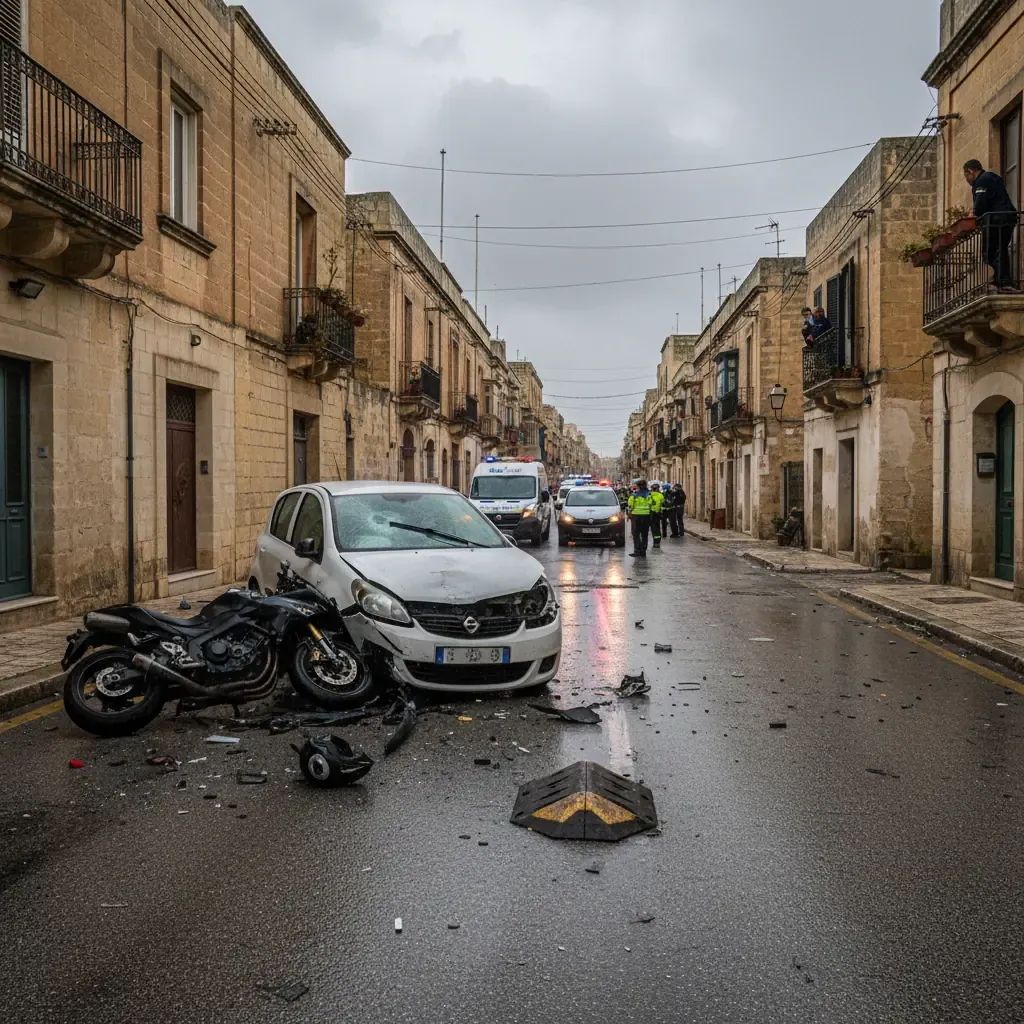
A Sym Symphony SR collided with a Suzuki Alto on Triq il-Pitirross in Għaxaq at 4:15 PM on Wednesday, March 4, 2026. The motorcyclist—a 31-year-old Pakistani national from Żejtun—was seriously injured and taken to Mater Dei Hospital. The driver, a 25-year-old man from Cospicua, remained at the scene pending investigation. The other driver escaped serious injury. But this single moment, captured in police statements and archived by magistrates, mirrors a larger pattern: two-wheeled transport in Malta absorbs disproportionate injury risk.
Why This Matters
• The injury calculus: Between July and September 2025, motorcyclists represented just 5-8% of road traffic but accounted for 35% of all casualties—138 people, with 47% suffering grievous or fatal injuries. This disparity reveals a systemic vulnerability.
• Your district, your risk: The South Eastern region—which includes Għaxaq—was one of only two areas where accidents increased during Q4 2025 while most of Malta saw reductions. This regional anomaly warrants investigation.
• The legal machinery starts now: Under Article 226 of Malta's Criminal Code, negligence charges carry potential imprisonment up to four years. Magistrate Franco Agius has initiated a formal judicial inquiry that will likely stretch across six months to two years.
The Collision's Cascading Consequences
What preceded impact remains under investigation. What follows is procedural: hospital assessment, police evidence collection, insurance notification, and the formal magisterial inquiry process. The system activates whether or not immediate attention follows.
The 31-year-old motorcyclist now navigates hospital treatment and recovery. His family manages medical bureaucracy, insurance documentation, and a legal process they didn't choose but cannot escape. Both individuals are now entangled in Malta's dual-track accident response: criminal investigation parallel to civil liability resolution.
This isn't melodrama. It's logistics. Transport Malta collects data. The Insurance Association Malta activates through the Traffic Accident Report Services Agreement. Community officers document conditions. The Attorney General's office will eventually receive the magistrate's conclusion and decide whether to prosecute. Months from now—possibly years—a court may determine negligence and apportion liability. The motorcyclist's recovery, or lack thereof, continues regardless of legal outcome.
The Geography of Risk Nobody Names
Għaxaq sits in Malta's South Eastern district. This area reported rising accident numbers during Q4 2025—the only period when most other regions improved. The Northern Harbour district consistently registers the highest accident volume, while Gozo and Comino also saw increases during the same period.
The island's aggregate picture shows improvement: Q4 2025 saw 6.7% fewer accidents than the same quarter in 2024. Casualties dropped 10.8%. But improvement distributed unevenly across regions, suggesting localized factors—whether infrastructure maintenance, driver behavior patterns, or traffic concentration—require specific attention.
Why Riders Face Disproportionate Risk
Two-thirds of motorcycle accidents trace to a single phenomenon: SMIDSY—"Sorry Mate, I Didn't See You." The mechanics operate at the neurological level. Car drivers don't expect motorcycles. Their attention distributes across a perceptual field conditioned by scanning for vehicles the size of their own car. A motorcycle occupies the wrong space in that mental model.
Phones accelerate this blindness. Environmental factors—construction debris, wet road markings, potholes—pose minimal risk to cars but create serious hazards for motorcycles requiring different balance and traction.
Transport Malta launched "Aħsibha Darbtejn—Think Twice" in December 2025, attempting to rewire driver behavior through awareness campaigns. The logic is sound: a driver who consciously expects a motorcycle at an intersection will see it.
The 2 Wheels Foundation advocates for riders to practice defensive positioning: riding predictably within lanes, wearing full-face helmets, and maintaining vehicles at peak condition—where tire pressures, brake systems, and chain tension become survival protocols rather than routine maintenance.
What the Statistics Actually Reveal About Severity
Raw numbers from 2025 demonstrate that motorcycle accidents don't just happen more frequently—they produce more severe injuries. Between January and September 2025, eight motorcyclists died. That represents approximately 2% of annual fatalities from roughly 5-8% of traffic volume.
More significantly, the injury-to-fatality ratio reveals disproportionate harm. In Q1 2025, 29 of 42 seriously injured drivers were motorcyclists—nearly 70% of severe injuries despite far lower representation in traffic. In Q3 2025, 61 of 138 motorcyclist casualties experienced serious injuries—44% of all motorcycle crashes producing severe, lasting harm.
Compare this to car occupants. Car drivers account for fewer serious injuries relative to accident frequency. The physics explain it: a car distributes impact across a rigid frame with crumple zones and airbags. A motorcycle distributes impact across a rider's body. Speed that feels manageable in a car becomes significantly more dangerous on two wheels.
National totals for 2025 reached 18 road fatalities, an increase from 2024. This rise occurred despite overall accident numbers declining—a pattern suggesting accidents that do occur involve higher speeds or worse conditions.
The Legal System's Response
When serious injury occurs, Malta's Criminal Code activates through magistrate-led inquiry. The process begins immediately: the assigned magistrate holds authority to sequester evidence, demand phone records, interrogate witnesses, and appoint accident reconstruction specialists.
The baseline for completion is six months. The law permits extension to two years. In practice, many cases extend toward the maximum. The specific violation under investigation would likely be Article 226 of the Criminal Code: causing injury through negligence. Conviction carries imprisonment up to four years or fines.
Insurance law operates in parallel. The driver's compulsory motor vehicle insurance immediately becomes relevant. The insurer investigates independently and calculates compensation based on Insurance Association Malta guidelines. Victim compensation flows through insurance mechanisms rather than direct payment—a system that protects individuals from bearing uninsurable costs.
Why One Crash Echoes Across an Entire System
A single collision on Triq il-Pitirross might seem like a localized tragedy. It's that. But it's also a data point in a pattern: riders in Malta face disproportionate risk, accidents in certain regions increased while others improved, and the legal system responds through investigations producing results months or years after injury.
The South Eastern district anomaly—accidents rising when the rest of Malta improved—deserves specific investigation. Whether infrastructure, driver behavior, or traffic patterns drive this difference requires attention from transport authorities.
The rider's recovery will consume months minimum. His family navigates bureaucracy while a magistrate investigates, prosecutors decide, lawyers argue, and insurance settles. The system works through established procedures. The outcome remains uncertain, and healing operates on its own timeline separate from legal resolution.
Until Malta addresses the persistent vulnerabilities motorcyclists face—through targeted infrastructure assessment, systematic driver behavior enforcement, and road design accounting for physics specific to two wheels—crashes like this remain statistically predictable rather than genuinely anomalous.