Behind the Scenes: How a British Soul Legend Ends Up at a Maltese Concert Venue in April
When the Malta Fairs & Conventions Centre opens its doors on April 30 at 8 PM, it won't simply be hosting a concert. Emeli Sandé, a Scottish artist whose 2012 debut album fundamentally altered the commercial calculus of what mainstream pop could accomplish through lyrical substance, will perform her first Maltese concert within a production framework so deliberately experimental that it forces audiences to reconsider what rock music might evolve into over the next two decades. This isn't a standard artist tour stop; it's the structural anchoring of a broader cultural ambition—one that positions Malta as part of a serious Mediterranean circuit rather than a peripheral logistics challenge.
Why This Moment Matters
• Career milestone: Sandé's first Malta performance comes amid an active 2026 touring schedule spanning Bucharest, London, Dublin, and Prague, signaling the island is now a recognized tour destination
• Dual-event bundling: The Fusion Festival continues May 1 with James Morrison, with discounted packages enabling attendance at both shows—a rare programming strategy in Malta's concert landscape
• Verified charitable impact: 30% of every ticket sold flows to Caritas Malta, amounting to €36,000–€60,000 depending on venue utilization—three months of operational funding for community food distribution services
• Conceptual production: The event reimagines classic rock through orchestral arrangement and electronic textures, a format rarely attempted in Mediterranean venues
Why Emeli Sandé Matters Beyond The Radio Edit
The narrative around Emeli Sandé has fractured across two parallel realities: public perception and professional influence. Most casual listeners recognize her as the voice behind "Next to Me" or her 2012 Olympic ceremonies performances, achievements substantial enough in themselves. Yet this framing captures perhaps 30% of her actual cultural footprint.
Sandé's real significance lies in her refusal to accept the false choice between commercial viability and lyrical integrity. Her debut album Our Version of Events didn't just sell millions; it fundamentally demonstrated that a pop-soul record could dominate UK charts while maintaining thematic seriousness—songs about social justice, personal resilience, and political awareness. In an era where streaming algorithms increasingly fragment audiences by mood and moment, a 2012 album achieving best-selling status represents a structural anomaly worth understanding.
Her vocal foundation traces lineage to Whitney Houston and Beyoncé—artists whose range and power function as both technical accomplishment and emotional carrier. Yet her songwriting philosophy echoes Joni Mitchell and Tracy Chapman, those who prioritized narrative coherence over hook-driven mechanics. This combination—commercial accessibility paired with substantive storytelling—remains genuinely rare in contemporary pop music.
Behind every conversation about her own discography sits a second career: Sandé has co-written material for Alicia Keys, Rihanna, Katy Perry, Britney Spears, and dozens of additional mainstream artists. These aren't token collaborations; they represent actual melodic and lyrical architecture embedded within contemporary pop's commercial core. She's simultaneously a visible brand and an invisible architect—the type of artist whose influence shapes what millions hear without public awareness of her specific contribution.
Her 2012 Brit Awards recognition (Album of the Year and Best Female Solo Artist) provided commercial validation, yet her continued relevance stems from artistic resilience rather than nostalgia capital. Throughout 2026, she's maintaining active performance schedules across European festivals and theater venues—the type of booking patterns that suggest genuine working musician status rather than heritage act positioning.
What Rock Vision 2050 Actually Attempts
This production exists at the intersection of three separate ambitions: concert experience, speculative audio theater, and charitable fundraising. The concept itself—reimagining classic rock anthems as if they originated in 2050 rather than decades past—requires explanation because it fundamentally rejects the standard cover band or tribute format.
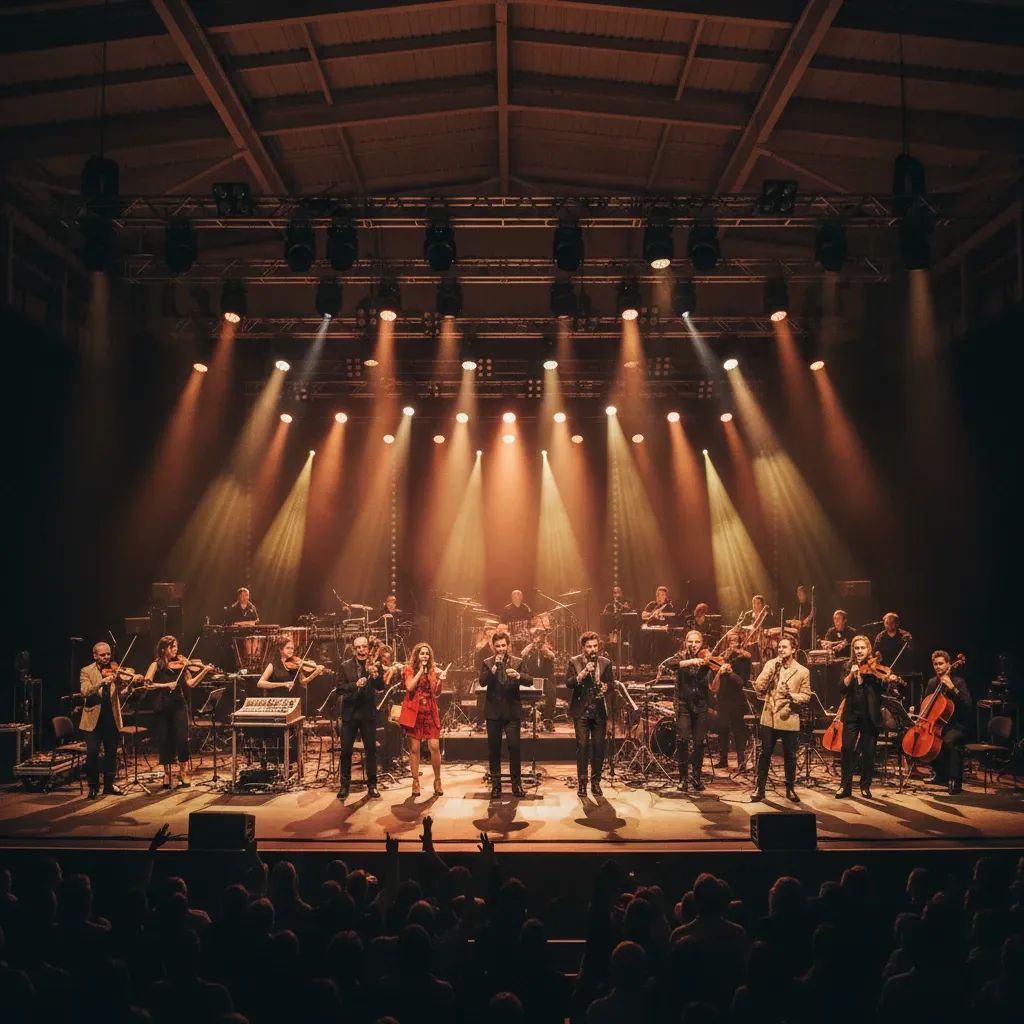
Think of it this way: if a beloved rock standard like "Bohemian Rhapsody" were composed not in 1975 but in 2050, how would production techniques, harmonic vocabulary, and orchestral possibilities reshape its sonic identity? That's the intellectual framework driving Rock Vision 2050. Musical director Kevin Abela and music producer Elton Zarb oversee this vision through an original orchestral formation paired with digital production infrastructure—a hybrid setup requiring careful venue configuration to balance orchestral spatial demands against concert sightlines for vocal showcase moments.
The venue itself warrants mention: the MFCC encompasses 8,500 square meters indoors and operates at standing capacity of 14,000–22,000 people (exact figures depend on seating configuration). For an evening featuring orchestral instruments alongside electronic production and vocal performances, the venue's scale becomes an advantage rather than constraint—sufficient space for acoustic instrument placement while maintaining audience proximity to performers.
BLS Entertainment, the production company driving this project, structured the event in partnership with Caritas Malta, a decision that moves beyond tokenistic charity association. Rather, the production embeds social responsibility into its foundational financial model. This approach mirrors successful European festival strategies where cultural programming functions simultaneously as revenue-generation and fundraising mechanism.
The Maltese Talent Architecture
While Sandé provides international credibility, the production deliberately constructed a local roster to ensure cross-generational appeal and cultural ownership. Destiny, Malta's Eurovision 2020 representative, brings high-production concert experience and recognizable stage presence. Kenneth Calleja operates as a session musician spanning pop, rock, and theatrical contexts, offering stylistic versatility. Ozzy Lino represents Malta's rock heritage, drawing on decades of live performance infrastructure. Emerging talent Martina Borg introduces contemporary soul and jazz influences, while Mikaela Attard represents younger demographics through social media engagement and regional vocal collaborations.
This roster construction serves a specific function: preventing the evening from reading as a foreign artist dropping into Malta for a one-off performance. Instead, the collaborative structure signals genuine local investment and audience accessibility regardless of prior familiarity with Sandé's catalog. For attendees unfamiliar with her work, local performers provide cultural anchoring; for longtime fans, the Maltese talent adds contextual depth.
Decoding the Charitable Mathematics
The 30% ticket allocation to Caritas warrants closer financial analysis because it represents substantially more than token partnership language typical in Malta's events landscape. Standard ticket pricing appears set around €20, with €6 flowing directly to community services per transaction. If the MFCC operates at 60% capacity (approximately 10,000 attendees), the donation pool approaches €60,000. For context, this approximates three months of operational funding for a mid-sized food distribution center operating in Valletta or Sliema.
Caritas Malta operates across multiple social vectors—food distribution, migrant support, elderly care counseling, and debt mediation—work that has intensified as the island grapples with rising housing costs and wage stagnation. The organization's impact depends entirely on operational capacity; additional revenue directly translates into expanded service hours or geographic coverage. A €60,000 contribution from a single event carries measurable social infrastructure implications beyond symbolic gesture.
Logistical and Scheduling Reality
Rock Vision 2050 opens the Fusion Festival, which continues May 1 with James Morrison, a British singer-songwriter known for "You Give Me Something" and "Broken Strings"—a traditional solo artist format that contrasts sharply with the experimental orchestral framework of opening night. Festival organizers priced dual-event packages at discounted rates, encouraging attendance at both evenings and maximizing total revenue for Caritas Malta.
The Ta' Qali location presents standard logistical considerations: public transport becomes limited post-event, parking constraints emerge during large-scale gatherings, and the site's industrial surroundings (adjacent to recreational parkland) create distinct atmosphere compared to city-center venues. Attendees relying on rideshare services should anticipate surge pricing and extended wait times during the late-evening exit window—early booking remains advisable.
What This Production Signals About Malta's Cultural Trajectory
Rock Vision 2050 reflects genuine strategic ambition within Malta's live music sector: the deliberate attempt to attract globally recognized talent through conceptual sophistication and collaborative infrastructure rather than simple fee negotiation. Malta's population of approximately 520,000, combined with geographic isolation, typically positions the island as a logistical outlier on European touring circuits. Yet productions combining international headliners, local talent, orchestral production, and integrated charitable components suggest that careful framing can overcome demographic constraints.
Sandé's participation—arriving amid an active 2026 tour spanning multiple European capitals—indicates her team views Malta as part of a serious Mediterranean circuit rather than an isolated detour. If Rock Vision 2050 succeeds both artistically and commercially, expect similar hybrid productions to proliferate, particularly those leveraging charitable components to offset financial risk while building community alignment.
For attendees, the proposition simplifies: access to a Brit Award-winning artist performing her first Maltese concert in a full-production environment, paired with local talent and anchored by meaningful charitable contribution. Execution will determine whether the futuristic rock reimagining resonates authentically or remains conceptual abstraction. The foundational elements, however, position this evening as a potential benchmark for how Malta can strategically position itself within European cultural programming—ambitious without overreach, socially conscious without performative charity, and genuinely relevant to people living on an island often relegated to touring circuit periphery.