A Fortress Marks Its Turning Points: Fort St Angelo Remembers 120 Years Under the White Ensign
Heritage Malta will invite the public to retrace a dual anniversary on March 31—both the moment when Fort St Angelo entered Royal Navy service in 1906 and the date it departed 73 years later. The occasion, deliberately scheduled for Freedom Day, transforms what could be abstract military history into a tangible exploration of how a single fortification anchored Malta's entire strategic identity, shaped wartime resilience, and ultimately catalyzed an economic transformation that rescued the island from post-independence collapse.
Why This Matters
• €3 admission—a third of the usual €10 rate—opens 10 hours of continuous access (9 AM to 7 PM) on March 31, creating an affordable family outing without sacrificing depth or archaeological value
• Free guided tours connect maritime bombardment, operational logistics, and the psychological impact of foreign occupation through spaces where command decisions were actually made
• Regatta races below the ramparts anchor the day within living Maltese tradition, demonstrating how harbor celebrations continued throughout military rule
• The alignment with Freedom Day positions military history within the broader national narrative of economic diversification, neutrality, and non-alignment—principles now enshrined in Malta's Constitution
The Medieval Fortress Becomes an Imperial Nerve Centre
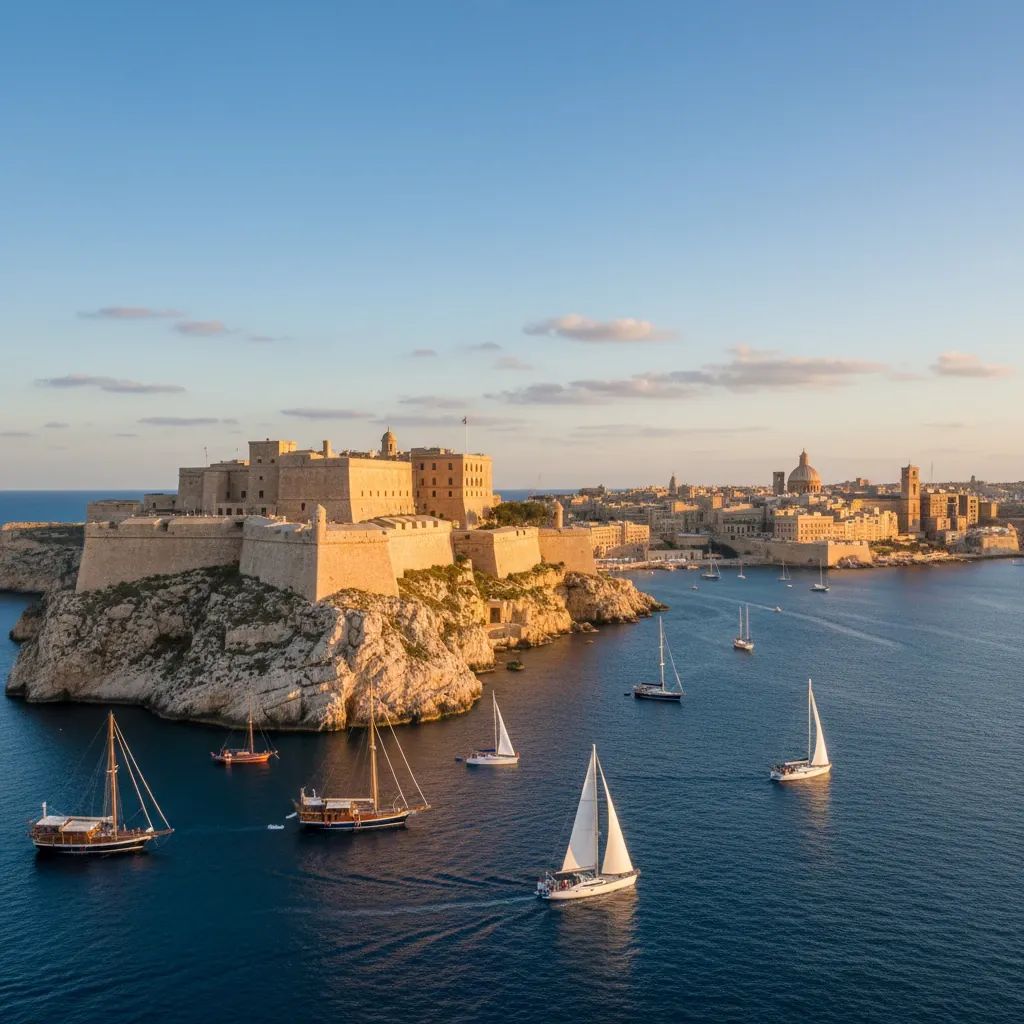
Before Royal Navy ensigns flew from its ramparts, Fort St Angelo existed for half a millennium as a medieval stronghold known as Castrum Maris. The Order of St John redesigned it after their 1530 arrival in Malta, introducing the bastioned fortifications that became the template for the entire harbor's defense architecture. When British forces took Malta in 1800, they inherited a structure already 270 years old, yet saw in its harbourside position the perfect headquarters for Mediterranean naval command.
The formal handover occurred on December 8, 1906, marking the instant when the fort ceased being merely a historical artifact and became an active operational center. Naval regulations renamed it a "stone frigate"—institutional terminology for a land-based facility operating under complete naval discipline and protocols as though it were an actual warship. The successive names tracked strategic evolution: HMS Egmont (1912) signaled early-twentieth-century reorganization; HMS St Angelo (1933) reflected deeper institutional integration. By the 1930s, the medieval compound had been internally transformed with accommodation blocks for officers and lower ranks, separate administrative wings, recreational facilities including a cinema and gymnasium, and a fully equipped sick bay. The fort became a self-contained naval township housing hundreds of permanent residents and their families.
The fortress underwent its most severe test between 1940 and 1943. Malta's geographic position made it the world's most heavily bombed location during the Second World War—over 6,700 aerial bombardments targeted the island, with Fort St Angelo absorbing 69 direct strikes. The walls, engineered across generations and reinforced after each strategic upgrade, held. This physical endurance became symbolically inseparable from Malta's wartime sacrifice, ultimately earning the island the George Cross in 1942—the only nation in history to receive this decoration for collective courage. For Maltese residents, the fort's survival proved tangible proof that resistance was possible.
When the Empire Withdrew: Economic Panic Meets Deliberate Transition
Prime Minister Dom Mintoff initiated withdrawal negotiations in 1971, but the prospect terrified Malta's economic establishment. The military presence and its supporting infrastructure had dominated the island's financial life for 171 years. Dockyard employment, defense contracts, barracks provisioning, and spending by British military personnel and their families created the dominant economic sector. The prospect of British departure without replacement income streams suggested economic freefall.
The British government, confronting its own fiscal crisis, accepted a fixed departure date: March 31, 1979. Critically, London also agreed to substantially elevated rental payments through that date—a financial lifeline that allowed Malta's government crucial years for deliberate economic repositioning rather than panicked improvisation.
The Maltese response proved strategically sophisticated. The Malta Drydocks underwent rapid nationalization and capacity expansion, absorbing shipyard workers who faced redundancy. State-owned enterprises received targeted capital investment to create employment anchors. The decisive pivot involved aggressive tourism promotion. Commercial tourism had begun tentatively in the 1960s, but government coordination transformed it into the dominant foreign-income earner by the mid-1970s. Simultaneously, Malta developed manufacturing as a secondary employment sector and began laying groundwork for financial services as a long-term economic pillar. The outcome defied pessimistic predictions: when the last British warship departed, Malta's unemployment rate stood at approximately 2.7%—a figure that would rank as exceptionally low across contemporary Europe.
What This Means for Residents: Walking Through Decision-Making Spaces
The March 31 programming provides something rare in heritage tourism: access to physical spaces where geopolitical decisions were actually made. The €3 admission—roughly half a cappuccino in Valletta—eliminates financial barriers to what amounts to an educational pilgrimage through Malta's most consequential turning point.
The 9 AM to 7 PM schedule (with last entry at 6:30 PM) accommodates working residents. Free guided tours contextualize bombardment resilience without romanticizing occupation. For children, hands-on nautical activities make maritime heritage tangible beyond classroom abstraction. The Sea Cadets' participation provides living continuity with the British-period narrative, bridging historical distance through living tradition.
Critically, the day's programming incorporates the Regatta races in the creek below—a cultural practice that predates military occupation by centuries and continues after it. Watching from the fort's ramparts creates sensory continuity: the same stones that withstood aerial bombardment now frame communal celebration. For residents, this visual connection translates abstract notions of "transition" into concrete spatial experience.
Fragmented Sovereignty: How a Fortress Became Two Authorities
Fort St Angelo's post-1979 trajectory became deliberately complex, reflecting competing interests. The upper section—including the Grand Master's House and the Chapel of St Anne—has been leased to the Sovereign Military Order of Malta (SMOM) since 1998 under a 99-year arrangement (expiring 2097). This religious-diplomatic entity uses its portion for cultural events, humanitarian coordination, and formal diplomatic functions. The arrangement essentially created two sovereignties operating under a single perimeter fence.
Heritage Malta manages the remaining larger portion. A major EU-funded restoration commenced in 2012, with the European Regional Development Fund (ERDF) allocating €13 million. The project restored 16,000 square meters of interior space and opened 6,500 square meters of courtyard and recreational areas to public access for the first time since the 1970s. Conservation protocols retained pre-1979 buildings wherever structurally sound, creating physical continuity with the military period while adapting spaces for contemporary interpretation.
Ongoing preservation extends into 2026. In September 2024, Heritage Malta and the Vittoriosa Historical and Cultural Society completed restoration of a 13th-century chapel dedicated to the Nativity of Our Lady. The Malta Tourism Authority allocated over €35,000 for this work, incorporating new artwork including a titular painting by artist Manuel Farrugia. The restoration also serves the Camino de Santiago pilgrimage route, positioning the chapel as a significant waypoint. Looking ahead, Heritage Malta plans a February 2026 public event showcasing restoration techniques across Fort St Angelo and Fort Delimara. In March, the fort will participate in "Museums by Candlelight," a returning Birgu event offering atmospheric after-hours access.
Navigation and Practical Details for March 31 and Beyond
Standard admission runs €4 for children (6–11), €6 for seniors and students, and €10 for adults, with free entry for Heritage Malta members. March 31's reduced €3 rate applies only to the anniversary programming. Combination tickets bundling Fort St Angelo with the Inquisitor's Palace and Maritime Museum allow construction of a full-day Birgu itinerary. A typical independent visit requires approximately 2 hours.
The fort sits at Birgu's harbourside tip. A 7-minute ferry or water taxi from Valletta's waterfront provides the most atmospheric route, depositing visitors directly at the harbor. Bus routes 2 and 4 from Valletta reach Birgu in approximately 15 minutes. Walking from Senglea remains feasible for pedestrians. Parking is available near the fort's entrance.
Accessibility accommodations include electric vehicles for wheelchair users across Heritage Malta-administered sections, though medieval architectural constraints limit access to certain original areas. Adverse weather may restrict electric vehicle deployment for safety reasons. Visitors should verify current conditions before planning visits.
March 31 and Its Deeper Resonance
Jum il-Ħelsien (Freedom Day) extends beyond military commemoration. The date acknowledges Malta's deliberate embrace of constitutional neutrality and non-alignment—frameworks formalized in the years following 1979 and now core to national identity. The holiday recognizes both economic anxiety successfully overcome and a national identity consciously constructed through the choice to diversify away from military dependence.
Walking Fort St Angelo on March 31 anchors these abstract political principles in physical reality. Visitors traverse corridors where officers commanded Mediterranean operations, stand on walls that absorbed aerial assault, and contemplate the moment when the Union Jack descended and the Maltese flag rose. The experience transforms March 31 from a calendar entry into lived historical understanding—accessible to residents and visitors alike for the cost of a morning coffee.