The Malta Government has committed €2 million to rebuild Għar Lapsi, the popular south-coast swimming and fishing spot that was all but obliterated by Storm Harry in January. The Public Works Department has begun trenching, debris clearance, and ramp reconstruction—a phased effort designed to reopen access while preserving the site's rustic, minimalist character, according to feedback from nearly 300 public consultation responses.
Why This Matters
• Access restored: The main beach ramp and slipway used by swimmers and fishermen are being rebuilt after being destroyed by storm waves.
• Timeline: Works are underway now, with key phases expected to complete within months under a phased schedule tied to the low season.
• Preservation promise: The government pledged to keep the area "simple" and avoid overdevelopment, honouring local sentiment.
• Solar lighting and safety: New solar-powered street poles and geological studies aim to stabilize the cliff and prevent future erosion.
What Storm Harry Left Behind
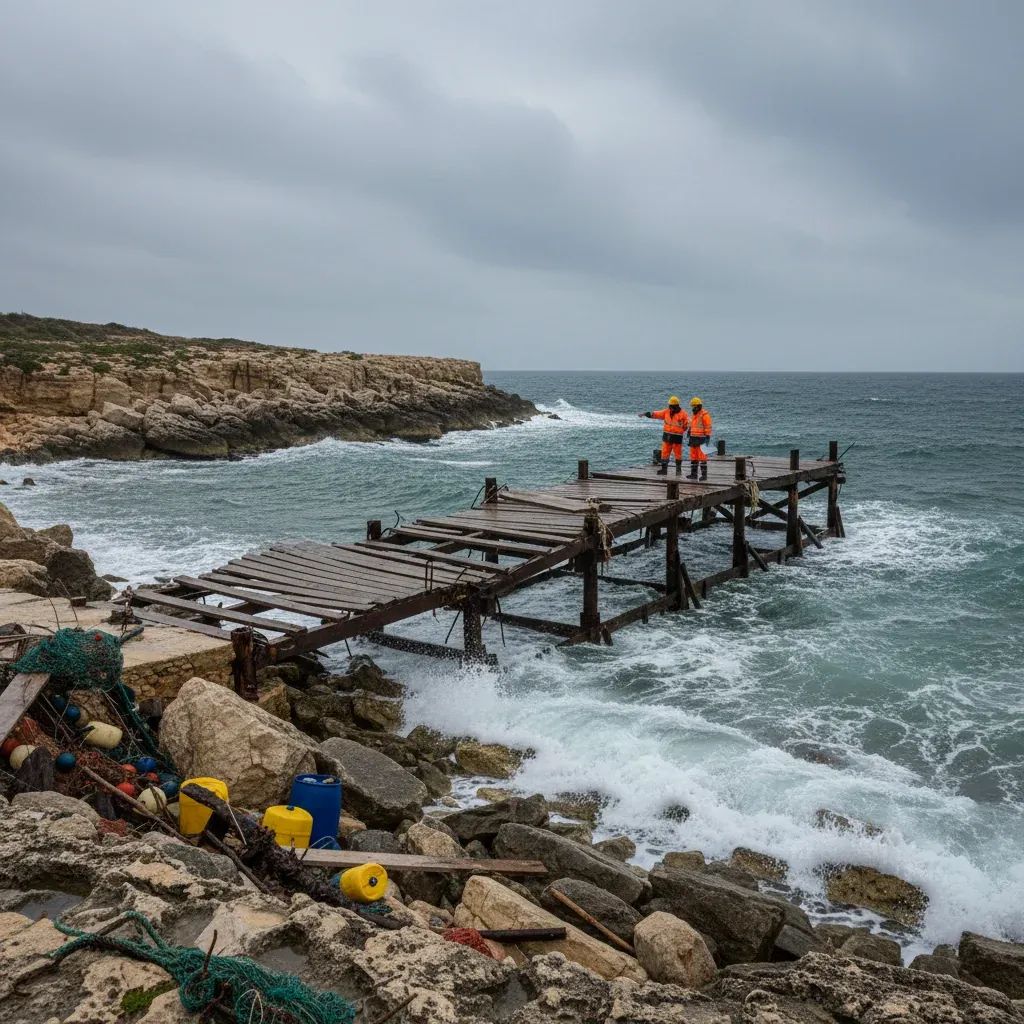
When Storm Harry struck the Maltese Islands in January 2026, it brought Force 9 winds and massive swells that reshaped the coastline. At Għar Lapsi, the damage was among the most severe: the concrete slipways fishermen rely on were pulverized, the main access ramp crumbled, and a section of the cliff face collapsed, blocking pathways and burying rock-cut garages in rubble.
Carmen's Bar, a fixture for decades, was forced to close permanently and is now searching for a new location. The Takarma restaurant saw its doors smashed inward, its seaside platform swept away entirely. Even the upper garages, typically sheltered from the worst of winter storms, were flooded and gutted. Boats stored inside boathouses were smashed, steel handrails twisted like wire, and large boulders that once defined the bay's natural contours either vanished or shifted positions.
The storm left the area closed to the public due to unstable rock and debris. Officials described the landscape as "virtually unrecognisable."
The €2 Million Reconstruction Plan
Funding comes from the National Social and Development Fund (NDSF) and the Public Works Department, overseen by Parliamentary Secretary Omar Farrugia. The project unfolds in stages:
Phase 1: Trenching and Debris ClearanceCrews are currently excavating storm debris, laying new electrical cables, and conducting detailed geological surveys at depths of 10, 12, and 18 meters to assess rock stability. This groundwork ensures the cliff face won't collapse again during heavy seas.
Phase 2: Ramp and Pathway ReconstructionThe main beach ramp—currently being filled with concrete—will be rebuilt to allow vehicular and pedestrian access. Once heavy machinery completes the ramp, smaller equipment will move in to restore damaged pathways, remove fallen concrete, and clear collapsed cliff sections. The staircase connecting to the adjacent Għereq Miżun beach will also be reconstructed.
Phase 3: Long-Term Erosion ControlA separate project approved in May 2025, before the storm, involves creating a boulder scree in front of the cliff to act as a wave breaker. This complements the quay rebuilding work, which was largely buried by falling rock during the storm. Together, these measures aim to reduce future erosion and stabilize the vulnerable cliff face.
Infrastructure UpgradesThe Public Works Department is installing solar-powered street lighting poles as part of a broader agreement with local councils, improving safety and reducing the site's carbon footprint.
What the Public Consultation Revealed
The government launched a consultation titled "Għar Lapsi – Back to the People" shortly after the storm, gathering nearly 300 proposals from residents, fishermen, swimmers, and conservationists. The overwhelming sentiment: keep it simple.
Respondents opposed major development, calling instead for basic infrastructure repair, natural materials, and minimal intervention. The vision is to restore what was lost—not reinvent the site as a tourist hub. This aligns with Għar Lapsi's identity as an unpretentious, off-the-beaten-path destination cherished by locals and expats alike for its authenticity.
Parliamentary Secretary Farrugia pledged that the area "will be returned to the public within the stipulated timeframe," though he did not specify an exact completion date. Related works, such as the quay rebuilding, were initially projected to take 16-18 weeks and are ideally carried out during the low season (end of September to mid-May), suggesting a completion window of late spring or early summer 2026.
Impact on Fishermen and Local Businesses
For the small community of fishermen who use Għar Lapsi's slipways to launch boats and store equipment, the storm was catastrophic. Both the lower garages along the slipway and the upper garages, carved into the rock face, sustained severe damage. Doors were ripped off, interiors flooded, and stored boats wrecked.
The loss of the slipway means many have had to relocate their operations temporarily to Wied iż-Żurrieq or other coastal points, adding travel time and fuel costs. The reconstruction of the ramp is therefore critical not just for swimmers but for livelihoods.
Local businesses face a longer road. Carmen's Bar announced it cannot return to its original location and is seeking an alternative site. The Takarma restaurant, once a popular stop for day-trippers, is assessing whether to rebuild on the same footprint or relocate entirely. The extended closure and uncertainty have ripple effects on the broader Siġġiewi and Qrendi areas, which rely on modest coastal tourism.
Broader Storm Recovery Across Malta
Għar Lapsi is one of several coastal sites battered by Storm Harry. The government has pledged to begin restoration works at multiple locations, with funding drawn from the NDSF. Other affected areas include parts of the Marsaxlokk waterfront and sections of the Sliema promenade, though Għar Lapsi has received the most significant single-site investment to date.
The Malta Environment and Resources Authority (MERA) is coordinating erosion studies and will inform future coastal defence projects. Climate scientists have noted that storms of Harry's intensity are becoming more frequent in the Mediterranean, raising questions about whether traditional concrete and rock defences are sufficient.
What This Means for Residents
If you're a regular at Għar Lapsi, expect restricted access through at least the next few months. The ramp reconstruction is the critical bottleneck—once that's done, pedestrian and vehicular access will resume, though some areas may remain cordoned off while cliff stabilization continues.
For those who value the site's simplicity, the consultation results are encouraging. The government has committed to avoiding heavy-handed development, meaning no car parks, no large kiosks, and no paved terraces. The focus is on restoring access and safety, not commercializing the space.
Fishermen should monitor updates from the Public Works Department for timelines on slipway reopening. If you're planning summer weekends at the coast, it's worth checking official channels—parts of the site may reopen in phases, with some sections accessible before others.
Long-Term Questions on Coastal Resilience
The €2 million investment raises broader questions about how Malta manages its coastline in an era of intensifying storms. The boulder scree and geological studies represent a shift toward adaptive, nature-based defences rather than purely engineered solutions. Whether this approach proves durable will be tested in the next major storm season.
For now, the focus remains on getting Għar Lapsi back to the people—scarred but functional, simple but safe, and as close as possible to the rugged, unpolished character that made it beloved in the first place.