
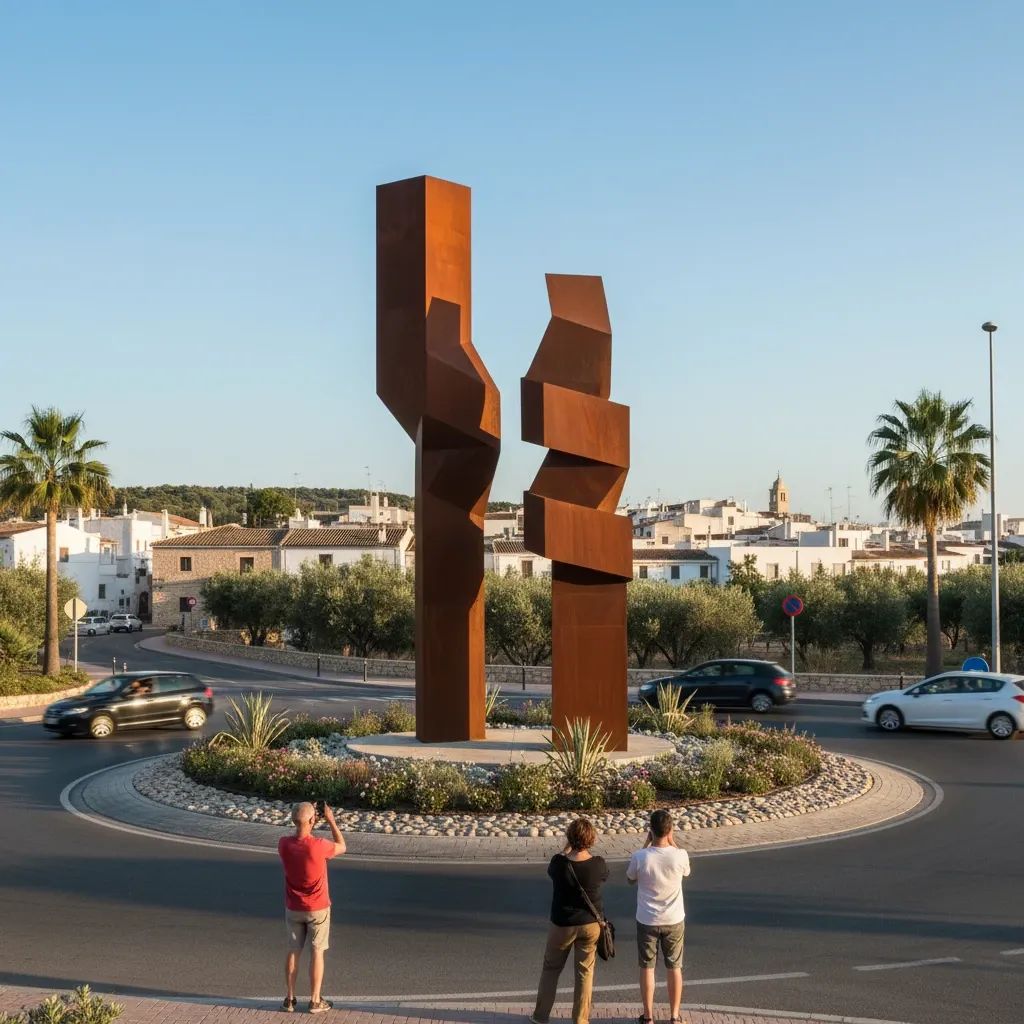
A Steel Monument Awakens Xewkija's Cultural Ambition
The Ministry for Gozo and Planning has unveiled Encounter, a 2.5-meter corten steel sculpture in Triq San Anard, ix-Xewkija, signaling a strategic reorientation of how the island treats its public spaces. The installation was completed in early April 2026 and is visible to all traffic moving between Victoria and Nadur toward Xagħra. The work arrives at a traffic roundabout—conventionally mundane territory—and transforms it into a cultural marker. For residents, tourists, and the local arts economy, this shift carries practical weight: public art is no longer confined to galleries and festival grounds but embedded into the everyday landscape where commerce, commuting, and cultural reflection intersect.
Why This Matters
• Local commissions create rare income: Four Gozitan artists selected through competitive bidding in February 2026 will receive direct government funding for public works, a significant opportunity in a constrained creative market.
• Infrastructure gains follow: Sculptures attract foot traffic, triggering complementary investments in lighting, pathways, and signage that benefit adjacent businesses and municipal aesthetics.
• Tourism positioning accelerates: Public art functions as visible proof of cultural investment, strengthening Gozo's candidacy for European Capital of Culture 2031 while generating authentic reasons for extended visitor stays.
The Artist and the Work
Christopher Saliba, a Gozitan sculptor whose studio operates within walking distance of both the Xagħra Stone Circle and Ġgantija (approximately 2 kilometers from Ġgantija in the island's southeastern interior), conceived Encounter not as a restatement of ancient forms but as a contemporary dialogue partner. The two abstract steel forms occupy the Xewkija roundabout with deliberate visual weight, drawing formal language from Gozo's prehistoric temples without attempting replication—a distinction that separates Encounter from nostalgic pastiche and positions it as genuine artistic expression.
Saliba's choice of corten steel—a material that develops a protective rust-colored patina through natural weathering—carries conceptual purpose. This oxidation process mirrors the temporal accumulation visible on Ġgantija's limestone blocks, structures that have withstood Mediterranean salt spray and solar exposure for 5,600 years. Whereas polished stainless steel suggests permanence through artificial preservation, corten steel embraces visible aging, a visual philosophy that acknowledges both stone and steel as speaking the same language of endurance and transformation.
The sculptor framed the work as creating "a symbolic dialogue between Gozo's past and its present." The sculpture acknowledges the temples; it does not explain or subordinate them. Positioned at a functional traffic junction, it achieves what urban designers call a "pause point"—a reason to decelerate, observe, and engage with place beyond its utility.
Visiting the Sculpture
Encounter is accessible to residents and visitors at the Xewkija roundabout junction on Triq San Anard. The sculpture can be safely photographed from the roundabout perimeter, and parking is available in nearby commercial areas. The Ministry for Gozo and Planning has not yet announced specific installation dates or locations for the remaining three sculptures in the commission series, but they are scheduled to be completed by late 2026.
Why Xewkija, Why Now
The roundabout location carries strategic significance. Xewkija's identity has long been subsumed into proximity to Ġgantija—the temples define the geography but had not generated sustained infrastructure investment or diversified economic activity around them. By installing a contemporary sculpture at this junction, the Ministry for Gozo accomplishes multiple objectives: it marks the landscape as culturally intentional rather than merely functional, it creates an Instagram-worthy landmark for digital audiences and cultural tourism, and it extends an emerging cultural circuit tying the sculpture to adjacent archaeological sites and the Gozo Museum of Archaeology, nearing completion of its modernization.
This strategy mirrors approaches across the Mediterranean. Sardinia's mural tradition, rooted in decades of community expression, has transformed peripheral villages like Orgosolo into pilgrimage sites for cultural tourists. Sicily revitalizes working districts through large-scale figurative art addressing contemporary issues alongside historical narratives. Cyprus leverages annual festivals like Street Life in Limassol to attract younger audiences, while Crete develops sculpture gardens through foundations maintaining large-scale outdoor installations.
Gozo's advantage lies in megalithic authenticity. Every Mediterranean island references ancient history; few possess structures as architecturally sophisticated and temporally remote as Ġgantija. The challenge Encounter addresses is translating that heritage into contemporary relevance without reducing it to kitsch or historical museum-piece status.
The Commission Structure: Expanding the Initiative
The Ministry for Gozo and Planning's competitive call, launched in February 2026, selected four Gozitan artists through a process evaluating artistic merit, connection to Gozo's cultural landscape, and conceptual engagement with local identity. Encounter by Saliba initiated the sequence; three additional works will follow through late 2026:
"Wieħed" by Austin Camilleri engages themes of unity and singularity, drawing on Camilleri's practice of embedding community narratives and local memory into artistic form. "Fish Can Fly" by Vince Caruana reimagines natural boundaries through abstraction, likely referencing Gozo's maritime economy and fishing heritage through non-literal visual language. "Ancestors" by Mario Agius explores genealogy and collective memory, central to how communities construct identity across generations.
None of these artists were imported specialists; each operates within Gozo's existing cultural landscape. This deliberate constraint—prioritizing local embeddedness over external prestige—aims to strengthen professional pathways for Gozitan creatives, who historically face fewer exhibition and commission opportunities compared to peers in Valletta or mainland Europe.
Parallel funding mechanisms support the broader initiative. The broader initiative is supported by Arts Council Malta's €400,000 annual allocation for voluntary cultural organizations in Gozo—separate from the sculpture commissions—with individual projects eligible for up to €85,000. A dedicated Gozo Cultural Events Fund supports community-led creative activities, while the Artists' Residency Programme (administered by Spazju Kreattiv in collaboration with the Valletta Cultural Agency) is bringing international creatives to Gozo for immersive three-to-four-week placements between January 2026 and July 2027.
Tangible Impact on Public Life and the Local Economy
For Gozitan residents, Encounter signals a reconceptualization of public space. Cultural expression—historically sequestered in churches, galleries, and festival grounds—now appears in everyday landscapes: roundabouts, plazas, the routes people navigate daily.
This carries measurable implications. Public art installations alter pedestrian circulation patterns and create reasons to linger, increasing foot traffic around the sculpture. Adjacent businesses—petrol stations, cafés, retail shops—benefit from higher customer throughput. Local councils become incentivized to invest in complementary infrastructure: improved lighting, accessible pedestrian pathways, interpretive signage, waste management upgrades. The result is gradual qualitative improvement of the public realm at minimal direct cost to individual commercial operators.
For Gozitan artists, the scheme addresses a structural disadvantage. Government-funded commissions of this scale create space for experimental, locally resonant work that might lack a market through conventional gallery channels. Income is direct; validation is institutional. For residents working in creative sectors, this signals that the government acknowledges cultural production as economically and socially valuable.
For Gozo's tourism infrastructure, public art functions as a signaling mechanism. Travelers drawn by Encounter's visual presence become natural audiences for archaeological tours, museum visits, and hospitality services. Cultural economists term this a "cluster effect"—concentrated creative activity that attracts visitors and investment beyond the artworks themselves.
The European Capital of Culture Dimension
Victoria's bid for European Capital of Culture 2031 provides the organizational framework for much of this activity. The designation—conferred by the European Union—brings prestige, infrastructure funding, and a year-long surge in cultural programming and tourism. Valletta secured the title in 2018; the resulting international visibility and sustained investment endure. Victoria's candidacy is currently in the competition phase, with a final decision expected in late 2027.
Competitive candidates must demonstrate year-round cultural vibrancy, active community participation, and infrastructure capable of hosting large-scale events. Public art serves as visible, quantifiable proof of ambition and investment. The artworks function as evidence that government prioritizes culture, that local artists receive support, and that the island can host contemporary creative expression at professional standards.
Crucially, the competition reshapes municipal decision-making priorities. Typically, public space investment prioritizes functionality—roads, parking, utilities. The 2031 bid reframes those spaces as cultural assets, creating aesthetic and artistic justification alongside practical considerations. Once established, this shift in thinking frequently persists regardless of competition outcome.
Ancient Architecture and Contemporary Practice
Gozo's prehistoric temples—most significantly Ġgantija, dating to 3600–2500 BC—rank among the world's oldest free-standing stone structures, predating Stonehenge and Egypt's pyramids. The distinctive clover-leaf or trefoil architectural plan features orthostats (vertical standing stones) reaching 6 meters and weighing 50+ tonnes. These massive blocks were assembled without metal tools or wheels, likely using spherical stone rollers as ball bearings—a sophisticated engineering solution.
Archaeological investigation has revealed libation holes (small indentations for liquid offerings), animal bone deposits, figurines, and remnants of red ochre, a pigment symbolizing blood and fertility. Evidence suggests the temples functioned as ceremonial spaces linked to fertility rites, their interiors originally plastered and painted—architectural intention of considerable sophistication.
Contemporary Gozitan artists have engaged this heritage through varied approaches. Victor Agius, whose studio sits near Ġgantija and the Xagħra Stone Circle, incorporates local blue clay, terrarossa, natural pigments, and cement into sculptures and installations, explicitly treating the island's geology as both material and cultural text. His practice reads the landscape as an archive—a living repository of cultural and natural knowledge.
Sarah Maturin-Baird, a mixed-media artist based in Victoria, sources found materials and engages with Neolithic goddess iconography—referencing the fertility cults believed central to the temples' original religious function. Her work connects visually and conceptually with how ancient societies understood the divine and the feminine.
Encounter operates within this lineage but stakes a distinct position. Rather than embedding prehistoric imagery or sourcing ancient materials, Saliba created an abstract counterpoint—a contemporary form that acknowledges the temples without replicating them. The sculpture asserts that past and present are equally valid registers of human meaning-making, neither subordinate to the other.
Complementary Programming and the Cultural Circuit
Encounter's effectiveness depends partly on complementary infrastructure and programming. The Gozo Museum of Archaeology, in its modernization phase, will benefit from this expanded cultural circuit. Visitors drawn to the sculpture become natural candidates for deeper engagement with temple artifacts and curatorial interpretation, extending local time expenditure and spending.
"Springtime in Gozo 2026" reinforces this circuit, programming festivals, outdoor performances, and artist residencies across April through June. The broader "Gozo Region of Culture 2025" initiative, funded by the Local Government Division, sustained year-round multidisciplinary programming—music, theatre, visual arts, heritage work—throughout 2025. This calendared approach prevents the appearance of isolated cultural gestures and communicates sustained, serious investment in Gozitan creativity.
Sustainability and Long-term Cultural Shift
The ultimate test of this initiative's durability will emerge post-2031. Historically, cities invest heavily in competition bid years, then revert to baseline funding once designation is awarded or denied. Yet infrastructure—both physical and institutional—frequently persists. Valletta's transformation for 2018 created permanent public space improvements, established ongoing cultural programming, and elevated professional capacity within local cultural organizations. Gozo will likely experience similar residual effects, conditional on sustained funding commitment from the Ministry for Gozo beyond the competition deadline.
Encounter will oxidize gradually, becoming familiar to residents and visitors alike. Whether it succeeds as art remains subjective and evolving. Whether it succeeds as strategic positioning—as a tool to establish Gozo as culturally ambitious, historically grounded, and forward-oriented—will crystallize over the coming years as the remaining three sculptures are installed, as the 2031 bid progresses, and as Gozo's cultural infrastructure continues its expansion. For now, it stands at the Xewkija roundabout, a contemporary steel form in patient conversation with stones assembled 5,600 years ago.


