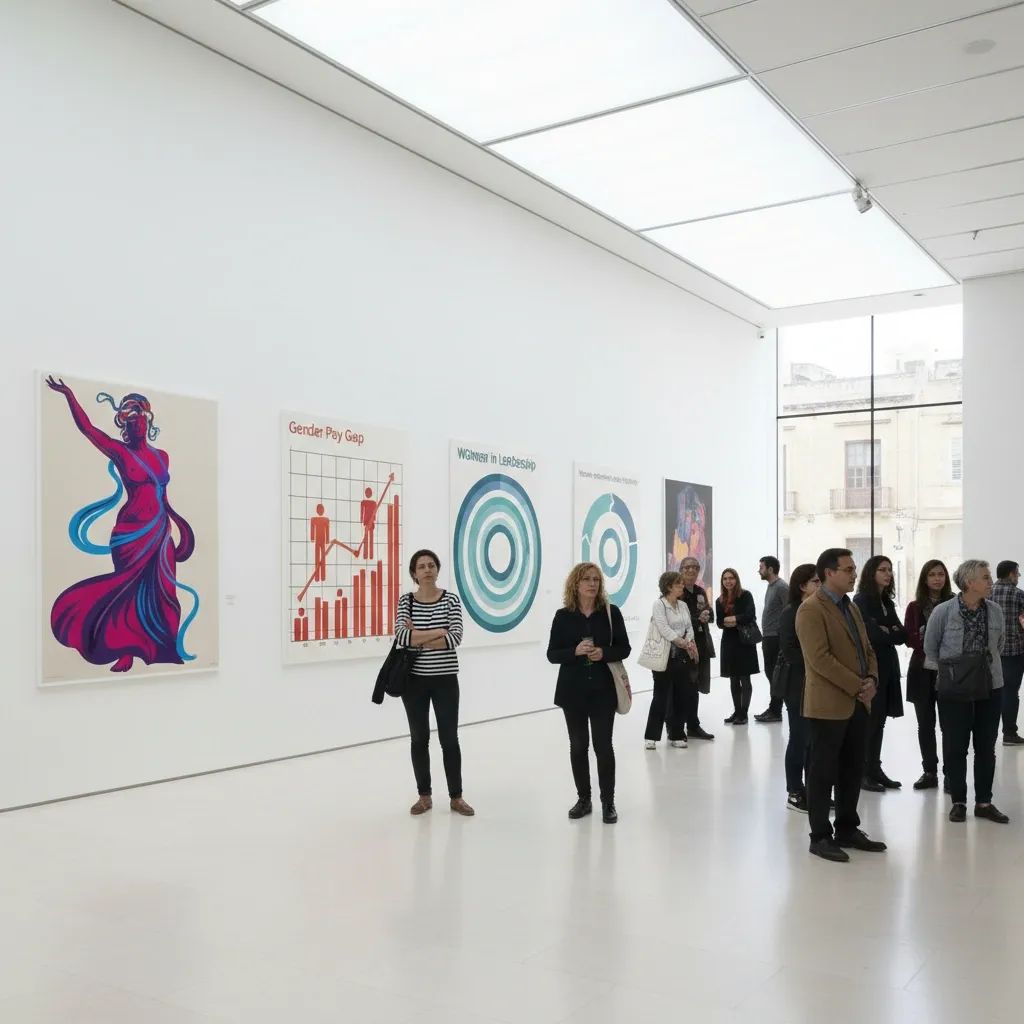
An anonymous feminist art collective that has spent four decades calling out sexism and racism using gorilla masks and biting statistics is now setting up shop in Valletta. The Guerrilla Girls have arrived for the Malta Biennale 2026, transforming MUŻA—Malta's National Community Art Museum—into what they describe as a "political space of resistance" aimed squarely at misogyny, racism, and institutional inequality.
Why This Matters:
• Direct access to globally influential activist art at the Malta Biennale 2026, running through May 29.
• The exhibition, "Laugh, Cry, Fight," explicitly targets the exclusion of women and people of color from art institutions.
• Over half the artists at this year's Biennale are women, reflecting a deliberate shift in representation.
• The event spans 11 historic sites across Valletta, il-Birgu, ix-Xagħra, and the Ċittadella in Gozo.
From Manhattan Street Corners to Maltese Museums
The Guerrilla Girls first materialized in 1985 after a now-infamous exhibition at New York's Museum of Modern Art featured fewer than 5% female artists. Enraged, a handful of women donned gorilla masks, adopted the names of dead female artists, and began plastering downtown Manhattan with posters that combined hard data with scathing humor. Their most famous piece from 1989 asked: "Do Women Have To Be Naked To Get Into The Met. Museum?"—noting that while 85% of nudes were female, only a tiny fraction of the artists were.
What started as guerrilla tactics—wheat-pasting posters under cover of darkness—has since evolved into a global movement. The collective now targets not just galleries and museums, but Hollywood, mass media, government corruption, reproductive rights, and environmental issues. In 2001, the original group splintered into three independent entities: Guerrilla Girls on Tour (a traveling theater collective), GuerrillaGirlsBroadBand (focused on digital media), and Guerrilla Girls, Inc. (continuing the original art-focused mission).
Their anonymity remains non-negotiable. By hiding their faces, the collective ensures the spotlight stays on the data, the injustice, and the institutions rather than individual personalities.
What This Means for Malta's Cultural Landscape
The inclusion of the Guerrilla Girls in the Malta Biennale 2026—curated by Rosa Martínez and running March 11 to May 29—marks a significant moment for the island's arts scene. The Biennale, themed "CLEAN | CLEAR | CUT," showcases work from over 130 artists representing more than 40 countries. But the Guerrilla Girls' presence is more than just another high-profile name on the roster.
Their exhibition at MUŻA is designed to be immediately legible to anyone who walks in—no art history degree required. Using bold text, stark visuals, and humor sharp enough to draw blood, the work challenges visitors to consider who gets to be seen in cultural institutions and why. It's a direct challenge to Malta's own arts infrastructure, which, like institutions worldwide, has historically centered European male artists.
For Malta residents and visitors alike, the exhibition offers a rare chance to engage with activist art that has reshaped global conversations about equity in the cultural world. It also raises uncomfortable questions: How diverse are Malta's own museums and galleries? Whose stories get told, and whose are erased? This exhibition arrives at a moment when Malta's arts institutions are increasingly examining their own representation practices—making the Guerrilla Girls' work particularly relevant to local conversations about cultural inclusivity.
A 40th Anniversary Built on Rage and Humor
The Guerrilla Girls are marking their 40th anniversary in 2025 and 2026 with a packed schedule. In addition to Malta, they're headlining exhibitions at the Getty Research Institute in Los Angeles (running until April 12, 2026) and Charleston in Firle, UK (April 1 to September 6, 2026). They've also launched a "2026: THE FIGHT BACK TOUR!"—a series of workshops, lectures, and parties designed to equip participants with the tools to create their own activist art.
Their "PUSH/PUSHBACK, 9 Steps to Make a Difference with Activism and Art" workshop has become especially popular, teaching everything from data collection and culture jamming to grassroots distribution strategies. The program responds to what the collective sees as escalating threats to women's human rights, including rollbacks on reproductive rights and rising political authoritarianism.
Despite—or perhaps because of—their confrontational stance, the Guerrilla Girls have been embraced by the very institutions they once antagonized. Major museums now commission them to conduct surveys exposing their own inequalities. Their posters hang in permanent collections worldwide. Yet they've never softened their message. At a recent presentation at the Plains Art Museum in North Dakota, they noted that only a small percentage of the museum's collection was made by women—proving that the fight is far from over.
The Malta Biennale's Gender Shift
The broader context of the Malta Biennale 2026 is worth noting. More than half the participating artists are women—a deliberate corrective in a global art world where women and people of color remain underrepresented. The lineup also includes provocateurs like Maurizio Cattelan, whose satirical sculptures have scandalized and delighted audiences in equal measure.
The Biennale's 11 venues span some of Malta's most atmospheric locations: the fortified walls of il-Birgu, the neolithic temples near ix-Xagħra, the baroque palaces of Valletta, and the hilltop Ċittadella in Gozo. Each site becomes a stage for exploring the Biennale's theme—"CLEAN | CLEAR | CUT"—which curator Rosa Martínez has described as a meditation on precision, clarity, and decisive action.
For the Guerrilla Girls, the setting is particularly apt. Malta's compact size and dense history make it a microcosm of the broader tensions they've spent decades exposing: tradition versus progress, visibility versus erasure, power versus resistance.
Why Gorilla Masks and Fake Fur Still Matter
In an era of highly visible activism—when protest movements are live-streamed and activists become celebrities—the Guerrilla Girls' insistence on anonymity feels almost radical. The gorilla masks serve a dual purpose: they protect the members' identities and force audiences to focus on the message rather than the messenger.
That message remains consistent: gender and racial inequality are not accidents. They are the result of deliberate choices made by curators, collectors, critics, and institutions. The Guerrilla Girls' weapon of choice is the statistic—presented with enough wit and visual punch to make indifference impossible.
Their work has inspired generations of feminist artists and activists, contributing to a mutating feminist art movement that now includes digital interventions, flash mobs, and social media campaigns. Yet the core tactics—meticulous research, bold graphics, and strategic distribution—remain unchanged.
Practical Information for Visitors
The Malta Biennale 2026 runs from March 11 to May 29, 2026, with the Guerrilla Girls' "Laugh, Cry, Fight" installation featured at MUŻA in Valletta. MUŻA is located in the heart of Valletta's cultural quarter and is accessible by public transport and car. For specific details on opening hours, admission arrangements, accessibility information, and ticketing, Malta residents should visit the official Malta Biennale website or contact MUŻA directly.
Given the scale of the event—spanning multiple islands and historic sites across Valletta, il-Birgu, ix-Xagħra, and Gozo—visitors are advised to plan ahead and check the official Biennale website for detailed venue information and logistics, especially if they intend to explore the Gozo venues.
For those interested in the broader conversation about equity in the arts, the Guerrilla Girls' parallel exhibitions in Los Angeles and the UK offer additional context. Their workshops and lectures, part of the "FIGHT BACK TOUR!", are being offered both virtually and in-person to institutions worldwide.
Malta's cultural calendar has become increasingly international, but the Guerrilla Girls' presence is a reminder that art is never neutral. It either reinforces existing hierarchies or challenges them. The choice, as always, belongs to the institutions—and to the audiences who walk through their doors.