
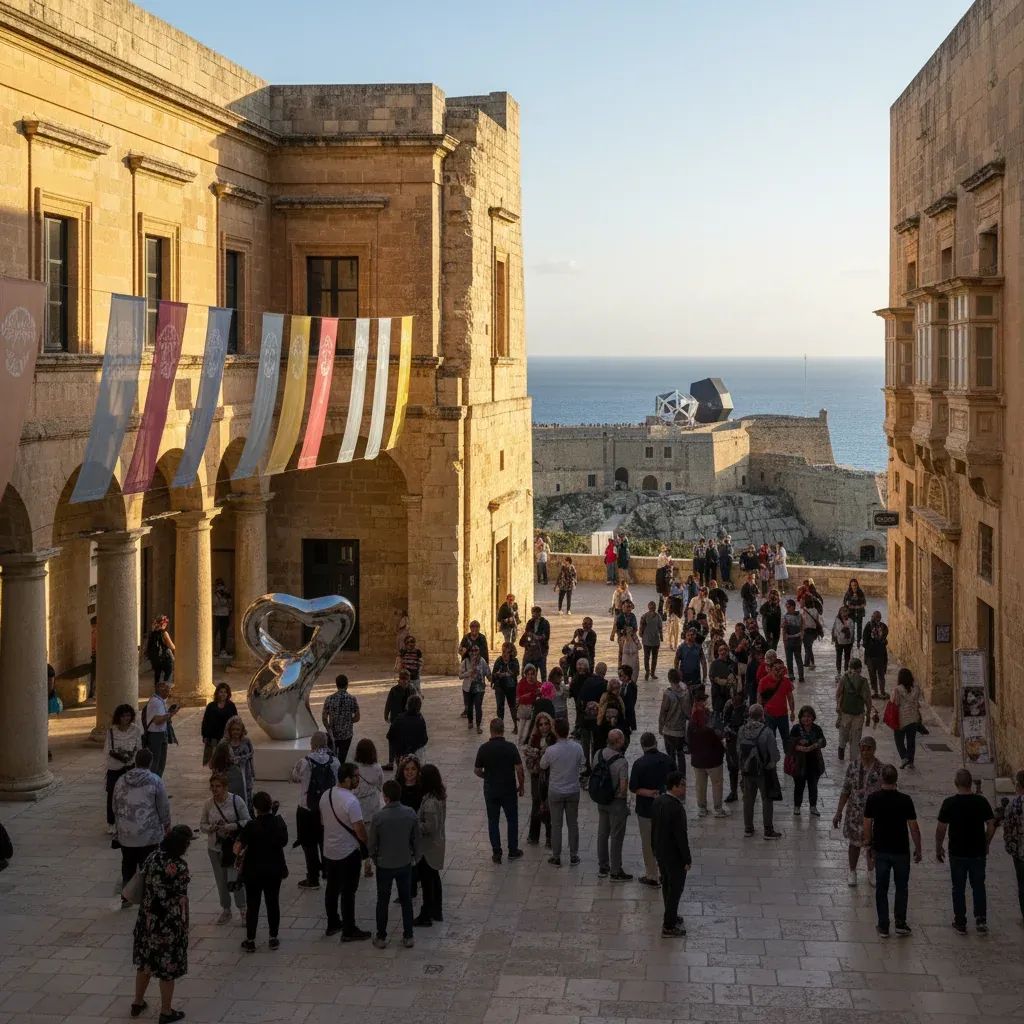
Heritage Malta's second national Biennale has sprawled across the archipelago's most storied venues—from Valletta's Grand Master's Palace to Gozo's windmills and Neolithic temples—inviting visitors to confront questions of space and belonging through the lens of contemporary art. Yet beneath the curatorial ambition lies a logistical tension: some works struggle for breathing room, and participating artists have flagged organizational friction that nearly overshadowed the event's cultural promise.
Why This Matters:
• Run dates: March 11–May 29, 2026 across Fort St Angelo, MUŻA, Ġgantija, the Inquisitor's Palace, and a dozen other Heritage Malta sites.
• Award highlights: Therese Debono (Malta) and Concetta Modica (Italy) won Best Artwork, while "Redefining. Polish–Ghanaian Textile Narratives" took Best Pavilion.
• Visitor impact: Expect dense programming in certain Gozo venues; budget extra time if you plan a multi-site tour.
• Backstage debate: The Malta Entertainment Industry and Arts Association (MEIA) flagged late payments and last-minute curatorial changes, prompting a sharp rebuttal from Heritage Malta.
A Curator Who Turns History Into Dialogue
Rosa Martínez, the Spanish curator at the Biennale's helm, built her reputation by weaving contemporary practice into heritage contexts. Her chosen theme—"CLEAN | CLEAR | CUT"—signals a surgical approach: strip away the noise, interrogate the landscape, carve out space for reflection. Across 27 pavilions (eight national, 19 thematic), the exhibition roster spans Italian headliner Maurizio Cattelan, China's delegation of 13 artists, and a Finnish pavilion titled "Bastion of Refugia."
Martínez's method hinges on site-specificity: artworks are not merely installed in these centuries-old fortresses and archaeological parks; they activate latent narratives embedded in stone and silence. At the Inquisitor's Palace in Birgu—a venue synonymous with scrutiny and judgment—Albert Moya's "Arca – Ritual" stages a woman dancing unreservedly in the former civil courtroom. The work transforms a space of historical conformity into one of liberated presence, asking whether belonging requires fitting in or simply being met without expectation.
Where Themes of Home Collide With Heritage
In Gozo, the tension between intent and infrastructure comes into sharpest focus. Nina Gerada's "Me in Place, and the Place in Me," exhibited at the Ċittadella Cultural Centre, offers an elemental meditation on place-based belonging. Yet its impact is diluted by the proximity of neighboring installations; the work demands contemplative solitude but receives only a fraction of the square footage it merits.
A few kilometers south, Victor Agius's video and sculpture pairing—"Ħobżna – A Ritual of Elements" and "Our Bread (2026)"—occupies the Ta' Kola Windmill. The piece traces a communal walk that links shared artmaking with the daily labor of bread production, a ritual loop pregnant with meaning about habitual identity. But the windmill's exhibition density crowds the narrative, limiting the amplification the work deserves.
Gozo's Ġgantija Archaeological Park presents a different curatorial gambit. Therese Debono's "BLANK," winner of the Maltese Falcon award, erects a towering white wall that deliberately obstructs sightlines to the Neolithic temples—Malta's oldest freestanding structures. Rather than frame the ruins as backdrop, Debono forces visitors to confront urban densification and erasure, the invisible layers of trauma and rebuilding that persist in transformed landscapes. It is a bold counterpoint to heritage tourism's usual reverence, and it unsettles precisely because it refuses easy access.
Textile Spaces and the Architecture of Connection
The standout thematic pavilion—"Redefining. Polish–Ghanaian Textile Narratives," awarded Best Pavilion 2026—unfolds at the Old Armoury of the Knights in Birgu. Curated by Natalia Bradbury and realized by Eliza Proszczuk, Ernestina Mansa Doku, and Marta Nadolle, the installation constructs a sequence of fabric environments that evoke both a children's refuge in Ghana and the domestic interior of a European home.
The textile structure invites visitors to step through thresholds of memory and migration, exploring belonging shaped by connection rather than origin. Historical solidarity between Poland and Ghana—rooted in mid-20th-century anti-colonial support—resurfaces here as a hopeful template for interdependence. The pavilion does not flatten difference into harmony; instead, it holds distinct histories in productive tension, allowing each artist's perspective to resonate without erasure.
National Entries and the Limits of Institutional Space
Among the eight national pavilions, the range is dizzying. China's "The Realm of Clarity" showcases ecological foresight through works by 13 artists including Liang Quan and Li Hongbo, exploring how Oriental philosophy meets contemporary environmental crisis. Armenia's "The Sound of What Was Never Seen" (artist: Raffi Yedalian) and Poland's "Archive of Hesitations" (curator: Ada Piekarska) each carve out distinct thematic lanes—sensory absence and bureaucratic inertia, respectively.
Malta's own national entry, "Wonderland: Kaos Kontemporanju," curated by Katya Micallef, confronts the archipelago's accelerated urbanization head-on. Local artists wrestle with the paradox of an island that celebrates its heritage while bulldozing agricultural land at a record pace. The pavilion's tone oscillates between elegy and alarm, a fitting microcosm for a nation caught between tourism revenue and livability.
What This Means for Residents
For anyone living on the islands, the Biennale offers more than a cultural outing—it is a mirror held up to Malta's contradictions. The exhibition's multi-site structure forces movement and recalibration, demanding that visitors shuttle between Valletta's fortifications, Birgu's maritime museums, and Gozo's rural landmarks. This geographic dispersion can be taxing (ferry schedules matter), but it also replicates the archipelago's own fragmented identity.
Tickets and access: Heritage Malta sites charge standard admission; some pavilions require timed entry. If you plan to hit Gozo's venues, consider booking the Ċittadella, Ġgantija, and Ta' Kola as a single-day circuit—but allow four hours minimum. Weekend ferry queues lengthen in late spring.
Economic angle: The Biennale drew 3,200 artistic proposals (up 30% from the 2024 inaugural edition) and applications for national pavilions jumped from 14 to 52. That influx signals growing international appetite for Malta as a cultural hub, a trend that could bolster niche tourism and hospitality bookings through May.
Backstage Friction and Public Reassurance
Yet the glossy programming masks operational turbulence. In early April, the Malta Entertainment Industry and Arts Association issued a public statement alleging communication failures, late payments, and last-minute curatorial decisions that left some participating artists scrambling. MEIA also questioned the appointment process for the opening-ceremony artistic director, hinting at transparency gaps in Heritage Malta's governance.
Heritage Malta fired back swiftly, dismissing the claims as "unfounded" and "detached from reality." The agency invoked survey data from the 2024 inaugural Biennale, noting that 87% of visitors reported satisfaction and 72% of artists said they would recommend participation. (Critics note that 2024 figures may not reflect 2026 conditions.) Heritage Malta accused MEIA of "publicly disparaging" the event without verification, a rebuke that escalated the dispute into a procedural standoff.
Despite the spat, MEIA urged the public to visit, emphasizing that the cultural value rests with the artists' contributions, not the organizational apparatus. For residents navigating the controversy, the takeaway is pragmatic: the work on view remains compelling, even if its backstage logistics fell short of seamless.
The Curator's Gambit: Can Heritage Sites Hold Contemporary Urgency?
Martínez's curatorial premise—that historic venues can "produce space" by engaging their own narratives—succeeds when scale and spacing align. Fort St Angelo's military labyrinth amplifies works about surveillance and power; the National Museum of Archaeology in Valletta grounds conversations about material culture and erasure. But in Gozo's denser installations, the formula falters. Placing multiple conceptual works within meters of one another risks diluting each piece's resonance, turning contemplation into checklist tourism.
The Biennale's strength lies in its refusal of a single venue or monolithic narrative. By scattering eight national and 19 thematic pavilions across the archipelago's geographic and historical strata, it forces visitors to reckon with Malta's layered identity—Neolithic, medieval, colonial, postcolonial, hyperdeveloped. The challenge is logistical and interpretive: can a visitor in four hours internalize the conceptual arc from Ġgantija's blank wall to Birgu's textile refuge to Valletta's Cattelan intervention?
Final Appraisal: A Biennale That Demands (and Rewards) Patience
For those willing to commit the time and ferry fare, Malta's second Biennale offers a rare convergence of place, memory, and artistic ambition. The thematic through-line—space, belonging, and the fragile conditions that sustain both—resonates especially for an archipelago grappling with overdevelopment, demographic flux, and the commodification of heritage.
Yet the event's reach occasionally exceeds its organizational grasp. Overcrowded Gozo sites and backstage payment disputes remind us that cultural infrastructure in Malta remains a work in progress. The artworks themselves rarely disappoint; the framework holding them together sometimes does.
If you plan to visit before the May 29 close, prioritize the Inquisitor's Palace, Old Armoury, and Ġgantija installations. Skip the weekend ferry crush if possible, and budget at least two full days to absorb the multi-site narrative. The Biennale rewards diagonal reading—those willing to skip between epochs and islands—with insights that static exhibitions rarely deliver.


