
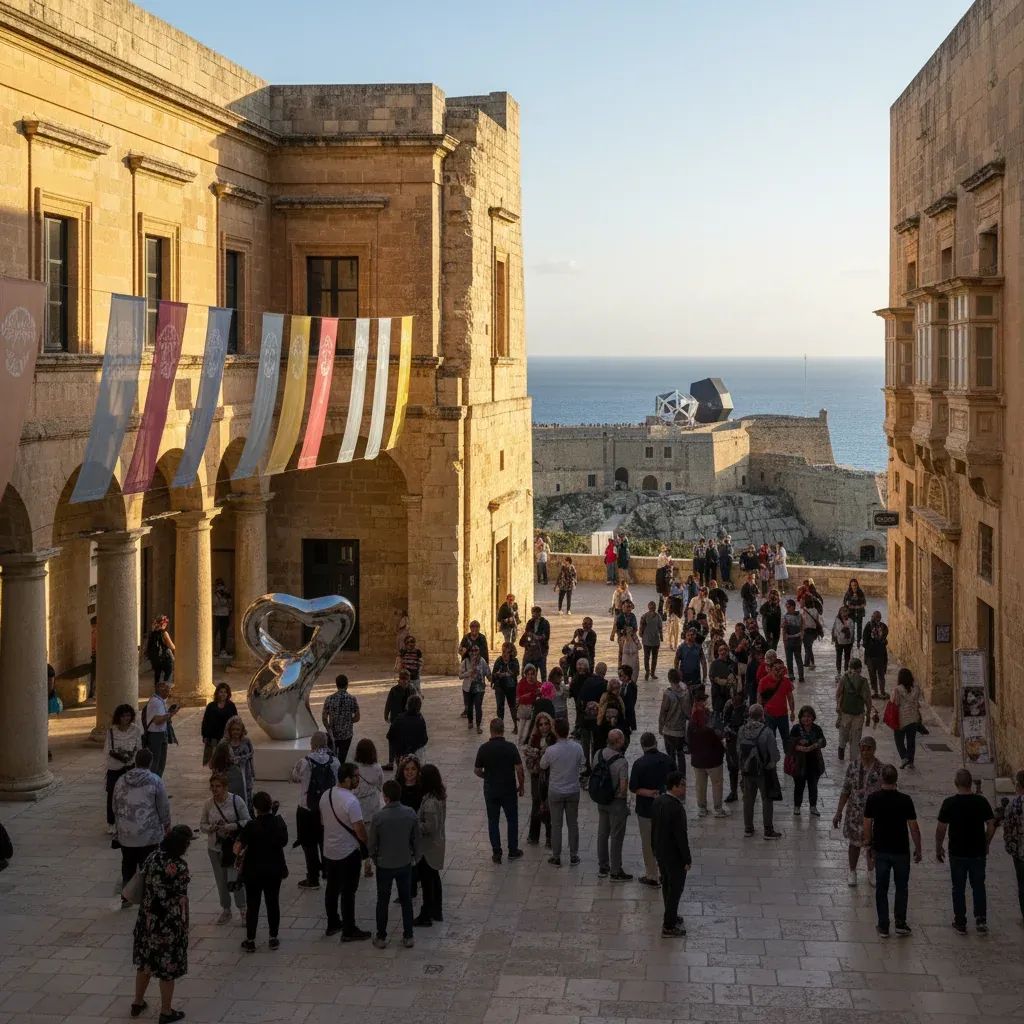
Heritage Malta's second international contemporary art exhibition has transformed historic Valletta into a canvas for over 130 artists, challenging residents and visitors alike to reconsider how culture can reshape economic priorities, environmental commitments, and social structures across the archipelago. Running through May 29, the Malta Biennale 2026 represents more than an aesthetic showcase—it's a deliberate attempt to position contemporary art as a policy tool capable of influencing Malta's trajectory on issues ranging from sustainability to tourism infrastructure.
Why This Matters
• Tourism revenue: The biennale generates substantial economic activity through cultural tourism, directly affecting hospitality, retail, and transport sectors dependent on visitor spending.
• UNESCO patronage: International recognition elevates Malta's cultural standing, potentially unlocking funding streams and diplomatic soft-power advantages.
• Heritage site access: Installations at the Grand Master's Palace, Fort St Elmo, and MUŻA offer residents reimagined experiences of familiar landmarks through May 29.
• Policy ambitions: Artistic director Rosa Martínez explicitly frames the exhibition as designed to "generate policies for the common good," signaling art's intended role beyond entertainment.
What 'Clean | Clear | Cut' Actually Demands
The thematic framework isn't abstract curatorial jargon—it translates into three concrete propositions for Malta's development model. CLEAN advocates stopping environmental degradation and ethical corruption, directly challenging Malta's struggles with overdevelopment and construction waste. CLEAR demands critical thinking and information literacy in an era where misinformation circulates rapidly through social media. CUT insists on abandoning failed systems entirely rather than incrementally reforming them, a radical stance in Malta's consensus-driven political culture.
Rosa Martínez, the Spanish curator steering the biennale, designed the theme around Malta's geological character—the limestone that defines the islands' physical identity becomes a metaphor for stripping away superficial layers to reveal fundamental truths. Her curatorial strategy deliberately places contemporary works inside historical venues to force dialogue between past institutional power and present-day questions about authority, migration, labor rights, and gender equality.
Historic Venues as Active Participants
The Grand Master's Palace hosts Maurizio Cattelan's 1:6 scale replica of Michelangelo's Sistine Chapel, a heritage site nested within another heritage site. Unlike the Vatican original, visitors can photograph this version—a democratizing gesture that questions who controls access to cultural monuments and under what conditions. The installation physically occupies chambers where Malta's governing institutions once wielded absolute power, creating unavoidable friction between Renaissance religious authority and contemporary artistic irreverence.
At MUŻA, located in the former Auberge d'Italie, the Guerrilla Girls bring their decades-long feminist critique of art-world discrimination. Their data-driven posters exposing gender and racial imbalances in museum collections confront visitors in a building that once housed only male Knights of St John. Therese Debono's "In Place. Where the Land Holds (2025)" also occupies MUŻA, engaging with Malta's relationship to land use and development pressures.
Fort St Elmo and the National Museum of Archaeology similarly function as more than backdrops. These sites, layered with Ottoman siege history and prehistoric artifacts respectively, become active participants in contemporary narratives. Artists selected for these locations specifically address themes of control, exclusion, and institutional memory—the Inquisition's suppression of knowledge, for instance, or colonial power structures that determined whose stories entered official archives.
The National and Thematic Pavilion Structure
Twenty-eight pavilions—eight national, the remainder thematic—represent 43 countries, double the inaugural biennale's participation. Malta's national pavilion presents "Wonderland: Kaos Kontemporanju," curated by Katya Micallef, explicitly engaging with the disorder and contradictions of contemporary Maltese identity amid rapid economic change and cultural tension.
Armenia's "The Sound of What Was Never Seen" explores sensory experience beyond visual dominance. China's "The Realm of Clarity: Ecological Foresight and Civilisational Exchange in Oriental Wisdom" frames environmental sustainability through non-Western philosophical traditions. Finland's "Bastion of Refugia" and France's "Facing the Challenge" address climate adaptation and social resilience. Poland's "Archive of Hesitations" and Serbia's "Where to Escape? In Search of Oneself" grapple with post-socialist transition anxieties that resonate in Malta's own identity negotiations between Mediterranean and European frameworks.
Spain's "Vessels of Silence: The Journey and Memory of the Mediterranean" directly engages with migration narratives—a politically charged topic in Malta, where maritime rescue operations and migrant detention policies generate ongoing controversy.
What This Means for Residents
The biennale's utility extends beyond cultural enrichment to tangible economic and infrastructural impacts. Heritage sites hosting installations see increased foot traffic, benefiting nearby cafes, shops, and transport services through May 29. The Valletta Cultural Agency's participation signals municipal investment in maintaining cultural programming beyond the event itself, potentially influencing how the capital allocates resources for heritage preservation versus commercial development.
Educational institutions partnering with the biennale gain access to international artistic networks and professional development for Malta-based curators and conservators. The President of the Republic of Malta's patronage lends institutional weight that can translate into diplomatic and funding advantages when competing for future cultural designations or European Union cultural project grants.
However, the biennale also surfaces governance questions relevant to Malta's broader institutional culture. Previous criticism regarding transparency in artist selection, adequate support for participants, and access to associated events reflects systemic challenges in how Maltese cultural institutions operate. Whether the current edition addresses these concerns affects not just this event but establishes precedents for future large-scale cultural initiatives.
Art as Economic and Policy Infrastructure
International research on biennales demonstrates measurable economic impact—tourism revenue spikes, hospitality sector employment rises, and cities gain branding advantages that persist beyond the event duration. Malta's compact size means these effects concentrate intensely in Valletta and accessible satellite locations, but distribution remains uneven. Gozo's participation ensures some geographic spread, yet smaller villages hosting peripheral exhibitions typically capture less economic benefit than Valletta's restaurant and accommodation operators.
The policy ambition embedded in "Clean | Clear | Cut" attempts something more complex: using artistic discourse to shift public priorities and governmental agendas. Whether contemporary art installations actually influence Malta's planning policies, environmental regulations, or social services depends on mechanisms rarely controlled by curators or artists—parliamentary attention, media coverage that extends beyond arts sections, and civil society organizations translating aesthetic critique into actionable advocacy.
The Algorithmic Age Question
Martínez emphasizes human judgment and ethical choice-making in art creation, explicitly contrasting this with algorithmic decision-making and artificial intelligence. For Malta, heavily invested in blockchain gaming companies and fintech operations, this philosophical stance carries practical weight. As AI-generated content proliferates, the biennale argues for preserving human creativity's irreducible value—a position with implications for education policy, workforce development, and intellectual property law.
The curatorial insistence on care, responsibility, and discernment as central to artistic practice challenges efficiency-maximizing logic that dominates both private sector management and public administration. Whether Malta's policymakers engage with this critique or dismiss it as aesthetic philosophy disconnected from governance realities will determine if the biennale achieves its stated aim of generating new value systems.
Accessibility and Institutional Critique
Free or affordable entry to many biennale venues matters in a country where disposable income varies dramatically between affluent expatriates and working-class Maltese families. MUŻA charges minimal admission; Fort St Elmo and the archaeology museum maintain standard Heritage Malta rates. This pricing structure determines whether the biennale functions as elite cultural tourism or genuinely public programming accessible to residents.
The Guerrilla Girls' presence specifically targets institutional practices within Malta's own cultural sector—their statistical methodology for exposing discrimination offers a template for examining gender representation in Heritage Malta's permanent collections, Arts Council funding decisions, and university arts faculty composition. Whether local institutions embrace this scrutiny or deflect it reveals their actual commitment to equity beyond declaratory statements.
Through May 29, Valletta's historic core operates simultaneously as museum and laboratory, testing whether Malta can leverage cultural heritage to generate forward-looking economic models rather than merely monetizing nostalgic tourism. The answer depends less on artistic quality than on institutional follow-through, transparent governance, and willingness to let uncomfortable questions posed by contemporary art actually inform policy choices.


