
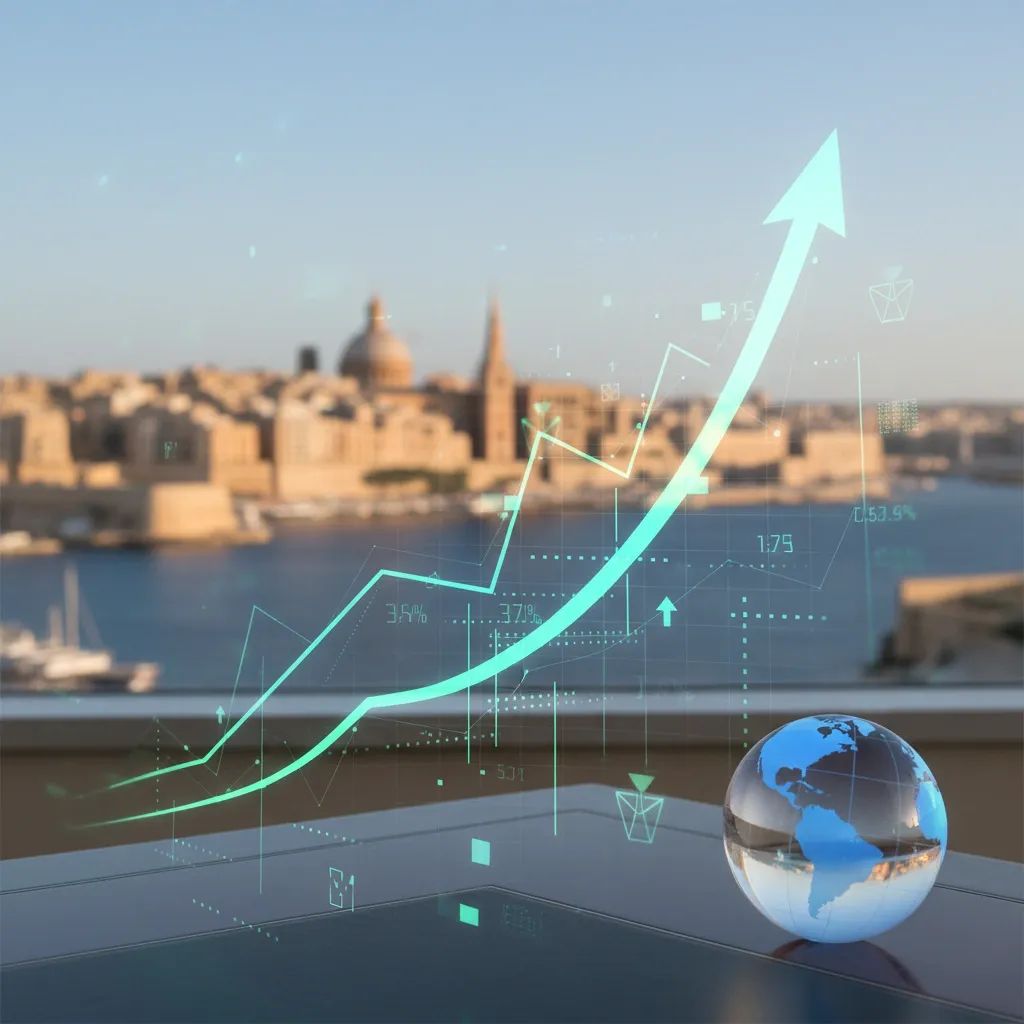
Malta's economic rulebook is being rewritten. The island is no longer chasing GDP growth at any cost—instead, policymakers and business leaders are orchestrating a deliberate pivot toward a model where efficiency, innovation, and human welfare define success. For residents and investors, this shift signals a fundamental reordering of priorities that will reshape jobs, infrastructure spending, tax incentives, and the very metrics by which the government measures national progress.
Why This Matters:
• Productivity becomes the engine: Rather than adding workers, Malta is investing in AI, digitalization, and automation—with a 175% R&D tax deduction and accelerated depreciation on tech investments to accelerate the transition.
• Wellbeing replaces GDP as scorecard: The new Wellbeing Index tracks housing affordability, mental health, environmental quality, and civic trust—signaling where government budgets will flow in coming years.
• Waste-to-value economy: Malta is targeting 55% municipal waste recycling by 2025, with the ECOHIVE project converting waste into energy and compost while the EU's Circular Economy Act (adopted in 2026) establishes a continent-wide secondary materials market.
The Economics of Less but Better
For two decades, Malta's growth formula was mechanical: recruit more workers, build more housing, let GDP climb. The strategy delivered prosperity on paper. GDP per capita rose steadily, unemployment fell, and construction cranes became Malta's skyline trademark. But the model's seams began to tear. Housing prices detached from local wages, roads clogged during rush hours, and the Central Bank of Malta noticed something troubling—productivity growth lagged peers across the EU, meaning the island was adding workers without proportionally raising output per person.
The Malta Fiscal Advisory Council and Central Bank of Malta have now sounded a clear alarm: an economy cannot expand its labor force indefinitely. Demographic reality and EU immigration rules make endless worker recruitment impossible. Infrastructure is stretched. Wages for service-sector jobs remain low despite tight labor markets, suggesting the economy is absorbing workers without generating meaningful value gains.
Enter productivity-led growth. Rather than hiring 10 workers to achieve a 3% output increase, the strategy aims to have those same 10 workers—equipped with better tools, smarter processes, and digital capabilities—generate a 5% increase. The Malta Chamber of SMEs has pushed hard for this reorientation, proposing grants and subsidized lending schemes to help smaller firms afford the upfront costs of upgrading to AI and automation systems.
How Government Money Will Flow Differently
The tax code is already shifting to reflect new priorities. Research and innovation expenditure now qualifies for a 175% tax deduction—among Europe's most generous—directly incentivizing firms to invest in breakthrough thinking rather than hiring more staff. Meanwhile, depreciation schedules for AI and emerging technologies have been accelerated, allowing companies to recover investment costs faster and lower their taxable income sooner.
The MicroInvest scheme, traditionally used for general business expansion, has been retooled to prioritize digital solutions. A proposed Productivity Tech Kit Grant would help SMEs acquire software, automation tools, and training without bearing the full cost themselves. A companion Business Investment Scheme is designed to unlock government-backed lending for firms that otherwise struggle to secure bank credit—particularly family businesses and start-ups without conventional collateral.
These incentives target a specific problem: Malta's business landscape is dominated by small and medium enterprises that lack the capital reserves or credit history to self-fund the transition to knowledge-intensive operations. Without targeted support, many risk obsolescence as the economy reorders itself around digital competencies.
The European Playbook: What Malta Is Copying
Malta is not pioneering this shift alone. Across Europe, small prosperous nations are abandoning the growth-at-all-costs mentality. The pattern is strikingly similar—and for residents, understanding the European precedent clarifies what Malta is signaling.
Iceland, holding the founding membership of the Wellbeing Economy Governments (WEGo) partnership, hosted the Wellbeing Economy Forum 2026 in Reykjavík. The message: integrate well-being directly into fiscal planning rather than treating it as a byproduct of growth. Iceland's government now considers mental health, social cohesion, and environmental resilience when allocating budgets—not as nice-to-haves but as core economic drivers.
Luxembourg operates a Luxembourg Index of Well-being spanning 21 indicators across 11 domains—income, employment quality, health, work-life balance, social connections, civic participation, and environmental sustainability. The index is not merely descriptive; it actively influences policy. When one domain scores poorly, government intervention typically follows.
Cyprus, holding the EU Council Presidency in early 2026, has championed a dedicated Well-being Dashboard to monitor youth mental health, civic trust, and biodiversity loss in real time. The intent is transparent: prosperity that erodes mental health or damages ecosystems is not genuine prosperity.
Andorra has enacted a Sustainable Growth Law 2026 that explicitly prioritizes affordable housing, controlled population growth, and free national public transport—aligning economic strategy with environmental limits and social cohesion rather than maximizing visitor arrivals or speculative investment.
The European Commission's Joint Research Centre has rolled out a Sustainable and Inclusive Wellbeing (SIWB) framework featuring a 50-indicator dashboard. This tool is now used alongside GDP when evaluating policy success across member states. The message is unambiguous: governments that ignore well-being metrics will face credibility and legitimacy questions in Brussels and among their own populations.
What Malta's Wellbeing Index Actually Measures—And Why It Matters
Malta's Wellbeing Index 2026 and Malta Vision 2050 represent a fundamental departure from how previous administrations measured national success. The government has committed to improving quality of life by 25% during its current term while maintaining 4% annual economic growth—two targets that, historically, would have been treated as contradictory.
The index tracks nine dimensions: health and personal well-being, housing and social protection, education and skills, income and employment, civic participation and social connections, environmental quality, and emotional well-being—including rising stress, loneliness, and anxiety. Each dimension carries a data set and trend line. Each one has budget implications.
This is not aspirational rhetoric. When housing affordability scores poorly (as they have), government budgets shift toward anti-speculation measures, rent controls, or first-time buyer subsidies rather than developer incentives. When environmental quality indicators decline, investment in public transport and green infrastructure becomes non-negotiable. When civic participation is flat, government spending on community infrastructure and civic engagement programs increases.
For residents, the practical consequence is a reallocation of public resources. The construction boom may slow. Tax incentives for hospitality and mass tourism will be competed against investments in preventive health, mental health services, and housing affordability. The scoreboard is no longer purely fiscal—it is social and environmental as well.
The Circular Economy: From Waste to Competitive Advantage
Embedded in Malta's new growth model is a circular economy strategy—transforming waste from a disposal cost into an economic input. The Circular Economy Strategic Vision 2020-2030 and the freshly adopted EU Circular Economy Act establish a regulatory framework for secondary raw materials across the bloc.
The EU's goal is stark: double circularity from 12% to 24% by 2030. This means the continent will recycle, reuse, and regenerate roughly 1 in 4 tons of material that would historically be discarded. For Malta, which historically imported most raw materials and struggled with waste management, this presents both challenge and opportunity.
The Beverage Container Refund Scheme (BCRS), introduced in late 2022, has shown early promise—incentivizing return of single-use bottles and cans through small cash refunds. The Construction and Demolition Waste Strategy 2021-2030 applies similar logic to the island's vast building stock, establishing frameworks to salvage, reuse, or safely process materials rather than landfill them. The ECOHIVE project will industrialize this process, converting municipal waste into energy and agricultural compost.
Currently, Malta recycles only around 40% of municipal waste, well below the EU target of 55% by 2025. Food waste remains a particular problem—restaurants, households, and supermarkets discard vast quantities of edible materials. Reaching 55% will require behavioral shifts and investment in sorting infrastructure. But the regulatory requirement creates a market: firms that can process waste into secondary materials or energy will find ready demand from across the EU.
The Labor Market Paradox: Fewer Jobs, Higher Pay—In Theory
Productivity-led growth carries a hidden tension. If machines and software replace manual labor, total employment may contract even as output rises. This is precisely what opponents of the new model fear.
The Malta National Talent Register—a planned database mapping national skillsets and workforce capabilities—is intended to mitigate this risk by aligning training to emerging sectors. Jobs in AI development, data analysis, renewable energy installation, and advanced manufacturing are expected to proliferate. But those jobs demand qualifications that low-skilled service workers may not possess. Without aggressive retraining and education reform, wage inequality could widen, leaving hospitality, retail, and care workers further behind.
The government's position is optimistic but not guaranteed. Advocates argue that as lower-value work is automated, labor demand shifts to higher-skill sectors where wages are better, hours more regular, and job security greater. But the transition period—potentially lasting years—could harm workers caught between shrinking sectors and skill-hungry industries they cannot easily enter.
Where Money Flows in the New Economy
The government's fiscal priorities are already shifting to reflect the new model. Malta's Recovery and Resilience Plan allocates 62% of available funds to climate and green transition objectives. This translates to €60 million for electrification of transport and €52.2 million for energy efficiency in public buildings. Public procurement will increasingly favor sustainable suppliers and circular-economy-compliant vendors.
The Malta Tourism Strategy 2021-2030 is redirecting investment away from mass-market beach tourism toward niche segments: faith tourism, luxury retreats, wellness centers, MICE events, medical tourism, and gastronomy experiences. This shift means fewer tourists but higher spending per visitor—higher tax yield, higher wages in premium services, and reduced infrastructure strain.
Energy policy is locking in the transition. The Energy Shift: A Sustainable Power Transition strategy targets carbon neutrality by 2050, driving investment in offshore wind, battery storage, and electrical interconnectors. These are capital-intensive, technology-rich projects that create high-skill jobs and attract specialized firms.
The Risk Zone: SMEs and Implementation
The new model's viability hinges on one critical assumption: that Malta's thousands of small and medium enterprises can successfully transition to digitalization and higher productivity. The data suggests significant obstacles.
SMEs make up the economic backbone—construction, hospitality, retail, professional services, and small manufacturing all rely on independent operators and family firms. Most lack dedicated IT departments, sustained access to venture capital, or expertise in AI and automation. When banks demand collateral for innovation loans, many cannot qualify. When consultants charge €200 per hour for digital transformation advice, costs quickly exceed available budgets.
The Malta Chamber of SMEs has warned that access to credit remains the primary bottleneck. The proposed Business Investment Scheme aims to solve this through government-backed lending, but implementation details remain thin. Which firms qualify? What interest rates apply? How quickly can applications be processed? These operational questions will ultimately determine whether the scheme actually reaches struggling businesses or becomes another paper exercise.
Education and skills alignment pose a second risk. Training programs take years to produce graduates. By the time new data scientists or AI specialists enter the labor market, technological demands may have shifted again. The Malta National Talent Register is designed to anticipate this drift—tracking emerging skills gaps and adjusting training in real time—but no government has successfully executed such predictive education at scale.
The Realism Check
The Central Bank of Malta forecasts 3.7% real GDP growth for 2026, driven by domestic demand and net exports—particularly services. This is respectable but not exceptional. It reflects confidence that the transition is real but also acknowledgment that the adjustment period will be neither smooth nor swift.
Malta's economic debate has indeed shifted from "growth or no growth" to "what kind of growth." The shift is visible in policy documents, budget allocations, tax code changes, and international positioning. But the gap between rhetorical commitment and operational execution remains substantial. Whether SMEs can actually afford the transition, whether workers can actually retrain in time, whether housing affordability actually improves despite land scarcity, and whether the wellbeing metrics actually rise rather than stagnate—these remain open questions.
For residents, the incoming changes are real but gradual. Tax policy is already redirecting investment toward innovation. Infrastructure spending is reorienting toward sustainability. Waste management requirements are tightening. The labor market is beginning to reward technical skills more than it rewards willingness to work long hours at low wages. The mentality of endless expansion is receding. Whether that mentality is replaced with genuine prosperity or with managed stagnation will depend entirely on execution—and on whether policymakers can navigate the legitimate interests of workers, small businesses, and communities during a period of significant economic restructuring.


